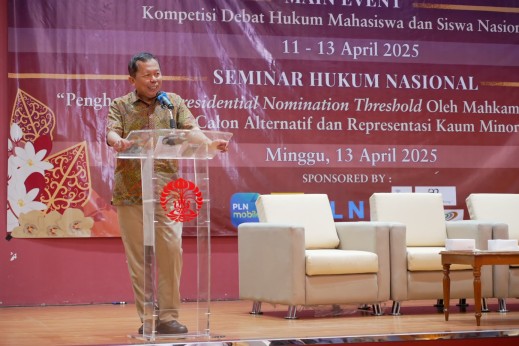
Constitutional Justice Arsul Sani delivering a keynote speech at the National Law Seminar of the Indonesian Law Debating Competition at the Auditorium of the Faculty of Law Universitas Indonesia, Depok, Sunday (4/13/2025). Photo by MKRI/Hamdi.
DEPOK (MKRI) — Constitutional Justice Arsul Sani explained that shifts in judicial decisions are not uncommon in constitutional courts, including the Constitutional Court of the Republic of Indonesia (MKRI), during a keynote speech at the National Law Seminar of the Indonesian Law Debating Competition (ILDC) organized by the Faculty of Law of Universitas Indonesia (FH UI) on Sunday, April 13, 2025.
He addressed growing public curiosity surrounding the Court’s Decision No. 62/PUU-XXII/2024 that granted the judicial review petition against the presidential nomination threshold stipulated in Article 222 of the General Elections Law. The Court had previously rejected or declared inadmissible 33 similar petitions. However, in this case, the petition filed by four students of UIN Sunan Kalijaga was granted.
“Such a shift is not unusual in the judiciary,” Arsul said. “Changes in judicial reasoning and decisions, especially in constitutional courts, are not only possible but a natural development in their history.”
He illustrated this by referring to decisions of the US Supreme Court. For example, in Furman v. Georgia (1972), the Court ruled that capital punishment laws were unconstitutional as they violated the Eighth Amendment's ban on cruel and unusual punishment. Yet in Gregg v. Georgia (1976), the Court reversed its stance and upheld the constitutionality of the death penalty.
He also cited Australia’s landmark Mabo case. “When I worked as a law clerk in Australia in 1990, the High Court of Australia overturned centuries-old jurisprudence based on the ‘terra nullius’ principle, recognizing indigenous land rights if that can change, why not a legal view that has only produced 33 decisions?” he said.
Although only one of the four petitions was granted, Arsul believes the ruling reflects the Court’s collective consideration of all four petitions. “In my opinion, even though three were declared inadmissible, the decision encompasses all four,” he noted.
An Open Legal Policy with Constitutional Limits
Arsul clarified that the Court still considers the presidential threshold an open legal policy of lawmakers. However, in Decision No. 62/PUU-XXII/2024, the Court found Article 222 to violate principles of morality, rationality, and intolerable injustice, as well as the political rights of citizens and the principle of popular sovereignty. The Court also considered the realities of the 2014 and 2019 presidential elections.
“The article has been tested 33 times. That alone shows it is problematic from the perspective of civil society and academics. The Court must revisit its stance in light of such persistent challenges,” he emphasized.
Safeguarding Democracy
Also speaking at the seminar, constitutional law expert Yance Arizona stressed the role of the Court in safeguarding democracy through its rulings. He cited several recent landmark decisions, including the judicial review of the parliamentary threshold (Decision No. 116/PUU-XXI/2023), defamation (No. 78/PUU-XXI/2023), the regional head election threshold (No. 60/PUU-XXII/2024), the age limit for regional head candidates (No. 70/PUU-XXII/2024), and the presidential threshold (No. 62/PUU-XXII/2024).
He attributed the shift in judicial view on the presidential threshold to changes in the composition of justices and leadership within the Court. “These factors are key to the Court’s current approach to overruling,” said Yance, a lecturer at Universitas Gadjah Mada.
Other speakers at the seminar included electoral and democracy researcher Titi Anggraini, constitutional law practitioner, and Chairman of Bulan Bintang Party Gugum Ridho Putra.
Author: Lulu Anjarsari P.
Editor: L.A.P
Translator: Yuanna Sisilia
Disclaimer: The original version of the news is in Indonesian. In case of any differences between the English and the Indonesian versions, the Indonesian version will prevail.
Sunday, April 13, 2025 | 18:58 WIB 1248