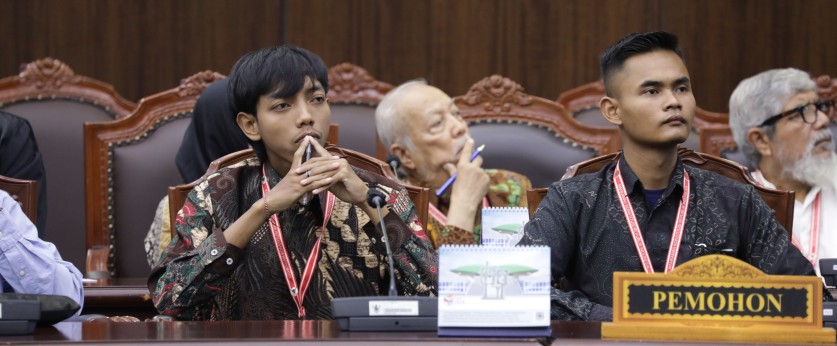
Adam Imam Hamdana (left), one of the Petitioners, attending the ruling hearing for the judicial review of Law No. 7 of 2017 on General Elections, Friday (3/21/2025). Photo by MKRI/Panji.
JAKARTA (MKRI) — Elected legislative candidates may resign only for government-appointed positions such as minister, ambassador, and other state/public offices. These means that they may leave their legislative positions for any positions as appointed officials, not elected officials.
The Constitutional Court (MK) handed down the Decision No. 176/PUU-XXII/2024 at the ruling hearing for the material judicial review of Law No. 7 of 2017 on General Elections (Election Law) on Friday, March 21, 2025 in the plenary courtroom. The petition was filed by university students Adam Imam Hamdana, Wianda Julita Maharani, and Adinia Ulva Maharani.
“[The Court] grants the Petitioners’ petition in part; declares Article 426 paragraph (1) of Law No. 7 of 2017 on General Elections conditionally unconstitutional and not legally binding if not interpreted as ‘resigns due to state appointment into a public office whose appointment is not through an election,’” said Chief Justice Suhartoyo delivering the verdict alongside the other eight constitutional justices.
In its legal consideration, delivered by Deputy Chief Justice Saldi Isra, the Court emphasized that despite resignation is the right of elected candidates, the people’s mandate through the election must be the first consideration before any decision to resign is made.
“When an elected candidate has won the highest number of votes, their election is a people’s mandate that must be respected. The people’s votes in the election is a manifestation of democracy and shall not be disregarded,” Deputy Chief Justice Saldi added.
The Court held that an elected legislative candidate’s resignation nullifies their voters’ votes. In the open-list proportional system, voters vote for the candidates’ figures. If the elected candidate resigned, their votes would be meaningless and it would lead to legal uncertainty.
Constitutional Justice Asrul Sani added that the ambiguity of Article 426 paragraph (1) of the Election Law could potentially lead to unhealthy practices in democracy. It did not provide clear limitation on the reasons for elected legislative candidates’ resignation. As a result, election organizers only process their resignation without any regard for the impact on the voters.
The Court held that limitation over their resignation is imperative in order to maintain the principle of popular sovereignty in elections. Therefore, it decided that the resignation of elected candidates must have a clear and constitutional reason. The two main issues by the Court had considered in this decision were resignation due to candidacy in the regional election and that related to the state duty.
The Court stated that resignation due to candidacy in the regional election is against the principle of popular sovereignty because said candidate has received a people’s mandate through the legislative election. However, such resignation is justified for state duty such as appointment as minister, ambassador, and other state/public offices whose appointment is not through an election.
The Court made this decision given the resignation of candidates elected in the 2024 legislative election to run in the regional election. It believes it to be an unhealthy practice in democracy and could potentially be transactional, thus reducing the respect for the people’s votes.
“As such, the Petitioners’ argument on the lack of limitation on the resignation of elected candidates under Article 426 paragraph (1) of Law No. 7 of 2017 was justified. Therefore, the Court holds that Article 426 paragraph (1) of Law No. 7 of 2017 must be declared unconstitutional and not legally binding if not interpreted as ‘resigns due to state appointment into a public office whose appointment is not through an election,’ as specified in the verdict of the a quo Decision,” Justice Arsul emphasized.
Also read:
Petitioners Challenges Election Law for Allowing Legislative Members to Step Down
Petitioners of Election Law Affirm Loss Due to Replacement of Candidate-Elect
The Petitioners argued that any elected legislative members who step down show betrayal and irresponsibility toward the mandate that the people give directly to them, more so when done for glib reasons. They also argued that the a quo article had allowed legislative candidates to test the waters and step down and then join the regional election if they receive sufficient votes in the legislative election. This, they claimed, reflects a disregard to the people’s votes, which is the spirit of the Constitutional Court Decision No. 60/PUU-XXII/2024. In addition, in a rule of law where the people have sovereignty, it is important to position public interest as the key, since popular sovereignty views that power comes from the people. So, in carrying out all matters relating to their duties, the holders of power must adhere to the will of the people, which is commonly referred to as democracy.
The Petitioners said the decision was relevant with the phenomena of DPR (House of Representatives), DPD (Regional Representatives Council), and DPRD (Regional Legislative Council) members stepping down, as the lack of clear restriction could potentially lead to barters between the people’s votes and political interests that are not in line with the principle of popular sovereignty. This is certainly contrary to the Constitutional Court Decision No. 40/PUU-VIII/2010, in which the Court held that the most basic principles of democracy are freedom and fairness.
Author : Utami Argawati
Editor : Lulu Anjarsari P.
PR : Fauzan Febriyan
Translator : Yuniar Widiastuti (NL)
Disclaimer: The original version of the news is in Indonesian. In case of any differences between the English and the Indonesian versions, the Indonesian version will prevail.
Friday, March 21, 2025 | 12:11 WIB 474