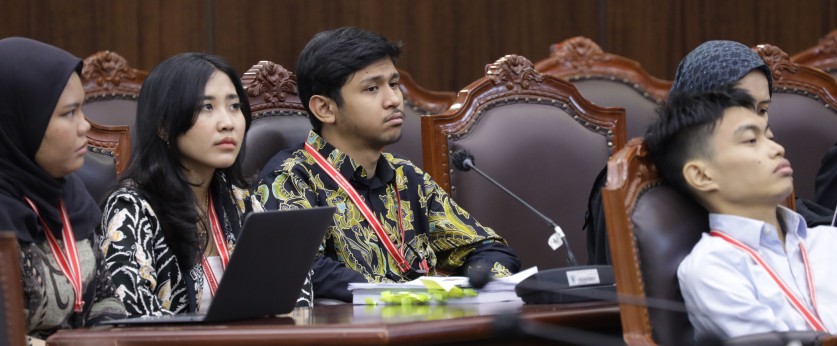
The Petitioners at the ruling hearing for the judicial review of the Regional Government Law, Friday (3/21/2025). Photo by MKRI/Panji.
JAKARTA (MKRI) — The Constitutional Court (MK) rejected the material judicial review petition of Article 216 paragraphs (2) and (3), Article 379 paragraph (2), and Article 380 paragraphs (1) and (2) of Law No. 23 of 2014 on Regional Governments. “[The Court] adjudicated: to reject the Petitioners’ petition in its entirety,” said Chief Justice Suhartoyo at the ruling hearing for Decision No. 177/PUU-XXII/2024 on Friday, March 21, 2025 in the plenary courtroom.
Delivering the Court’s legal consideration, Constitutional Justice Enny Nurbaningsih said Article 379 paragraph (2) and Article 380 paragraphs (1) and (2) of the Regional Government Law regulates fostering and supervision, which is the authority of the region towards the regional apparatus. In essence, in carrying out fostering and supervision of the provinces, the governor is assisted by the provincial inspectorate, while the regent/mayor is obliged to carry out fostering and supervision of regency/city regional apparatus assisted by the regency/city inspectorate.
Justice Enny said understanding the effectiveness of fostering and supervision towards regional apparatus in the regional government administration system requires more than Article 379 paragraph (2) and Article 380 paragraphs (1) and (2) of the Regional Government Law. This is because the norms are intertwined with other norms in the Regional Government Law, which cannot be separated from one another.
In this context, she continued, the Regional Government Law has formulated a design for the fostering and supervision of regional governments in the unitary state. The central government has the authority to set basic policies that will become regional references, including fostering and supervision of the implementation of government affairs by the regions. Therefore, the mechanism of fostering and supervision of the implementation of provincial government is carried out by the central government, under the Minister of Home Affairs.
Meanwhile, as the representative of the central government in the region and of the principle of de-concentration, the governor has the authority to foster and supervise the implementation of government affairs by the regency/city. In other words, the regulation of the mechanism and scope of fostering carried out in stages towards provincial and regency/city governments has been accommodated in Article 374 and Article 375 of the Regional Government Law.
Fostering is technically carried out by the minister in charge of government affairs. For regencies/cities, fostering is carried out by the governor as the representative of the central government, assisted by the governor’s apparatus, and the fostering includes general and technical matters.
Implementing Regulations of Regional Government Law
Justice Enny explained that implementing regulations have been established with regard to this fostering and supervision in accordance with the mandate of Article 232 of the Regional Government Law, i.e. Government Regulation No. 72 of 2019 on the Amendment to the Government Regulation No. 18 of 2016 on Regional Apparatus (PP 72/2019). The Court is of the opinion that the regulation was established to strengthen the role and capacity of regional inspectorates to be more independent and objective in realizing regional governance that is clean and free from corruption, collusion, and nepotism. In relation to that, it has also determined in more detail the functions of the regional inspectorates, which are different from the functions of supervision for specific purposes on assignment from the governor and/or minister; coordination of the prevention of criminal acts of corruption; and supervision on the implementation of the bureaucratic reform program. Therefore, the supervision by regional inspectorates of the implementation of government affairs argued by the Petitioners is ineffective because it has been resolved by the existence of fostering and supervisory procedures.
“According to the Court, the argument of the Petitioners, who wish the regional inspectorates to be directly responsible to the Minister through the inspector-general of the ministry, is unfounded, because it would actually result in a fundamental shift in the relations between the center and the regions, which could potentially reduce the scope of regional autonomy as guaranteed in Article 18 paragraph (2) of the 1945 Constitution of the Republic of Indonesia, and create bureaucratic control that could potentially hinder the services to improve the welfare of the community as specified in Article 28C paragraph (1) of the 1945 Constitution of the Republic of Indonesia,” she explained.
Strengthening Regional Inspectorates
Related to strengthening the regional inspectorates, the Court felt the need to emphasize that although the regional apparatus is an auxiliary element of the regional head filled with state civil apparatus employees, but its duties of fostering and controlling the arrangement of regional apparatus are carried out by applying the principles of coordination, integration, synchronization, and simplification. By applying this arrangement, it is expected that the regional apparatus can accelerate the achievement of community welfare through improved public services, which are part of the objectives of regional autonomy.
“Thus, the arguments of the Petitioners, who question the norms of Article 216 paragraph (2) and paragraph (3), Article 379 paragraph (2), and Article 380 paragraph (1) and paragraph (2) of Law No. 23 of 2014 are contrary to the principles of regional autonomy and improvement of public welfare as specified in Article 18 paragraph (2) and Article 28C paragraph (1) of the 1945 Constitution of the Republic of Indonesia, are unreasonable according to law,” said Justice Enny on the petition filed by Arivan Utama, Muhammad Irfan, and Bambang Sucahyo (the Petitioners).
Also read:
Petitioner Highlights Lack of Regional Govt Supervision Due to Politics
Retired Staff of Regional Inspectorate Joins Case Against Regional Govt Law
At the preliminary hearing on Friday, December 20, 2024, the Petitioners conveyed the subject matters of the petition, one being related to Article 216 paragraph (3) of the Regional Government Law, which reads, “In carrying out their duties, the Regional Inspectorate shall be responsible to the head of the region through the regional secretary.”
The Petitioners argued that the article does not reflect fair legal certainty and equality before the law, as the regional inspectorate is responsible to the head of the region, thus could potentially allow unchecked local political interests and could hinder corruption eradication in the region.
The Petitioners admitted that while Article 8 paragraph (3) of the Regional Government Law has mandated the regional government’s internal supervision to the inspectorate, which is under the Ministry of Home Affairs, its lack of independence—shown by its accountability to the head of region through the regional secretary—would lead to ineffective supervision.
Read the Decision No. 177/PUU-XXII/2024 here.
Author : Sri Pujianti
Editor : N. Rosi
PR : Fauzan F.
Translator : Yuniar Widiastuti (NL)
Disclaimer: The original version of the news is in Indonesian. In case of any differences between the English and the Indonesian versions, the Indonesian version will prevail.
Friday, March 21, 2025 | 13:13 WIB 369