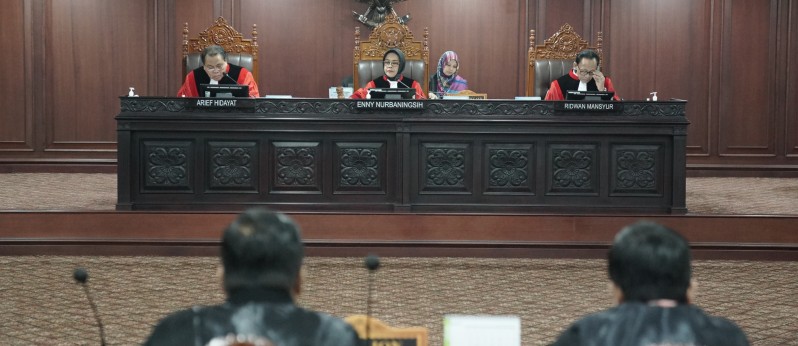
The preliminary hearing for the judicial review of the Lawmaking Law, Tuesday (3/19/2025). Photo by MKRI/Ilham W.M.
JAKARTA (MKRI) — The Constitutional Court (MK) held the preliminary hearing for the material judicial review of Law No. 13 of 2022 on the Second Amendment to Law No. 12 of 2011 on Lawmaking on Wednesday, March 19, 2025. The petition for case No. 20/PUU-XXIII/2025 was filed by law activist Ilham Fariduz Zaman and PT Pinter Hukum Indonesia. They challenge Article 96 paragraph (3) of the Lawmaking Law, arguing that it has led to legal uncertainty of public participation in the lawmaking process.
Article 96 paragraph (3) of the Lawmaking Law reads, “The public as referred to in paragraph (1) shall be an individual or group of people who are directly affected and/or have an interest in the content material of the Bill of Legislation.”
Meanwhile, its elucidation reads, “The ‘group of people’ shall be a community group/organization, professional organization, and non-governmental organization registered with the authorized ministry, customary law communities, and persons with disabilities.”
Before Constitutional Justice Enny Nurbaningsih and the other members of the panel, legal counsel Moh. Qusyairi said that the provision does not provide fair legal certainty to the Petitioners as individuals concerned with the lawmaking process. He emphasized that there is a discrepancy between the qualification for the right to participate in lawmaking in the article and the elucidation. The Petitioners believe this lack of clarity is detrimental to their constitutional rights as guaranteed under Article 28D paragraph (1) of the 1945 Constitution.
In addition, he continued, the Petitioners highlighted the lawmaking trend that increasingly disregards meaningful public participation. They cited the use of the article in question to exclude certain groups in the discussion of the bills on the Presidential Advisory Council and the Ministry of State. The legislators argued that the material in these two bills did not have a direct impact on society, and therefore did not require public participation. The Petitioners believe such interpretation can be used to limit public participation in lawmaking.
“According to logical reasoning, the Petitioners’ constitutional loss can certainly be ascertained when the provision of the a quo article has actually been used by the legislators to exclude people/groups who had concerns about the [Presidential Advisory Council] Bill and the State Ministry Bill. The legislators clearly admitted that there was no need for public participation because the content of the two bills concerned the authority of the president, which has no direct impact on or was unrelated to the interests of the public, such as the Petitioners. So, [we should] not rule out the possibility that the provision of the a quo article will also be used again by the legislators to exclude the Petitioners’ participation as a group that has concerns [over lawmaking],” he said.
Qusyairi said that the Petitioners filed the judicial review petition of Article 96 paragraph (3) of Law No. 13 of 2022, specifically the phrase “and/or has an interest” in the body of the article and the phrase “registered with the authorized ministry” in the elucidation. They believe both phrases are contrary to the principles of popular sovereignty, freedom of expression, the right to fight for interests collectively, and fair legal certainty for citizens.
Article 28 paragraph (1) of the 1945 Constitution guarantees the right of every citizen to associate, assemble, and express opinions orally and in writing. In addition, Article 28C paragraph (2) of the 1945 Constitution affirms the right of every individual to fight for their interests collectively. Based on this principle, the Petitioners argued that any individual or group that has a concern for any policy must have the right to be involved in its formation.
Shift of Right to Participation
In the petition, the Petitioners also highlighted a shift in meaning of the provision under review. Previously, the Constitutional Court had interpreted that parties who have the right to participate in lawmaking are not limited to only those who have a direct interest, but also those who have an interest in a policy.
However, the provision in the article under review narrows down the scope of public participation, thus eliminating legal certainty for individuals or groups who have concerns about certain legislation.
Petitums
With those arguments, the Petitioners requested that the Court declare the phrase “who are directly affected and/or have an interest in” in Article 96 paragraph (3) of the Lawmaking Law unconstitutional and not legally binding unless interpreted as “including those who have concerns.”
They also requested that the Court declare the phrase “registered with the authorized ministry” in the elucidation unconstitutional and not legally binding.
In response, Constitutional Justice Arief Hidayat asked the Petitioners to revise the subject of the petition. He also asked them to elaborate their constitutional impairment due to the article. “On the (Court’s) authority, please review petitions that have been granted,” he advised.
Constitutional Justice Enny Nurbaningsih shared the same sentiment. She asked the Petitioners to revise the petition’s subject. “[Clarify whether the petition] relates to the phrase being requested [for review] or the entirety of Article 96. Clarify that. In the petitums, only the phrase is mentioned,” she said.
At the end of the hearing, it was announced that the Petitioners have been given the opportunity to revise the petition and to submit it no later than April 8.
Read the petition No. 20/PUU-XXIII/2025 here.
Author : Utami Argawati
Editor : N. Rosi
Translator : Yuniar Widiastuti (NL)
Disclaimer: The original version of the news is in Indonesian. In case of any differences between the English and the Indonesian versions, the Indonesian version will prevail.
Wednesday, March 19, 2025 | 13:17 WIB 880