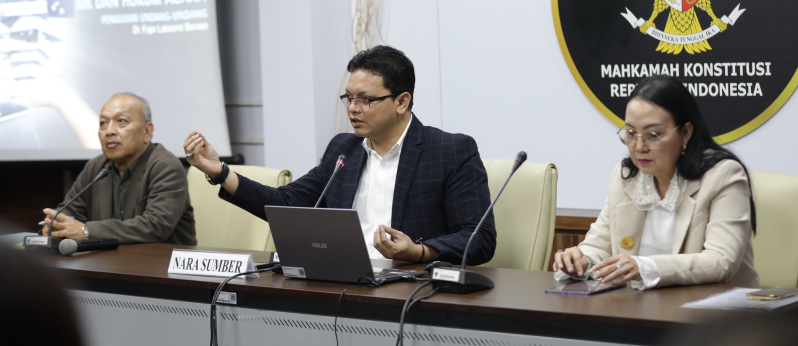
Head of the Legal and Administrative Bureau of Registrar, Fajar Laksono (middle) as a speaker during a visit by the Master's Program in Law from Warmadewa University at the second building of the Constitutional Court, Thursday (13/3/25). Photo by MKRI/Fauzan.
JAKARTA (MKRI) — More than 50 Master's students in Legal Studies from Warmadewa University, Bali, visited the Court on Thursday, March 13, 2025. They were accompanied by the Postgraduate Dean, Professor Ni Luh Made Mahendrawati, and the Curriculum Development Coordinator for the Master's Program in Legal Studies, I Wayan Rideng. The delegation was welcomed by the Head of the Bureau of Law and Case Administration of the Constitutional Court, Fajar Laksono, at the Second Building.
During the visit, which included a discussion session, Fajar addressed various questions from the students, one of which pertained to how constitutional justices maintain their independence. He explained that constitutional justices must uphold the Sapta Karsa Hutama, a code of ethics and conduct that consists of seven core principles: impartiality, integrity, competence and diligence, equality, independence, politeness and decency.
"Judicial independence is entrusted to each justice as long as they uphold Sapta Karsa Hutama, which is overseen by the Constitutional Court Ethics Council (MKMK or Majelis Kehormatan Mahkamah Konstitusi). The code of ethics serves as a guideline and boundary for justices," said Fajar, who also serves as Chairman of the MKMK Secretariat.
To ensure compliance with Sapta Karsa Hutama, the Ethic Council was established as a permanent body in January 2024. It is currently chaired by I Dewa Gede Palguna, with Ridwan Mansyur and Yuliandri as members. MKMK accommodates public concerns and oversees the performance and conduct of constitutional justices.
Fajar explained that justices often seek MKMK's guidance regarding their actions, such as considering recommendations when offered organizational positions, invited to open an event, or even when attending personal occasions, such as weddings of relatives of parties involved in ongoing cases at the Constitutional Court.
"At the very least, maintaining judicial independence involves establishing a system—one of which is through MKMK—to preserve the dignity of justices in court and social interactions beyond the courtroom," Fajar emphasized.
Writer: Mimi Kartika
Editor: Tiara Agustina
Translator: Yuanna Sisilia (NL)
Disclaimer: The original version of the news is in Indonesian. In case of any differences between the English and the Indonesian versions, the Indonesian version will prevail.
Thursday, March 13, 2025 | 13:24 WIB 541