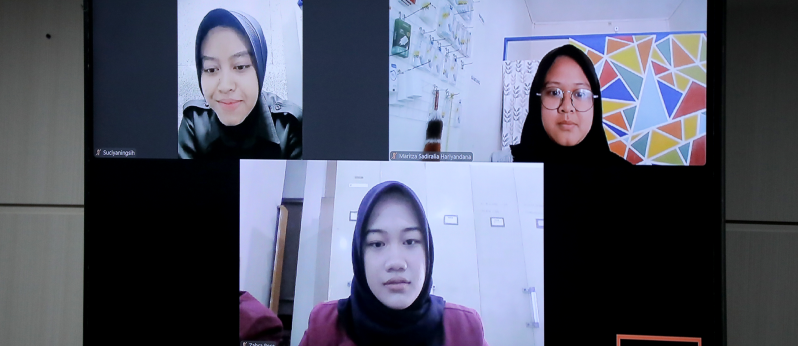
Suciyaningsih, Zahra Rose Budiatmaja dan Maritza Sadiralia Hariyandana withdrawing their petition remotely at the hearing for case No. 4/PUU-XXIII/2025 on the Manpower Law, Wednesday (3/5/2025). Photo by MKRI/Fauzan.
JAKARTA (MKRI) — The Constitutional Court (MK) held the preliminary hearing for the material judicial review of Law No. 13 of 2003 on Manpower on Wednesday, March 5, 2025. The petition was filed by nine university students: Sigit Julianto, Suciyaningsih, Zahra Rose Budiatmaja, Maritza Sadiralia Hariyandana, Erwin Dimas Wicaksono, Susilo Sumarno, Bambang Bayu Suseno, Junaidi H Mahir, and Sugianto. They believed that several provisions in the Manpower Law are unconstitutional and harmful to employees, especially outsourced ones.
The preliminary hearing for case No. 4/PUU-XXIII/2025 was supposed to hear the Petitioners’ petitums, but Constitutional Justice Arief Hidayat stated that the Petitioners had withdrawn their petition.
“Based on the information we received through the Registrar’s Office, the petition has been withdrawn, but only with the signature of one petitioner, Suci (Suciyaningsih),” he said.
Justice Arief added that the withdrawal request letter will be discussed at a justice deliberation meeting to decide the continuation of the case.
Highlight on Outsourcing System
In the petition, the Petitioners highlighted Articles 64, 65, and 66 of the Manpower Law on outsourcing system. They believed the provisions were in violation of Article 27 paragraph (2) of the 1945 Constitution, which guarantees the citizens’ right to occupation and decent livelihood.
The Petitioners argued that the current outsourcing system has created work uncertainty, given the short duration of work agreements. This means that employees cannot obtain certainty over decent, stable livelihood. In addition, outsourced employees are often cheated out of their rights, such us the right to health benefits, leave of absence, severance pay, and pension benefits. They also often receive lower pay than employees with permanent work agreements, despite both doing the same work.
They also stated that Article 66 of the Manpower Law has led to legal uncertainty and discrimination against outsourced employees. They argued that the work relations within this system are often unclear, especially in relation to who is responsible for the employees’ rights, whether the employers or the manpower service provider companies.
Author : Utami Argawati
Editor : N. Rosi
PR : Fauzan F.
Translator : Yuniar Widiastuti (NL)
Disclaimer: The original version of the news is in Indonesian. In case of any differences between the English and the Indonesian versions, the Indonesian version will prevail.
Wednesday, March 05, 2025 | 12:02 WIB 194