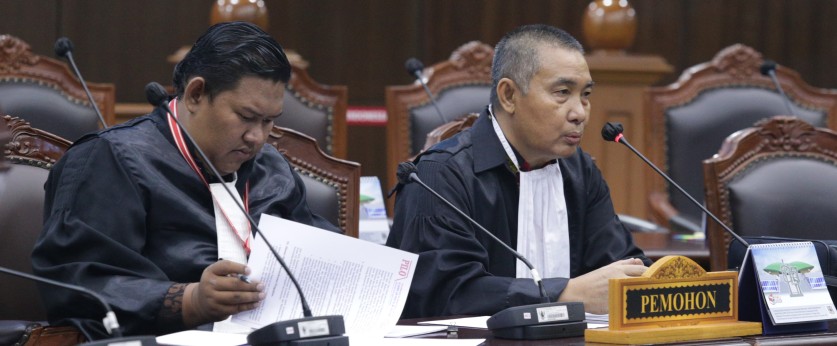
The Petitioner’s legal counsel during the preliminary hearing of Case No. 8/PUU-XXIII/2025, Wednesday (5/3/2025). Photo by MKRI/Bayu.
Jakarta (MKRI) – Frendys Eka Luki Putra, an individual citizen, submitted a material judicial review of Article 54 paragraph (2) of Law No. 48 of 2009 on Judiciary Power (Judiciary Power Law) and Article 206 paragraph (1) of the Legal Regulations for the Outer Regions of Java and Madura (RBg) promulgated and validated by Emergency law No. 1 of 1951 on Temporary Measures to Organize the Unity of the Structure of the Powers and Procedures of Civil Courts to Constitutional Court.
Legal counsel Bahrul Ilmi Yakup deemed Article 54 paragraph (2), which reads, “The execution of court decisions in civil cases is carried out by court clerks and bailiffs led by the chairman of the court,” and Article 206 paragraph (1) RBg which states, “The implementation of the law (execution) of cases decided by the district court in the first instance is carried out by order and under the leadership of the chairman in the manner specified in the following articles,” is contrary to the 1945 Constitution.
In the concrete case, the Applicant suffered a loss as a result of the execution and auction action carried out by the Chairman of the Pontianak District Court, Agung Wibowo, who had deliberately engineered the execution of the auction of the court's decision by including the Certificate of Title belonging to the Petitioner in the Determination of the Auction Execution Order. Whereas the Petitioner was not involved at all in the executed civil case and even the vacant land owned by the Petitioner had never been subject to execution seizure. As a result of this action, Agung Wibowo, as the executor, was investigated by the Supreme Court Supervisory Board and the Judicial Commission and was sanctioned as a non-judge for two years.
“It turns out that in the ranks of the Supreme Court (MA), there is a distortion of the implementation of judicial power, the failure of the Supreme Court to realize justice is real, in the execution of civil cases there is engineering by the Pontianak District Court on the property of people who are not related to the case. This happened because the formulation of execution norms in the Judicial Power Law is very vague and incomplete and is not supported by how the execution is carried out. Therefore, we ask [the Court] to interpret the meaning of execution to be carried out in accordance with the rule of law,” Bahrul explained in the Preliminary Hearing of Case No. 8/PUU-XXIII/2025 held on Wednesday, March 5, 2025.
Legal Arguments
Justice Daniel Yusmic P. Foekh noted the need for the Petitioner to strengthen the arguments on the norm's unconstitutionality with the 1945 Constitution of the Republic of Indonesia. “It may be enriched with universal legal doctrine related to execution actions in civil case decisions. Then, in the systematics of this petition, there is an unusual part (additional petition), so it needs to be merged into the arguments of the petition in the posita section,” Justice Daniel suggested.
Meanwhile, Justice M. Guntur Hamzah said that the systematics of the Petitioner's petition were considered more extensive than those of the usual petition submitted to the Constitutional Court. Therefore, the Petitioner needs to pay attention to Constitutional Court Regulation No. 2 of 2021.
“Then the Petitioner also needs to describe the constitutional loss because what is described is only a factual loss from the implementation of a norm. Perhaps this is an area of implementation, is this appropriate to be submitted to the Constitutional Court?” Justice Guntur asked.
Then Chief Justice Suhartoyo questioned the Petitioner again regarding the norms that were tested, whether they were related to the unconstitutionality of the norms or the implementation of the norms. “In a legal confiscation, it is usually registered or announced at the sub-district office, urban village, National Land Agency so that the public knows. If people's rights are violated, they can file a complaint. Then, there will be a warning before the court carries out the execution; the problem is how, at the point of execution and the object of execution that is executed, one must file a new lawsuit. So it is necessary to provide arguments that can convince the justices of the Petitioner's opinion on this issue,” Chief Justice Suhartoyo explained.
At the end of the hearing, Chief Justice Suhartoyo said that the Petitioner may improve the petition for the next 14 days. Then the revised document can be submitted no later than Tuesday, March 18, 2025 to the Registrar’s Office. Furthermore, the Court will schedule a hearing to hear the petition revision. (*)
Author: Sri Pujianti
Editor: Lulu Anjarsari P.
PR: Andhini S.F.
Translator: Rizky Kurnia Chaesario
Disclaimer: The original version of the news is in Indonesian. In case of any differences between the English and the Indonesian versions, the Indonesian version will prevail.
Wednesday, March 05, 2025 | 13:14 WIB 177