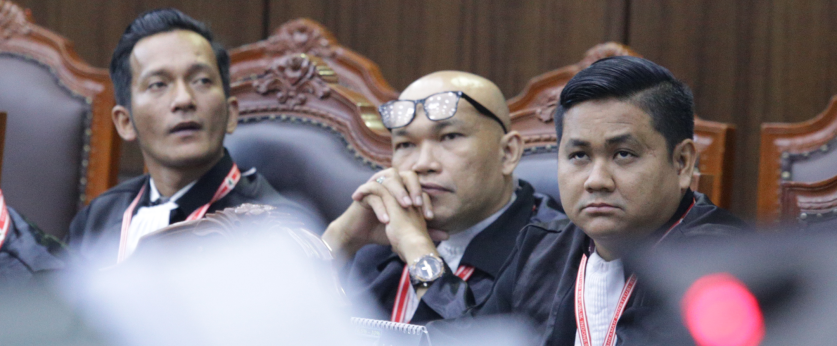
The Petitioners’ legal counsels attending the ruling hearing for Case No. 293/PHPU.GUB-XXIII/2025 on the dispute over the 2024 Papua Highland governor election results, Monday (2/24/2025). Photo by MKRI/Bayu.
JAKARTA (MKRI) – The Constitutional Court (MK) declared the petition on the dispute over the 2024 Papua Highland governor election results, filed by Candidate Pair Number 2 Befa Yigibalom and Natan Pahabol, inadmissible. The Decision No. 293/PHPU.GUB-XXIII/2025 was read out on Monday, February 24, 2025 in the plenary courtroom.
“[The Court] declares the Petitioners’ petition inadmissible,” stated Chief Justice Suhartoyo along the other eight constitutional justices.
In the legal reasoning, read out by Constitutional Justice Ridwan Mansyur, the Court was of the opinion that all of the Petitioners’ arguments had no basis in law. These include the Petitioners’ argument regarding the unanimous and one-sided vote only for Candidate Pair Number 1 John Tabo and Ones Pahabol (Relevant Party) in Tolikara District, the argument of intimidation and blockade in Yahukimo Regency, as well as the argument of the transfer of the Petitioners’ votes in Lanny Jaya District were unreasonable according to law.
“The Court is of the opinion that the arguments in the Petitioners’ petition are unreasonable according to law in their entirety,” Justice Ridwan stated.
In the context of the argument of unanimous and unilateral votes in Tolikara Regency, the Court was of the opinion that in an election the majority of the community might vote for one candidate pair. The reason is that the Court found the fact that only 12 polling stations in Karubaga District in Tolikara Regency had used the one-man-one-vote model in the 2024 Highland Papua governor election: 2 polling stations in Ampera Hamlet, 1 polling station in Ebenhaiser Hamlet, 6 polling stations in Karubaga Hamlet, and 3 polling stations in Kogimagi Hamlet. Those 12 polling stations saw a landslide win (100%) of one of the candidate pairs, meanwhile at the same polling stations, the vote acquisition for the regent election were distributed to the 4 contesting candidate pairs.
“This fact confirms that the choice of the people in a region for regional head election candidates is not affected by the election model used in the region, in this case the choice of using the noken* model or the one-man-one-vote model, because the noken election model is part of the local wisdom of the people in Papua Highland,” Justice Ridwan said.
Meanwhile, the Court was of the opinion that the Petitioners could not prove their allegation of intimidation and blockade in Yahukimo Regency. They did not present witnesses at the evidentiary hearing to prove the intimidation that had happened in Yahukimo Regency.
“The Petitioners could not convince the Court of the alleged intimidation and blockade and its relation to the Petitioners’ vote acquisition in Yahukimo Regency,” Justice Ridwan stressed.
The Court was of the opinion that the allegation of the transfer of the Petitioners’ votes in 15 districts in Lanny Jaya Regency was not legally justified because the Highland Papua Provincial Bawaslu (Elections Supervisory Body) had conducted an initial review and then issued a status report that the allegation did not satisfy requirements as the report did not clearly state the date of the reported incident and the report had passed the submission deadline.
Also read:
Vote Manipulation in Highland Papua Provincial Election
Highland Papua KPU Denies Accusation of Vote Manipulation
Witnesses Testify on Vote Manipulation in Highland Papua Gubernatorial Election
No Legal Standing
Because all of the Petitioners’ arguments were not legally justified, the Court finally reconsidered their legal standing in relation to Article 158 paragraph (1) of Law No. 10 of 2016 on Regional Elections. Justice Ridwan stated that the Court had postponed the application of the provision of Article 158 paragraph (1) of Law No. 10 of 2016 by conducting a further evidentiary hearing because of the Petitioners’ argument that the election (both the noken and the one-man-one-vote models) was not held in several districts in the Papua Highland Province. However, it was found that this and other arguments were unreasonable according to law.
The Court reconsidered 564,280 votes for the Petitioners vs 720,925 votes for the Relevant Party. The difference in votes was 720,925 or 12.19%. Thus, the Court held that the Petitioners did not have legal standing to file the petition because they did not fulfill the provision for filing a petition as referred to in Article 158 paragraph (1) letter a of Law No. 10 of 2016.
“The Court is of the opinion that although the Petitioners was a candidate pair in the 2024 Papua Highland governor election, they did not fulfill the provision for filing a petition as referred to in Article 158 paragraph (1) letter a of Law No. 10 of 2016,” Justice Ridwan emphasized.
Also read:
Petition for Case No. 293/PHPU.GUB-XXIII/2025
Response by the Respondent
Statement by Bawaslu
Statement by the Relevant Party
(*) The noken voting system is carried out by communities in Papua, either through public agreement on vote allocation or through the delegation of votes to a tribal leader.
Author : Ahmad Sulthon Zainawi
Editor : N. Rosi
PR : Andhini S.F./Tiara A./Fauzan F.
Translator : Dinita Aktivia/Yuniar Widiastuti (NL)
Disclaimer: The original version of the news is in Indonesian. In case of any differences between the English and the Indonesian versions, the Indonesian version will prevail.
Monday, February 24, 2025 | 18:25 WIB 283