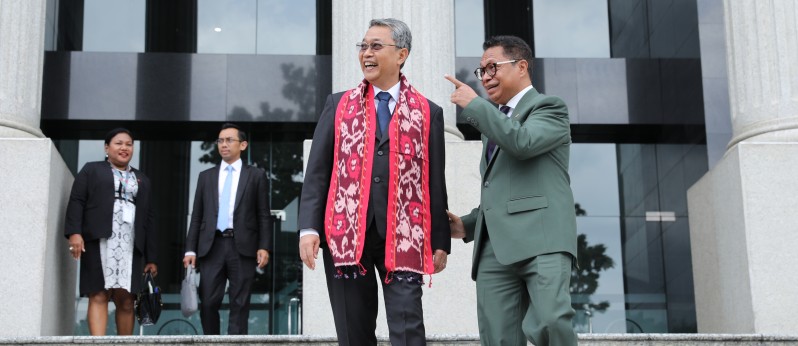
Secretary-General Heru Setiawan welcoming Timor Leste Ambassador Roberto Sarmento de Oliveira Soares, Thursday (2/20/2025). Photo MKRI/Ifa.
JAKARTA (MKRI) — Timor-Leste Ambassador Roberto Sarmento de Oliveira Soares visited the Constitutional Court (MK) on Thursday, February 20, 2025 and was welcomed by Secretary-General Heru Setiawan.
Head of the Public Relations and Protocol Bureau Pan M. Faiz and head of the AACC Permanent Secretariat and International Affairs Department Immanuel Hutasoit discussed the Constitutional Court’s role the guardian of the Constitution. The Court has five types of authority, as follows: to conduct judicial review against the Constitution; to decide disputes over the authority of state institutions; to decide the dissolution of political parties; to decide disputes related to the results of general elections; and to pass a decision on the opinion of the House of Representatives (DPR) regarding alleged violations by the president and/or vice president based on the Constitution.
In the judicial review, the Court must safeguard the citizens’ constitutional rights as regulated in the Constitution.
Exchange of Literature
Secretary-General Heru believes that by exchanging literature, especially within Asia, the Court can broaden its horizons, because some values of justice are universal and can be adopted in Indonesia with adjustments to Pancasila and the Constitution.
“Some of the universal values of justice in the whole world, because they are related to aspects of justice, are compatible with Indonesia, while some are not. In Indonesia, the universal values must be based on [the belief in] One Supreme God. The regulated universal values are filtered by the Court to remain in line with Pancasila and the Constitution,” Heru said.
This is the reason Indonesia is one of the seven founding countries of the Association of Asian Constitutional Courts and Equivalent Institutions (AACC). The association was established in July 2010 for close cooperation between constitutional courts and similar institutions that exercise constitutional jurisdiction for the development of democracy and the rule of law in Asia. As stated in its founding declaration, the AACC was founded by the constitutional jurisdictions of seven countries: Indonesia, Korea, Malaysia, Mongolia, the Philippines, Thailand, and Uzbekistan. Indonesia acts as one of the association’s permanent secretariats.
Universal Justice
Today the AACC has 21 members. Timor-Leste is expected to become the 22nd member.
In its meetings, the AACC often discusses decisions with universal concepts such as the rejection of colonialism, which is in line with the Constitution of the Unitary State of the Republic of Indonesia.
“Because freedom is the right of all nations, as stipulated in our Constitution, in the Preamble, it is important for us to be organized, to form a common view, to form a good atmosphere,” he said.
Timor-Leste’s Chances of Joining AACC
Such concept is also in accordance with the values in Timor-Leste. Ambassador Roberto Sarmento de Oliveira Soares said that the universal value of justice in international law has protected the rights of its citizens.
Given this aligning perspective, Ambassador de Oliveira Soares expressed Timor-Leste’s desire to join the AACC. Moreover, he added, Timor-Leste faces similar issues as Indonesia and other countries.
“What we are looking at right now is that we want to expand cooperation in the judicial system. And Indonesia is one of the important neighbor countries,” he said.
Author : Ashri Fadilla.
Editor : N. Rosi
Translator : Dinita Aktivia/Yuniar Widiastuti (NL)
Disclaimer: The original version of the news is in Indonesian. In case of any differences between the English and the Indonesian versions, the Indonesian version will prevail.
Thursday, February 20, 2025 | 15:05 WIB 1109