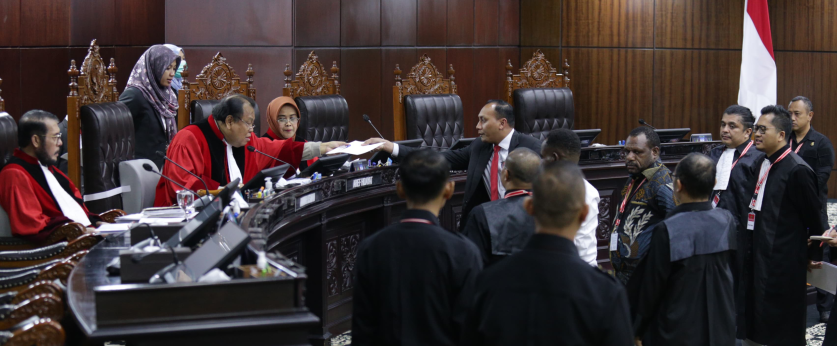
Witnesses are proving the authenticity of signatures at evidentiary hearing for Case No. 283/PHPU.BUP-XXIII/2025 on the Puncak regent election results dispute, Thursday (2/13/2025). Photo by MKRI/Bayu.
JAKARTA (MKRI) – The Constitutional Court (MK) held an evidentiary hearing on the Puncak regent election results dispute on Thursday, February 13, 2025, in the plenary courtroom. The petition for Case No. 283/PHPU.BUP-XXIII/2025 was filed by Candidate Pair 04 Peniel Waker and Saulinus Murib. At the hearing, experts and witnesses revealed various findings related to alleged vote manipulation and election malpractice.
The Petitioners’ expert Jamaludin Ghafur explained that the voting process using the noken* or ikat system can be preceded by a deliberative decision-making process. Through this mechanism, the tribal leader, together with voters registered in the final voters list (DPT), relocated voters list (DPPh), and additional final voters list (DPTb), can determine their support for a candidate pair prior to the voting day. This system has long been practised in several regions in Papua as a practice of democracy rooted in local wisdom.
Furthermore, Jamaludin Ghafur emphasized the potential for irregularities in the election process that could result in malpractice. He explained that election malpractice refers to any form of manipulation during the electoral process intended to favor certain parties at the expense of the public interest.
"The forms of election malpractice can be categorized into three types: manipulation of election laws and regulations, manipulation of voter selection, and the involvement of government officials in the election process," explained Jamaludin at the hearing presided over by Constitutional Justices Arief Hidayat, Anwar Usman, and Enny Nurbaningsih.
Jamaludin emphasized that the manipulation of laws and regulations can be carried out by officials with the authority to amend regulations to serve specific interests, either to favor or disadvantage certain candidate pairs. On the other hand, voter manipulation can take various forms, such as money politics or direct interference by government officials.
To prevent such practices, regulations explicitly prohibit government officials from engaging in the election process in a non-neutral manner. Article 71 of the Regional Election Law strictly forbids state officials, regional officials, state civil apparatus (ASN), members of the national armed forces (TNI), police, or village heads from making decisions or taking actions that could favor or disadvantage any candidate pair.
"If this provision is violated, Article 188 of the Regional Election Law stipulates that violators can face imprisonment for a minimum of one month and a maximum of six months, along with a fine ranging from at least 600 thousand rupiah to a maximum of 6 million rupiah," explained Jamaludin.
Jamaludin also underscored additional forms of malpractice, particularly manipulation in the voting and vote-counting process up until the conclusion of the election. He stated that the transfer of votes from one candidate to another constitutes a severe form of malpractice, especially when perpetrated by election organizers who are expected to remain professional, neutral, and non-partisan. Consequently, the Petitioners’ claim regarding vote manipulation in the noken system in Erelmakawia District and Ilaga District is deemed valid and supported by credible evidence. Jamaludin Ghafur emphasized that the Court has a constitutional duty to rectify such results to uphold the integrity and dignity of democracy.
Meanwhile, Candidate Pair 01 Elvis Tabuni and Naftali Akawal presented I Gusti Putu Artha as an expert. Putu explained that disputes over vote results often arise due to differing interpretations of the voting results in certain districts. In this particular case, disagreements regarding the election result figures emerged in Ilaga District and Erelmakawia District.
"The issue that emerged regarding the D-results in these two districts is the two conflicting versions. My recommendation is to focus on identifying the accurate D-results by thoroughly examining the supporting evidence. One key indicator is the number of witnesses who signed the document. Typically, patterns observed in various regions indicate that if a document is falsified, this can often be verified through inconsistent signatures of the witnesses," he explained during the court session.
At the same hearing, the Court also heard witness statements from the parties involved in the case. One of the Petitioners’ witnesses, Meki Wonda, the Head of Ilaga District, testified that on November 27, 2024, at 08:00 AM, he was already on-site overseeing the voting process. He further stated that the votes were cast in favor of Candidate Pair 04, totaling 10,865 votes.
In addition, Penius Dewelek Onime, who served as a witness at the regency level, testified that the General Election Commission (KPU) traveled to Nabire on December 10, 2024, to conduct the recapitulation and plenary meeting to determine the results, which was held on December 12, 2024. He mentioned that he was requested to be the Petitioners’ witness.
He explained that on December 5, 2024, no recapitulation was conducted because the district election committee (PPD) was not prepared. The recapitulation was further continued on December 6, in line with the community agreement reflected in the D-results. However, he revealed an unexplained change in the recapitulation results, prompting them to seek clarification from the PPD. "We at the regency level also filed a protest against the change," he stated.
Meanwhile, the Puncak Regency KPU (Respondent) presented regent candidate 02 Alus UK. Alus detailed the chronology of the plenary vote recapitulation process at the regency level. He explained that several PPD were initially unprepared, prompting the Puncak Regency KPU to suspend and postpone the plenary process.
"Because the PPD was not ready, the plenary meeting was postponed, and all parties went home. The plenary session was then continued on the 6th by inviting all related parties back," Alus said before the constitutional justices.
Furthermore, Alus explained that the plenary meeting was conducted simultaneously in one day for all 25 districts in Puncak Regency. During the meeting, each PPD presented the vote results from their respective areas. According to the recapitulation results, Candidate Pair 01 garnered 2,081 votes, Candidate Pair 02 and Candidate Pair 03 received 50 votes, and Candidate Pair 04 secured 8,684 votes.
"During the plenary meeting, many witnesses raised objections regarding the vote count results, but these objections were addressed and resolved following the proper procedures. Subsequently, the plenary session results were publicly announced," explained Alus.
Also read:
Alleging Vote Count Error, Waker-Murib Petition Puncak Regent Election Results
Puncak Regency KPU Confirms Use of Noken System in Election
At the preliminary examination hearing, the Petitioners argued that the vote count results determined by the Respondent did not match the data on the district D-result forms, which show that the vote count for candidate pair number 1 should have been 56,851 votes, while the Petitioners should have obtained 63,634 votes. This error caused the Petitioners’ votes to decrease by 4,343 votes while votes for candidate pair number 1 increased by 4,459 votes.
The Petitioners accused the Respondent of having manipulated or at least erred in recording the results of the count at the district level. This occurred because the Respondent did not base the determination of results on the recapitulation contained in D-result forms of Erelmakawia District and Ilaga District.
Regarding the errors in the vote count made by the Respondent, especially for the votes obtained in Erelmakawia and Ilaga Districts, the Petitioners submitted an objection and requested the correction or recount of the votes based on their witness objection letter to the district-level vote counting process on December 6, 2024, because they believe it did not follow the district D-result form.
(*) The noken voting system is carried out by communities in Papua, either through public agreement on vote allocation or through the delegation of votes to a tribal leader.
Author : Utami Argawati
Editor : Lulu Anjarsari P.
PR : Tiara Agustina
Translator : Nazila Rikhusshuba/FS (RA)
Disclaimer: The original version of the news is in Indonesian. In case of any differences between the English and the Indonesian versions, the Indonesian version will prevail.
Thursday, February 13, 2025 | 17:26 WIB 314