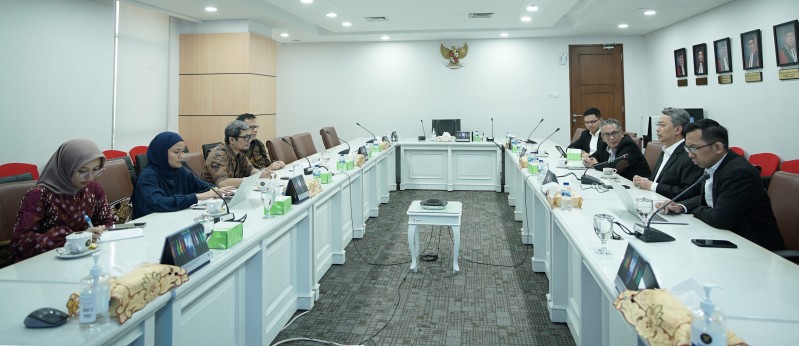
The Court welcomes the visit from the Corruption Eradication Commission on Friday, (2/7/2025) in the Court's meeting room. Photo by MKRI/Hamdi
JAKARTA (MKRI) — Constitutional Court Secretary-General Heru Setiawan welcomes the Corruption Eradication Commission (KPK) representatives on the 10th floor of the Court’s Building 1. Accompanying Heru are the Head of the Public Relations and Protocol Bureau, Pan Mohamad Faiz; the Head of the Legal and Administrative Bureau of Registrar, Fajar Laksono; and Head of the Center for Information and Communication Technology, Nanang Subekti. They discuss digital transformation in the judiciary sector, with a focus on enhancing transparency and accountability in the Court’s legal process.
Heru underscores the importance of technology in the Court’s hearings, highlighting the use of latest technology, such as smartboard in decision-making despite challenges in implementing digital transformation. He asserts that without comprehensive digital transformation, successful integration into the judicial system cannot be achieved.
Heru also highlights the fundamental role of democracy and justice in the Court’s decisions, especially when adjudicating cases involving vote margins. He underscores the need for the Court to continuously strengthen accountability in every legal process by leveraging digital technology.
“All [the Court’s processes] should be fully transformed. We received extraordinary support to integrate [this transformation] into [the Court’s] procedural law,” explained Heru.
Judicial Transparency
KPK’s Deputy for Information and Data, Eko Marjono states that they aim to learn from the Court’s digital transformation, as the KPK is behind. “We just prepared the roadmap for digital transformation and we expect resistance from several units,” explained Eko.
Eko expects many benefits from digital transformation. He notes the visit as a follow-up discussion on transparency to hearings. “The Court already implemented digital transformation, [while we have] many room for improvements at KPK,” Eko asserts.
Eko continues that KPK aims to study transparency implementation in the judiciary, the Court’s main concern. In this regard, KPK strives to continuously learn and improve digital systems. “Our goal is to enhance transparency and provide faster service for the public,” Eko explains.
Moreover, Fajar emphasizes that the Court upholds openness and publication principles as stipulated in Article 40 of the Court Regulation, stating that the Court’s hearings are open to the public.
“Hearings must be open, except during justice deliberation meetings, where all constitutional justices deliberate in isolation for rulings,” explained Fajar.
Fajar added that since its establishment, the Court has strived to develop all aspects to ensure transparency in hearings. He explains that all Court aspects were designed to support this purpose. “Since Secretary General Heru Setiawan took office, digital technology has been massively implemented,” he explains.
Technology Innovation
Faiz expresses his gratitude for the balanced implementation of top-down and bottom-down leadership styles in the Court. Through the top-down approach, the first Chief Justice, Jimly Asshiddiqie declared the Court a modern and trusted judicial institution.
“Modernization has been introduced since the beginning, encompassing not only technology application but development of a modern mindset by leaders, starting with the first Secretary-General Janedjri M. Gaffar, continued by Guntur Hamzah, and now strengthened by Secretary-General Heru Setiawan. This concept is well-internalized. Initially, [we] faced resistance to technology [innovation], but we agreed to continue implementing it,” explains Faiz.
Faiz asserts that it is not only about upholding justice but also demonstrating the process. “At the Court, we interpret this as the open hearings, with the audio available to listen, visuals on-demand, and the transcripts provided,” Faiz stated.
Moreover, Nanang emphasizes the importance of applying technology information in all Court business processes. “In the future, all areas not yet integrated with technology will be supported with IT solutions, which we need to optimize immediately,” Nanang adds.
This meeting also addresses improving transparency and the importance of cooperation in facing rapidly developing digitalization challenges. Both the Court and KPK expect that fully implementing digital technology will make Indonesia’s legal process more efficient and fairer.
Author : Utami Argawati
Editor : N. Rosi
Translator : Ryan Alfian/FS
Disclaimer: The original version of the news is in Indonesian. In case of any differences between the English and the Indonesian versions, the Indonesian version will prevail.
Friday, February 07, 2025 | 14:38 WIB 565