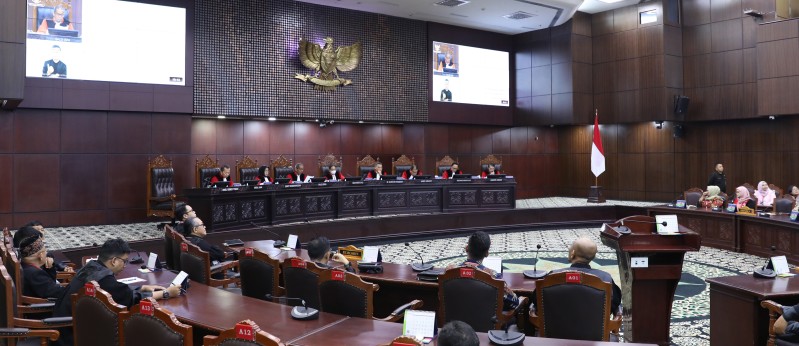
The Constitutional Court holding a ruling hearing for the judicial review of Law No. 15 of 2019 on the Formation of Laws and Regulations on Friday (1/3/2025) in the Courtroom. Photo by MKRI.
JAKARTA (MKRI) — The Constitutional Court rejected the petition for material judicial review of Article 23 paragraph (2) of Law No. 15 of 2019 on the Amendment to Law No. 12 of 2011 on the Formation of Laws and Regulations (P3 Law). The ruling hearing for Decision No. 165/PUU-XXII/2024 was held on Friday, January 3, 2025, in the Plenary Courtroom. The petition was filed by researcher and observer Ahmad Farisi and a Constitutional Law student from UIN Syarif Hidayatullah Jakarta, A. Fahrur Rozi. "[The Court] rejects the petition in its entirety," declared Chief Justice Suhartoyo, delivering the verdict.
Article 23 paragraph (2) of Law No. 12 of 2011 on the Formation of Laws and Regulations states that "In certain circumstances, the House of Representatives (Dewan Perwakilan Rakyat or DPR) or the President may propose a bill outside the National Legislation Program, including a. to address extraordinary circumstances, conflicts, or natural disasters; and b. other specific circumstances that demonstrate a national urgency for a bill, subject to joint approval by the organs of DPR specifically in charge of legislation and the minister or head of the institution responsible for government affairs related to the formation of laws and regulations."
However, in its legal considerations, the Court emphasized that the norm could not be interpreted in isolation or partially, as it is intricately connected to the norm regulating the process of formulating the National Legislation Program (Program Legislasi Nasional or Prolegnas).
"The norm is intricately linked to the norm regulating the comprehensive process of formulating Prolegnas outlined in the preceding articles, which determine the process for formulating the medium-term (five-year period) Prolegnas intended to be transparent to accommodate the need for legislation that supports the proper functioning of national governance," stated Justice Arsul Sani.
The Court further emphasized the principle underlying the norm in the a quo article, which was established to address the potential need for unplanned bills as is customary for bill planning under normal circumstances. In the context of Article 23 paragraph (2) of the P3 Law, the DPR and President, as lawmakers, are granted the authority to propose bills to address specific circumstances, including extraordinary events, conflicts, natural disasters, or other specific conditions. The Justices noted that the legislative process must be responsive in such circumstances. Requiring the inclusion of the proposed law in the five-year Prolegnas or annual legislative priorities before proceeding would be unreasonable within the bounds of rational consideration.
"This is a response or effort by the lawmakers to address specific circumstances, as referred to in Article 23 paragraph (2) letters a and b of Law No. 15 of 2019, through the enactment of a law," stated Justice Enny Nurbaningsih, reading the legal considerations.
Regarding the phrase "national urgency," the Justices believe that its interpretation must be understood in its entirety, in conjunction with the phrase "other certain circumstances that ensure the national urgency for a bill." If the term "national urgency" is considered in isolation, it would render the phrase "other certain circumstances that ensure the national urgency for a bill" in the a quo norm incomplete and unclear.
The phrase in the a quo norm is intended to address the submission of a bill outside Prolegnas, aiming to respond to extraordinary circumstances, conflicts, natural disasters, and other specific urgent situations.
"[This] ensures that there is a national urgency that requires a legislative response, where the draft bill and its academic text are prepared promptly, without the need to first amend the Prolegnas," stated Justice Enny.
Also read:
Regulation on the Law Making Outside National Legislation Program Challenged
Petitioners Strengthen Arguments on the Review of Law Formation Outside the National Legislation Program
At the Preliminary Hearing on Wednesday, December 4, 2024, before the justices in one of the Court’s panel courtrooms online, Fahrur revealed that Article 23 paragraph (2) of Law No. 12 of 2011 on the Formation of Laws and Regulations contradicts Article 28D paragraph (1) of the 1945 Constitution. Petitioner I is an active Indonesian citizen who studies and researches issues of state administration, democracy, and elections. Petitioner I feels responsible and has a special interest in academic knowledge regarding the applicable state administration system, both epistemically and systemically, regarding the validity of a legal norm that limits and revokes the constitutional rights of citizens. Meanwhile, Petitioner II is an active student majoring in constitutional law and a member of several national-level student organizations that focus on state administration issues and actively conduct discussions and advocacy on government decisions and policies.
Regarding this norm, the Petitioners were unable to clearly identify the concept and context of its application within the system and mechanism of law formation. The Petitioners argued that Article 23 paragraph (2) of the P3 Law appeared to be a "dead article" that lacked clarity and legal certainty, thereby hindering the legal policy surrounding the law-making process. As Fahrur further explained, when read systematically, the a quo article offers a basis for the authority of DPR/the government to propose a bill outside the Prolegnas, but does so with repeated, overlapping clauses and ambiguous benchmarks.
In the Petitioners' view, Article 23 paragraph (2) letter b of Law No. 15 of 2019, which stipulates the formation of laws outside Prolegnas under certain circumstances, lacks clear and specific criteria for lawmaking. It relies solely on the vague concept of 'national urgency' and places emphasis on the 'agreement' between the government and DPR.(*)
Author : Ashri Fadilla
Editor : Lulu Anjarsari P.
PR : Raisa Ayuditha Marsaulina
Translator : Nazila Rikhusshuba/Rizky Kurnia Chaesario
Disclaimer: The original version of the news is in Indonesian. In case of any differences between the English and the Indonesian versions, the Indonesian version will prevail.
Friday, January 03, 2025 | 15:08 WIB 271