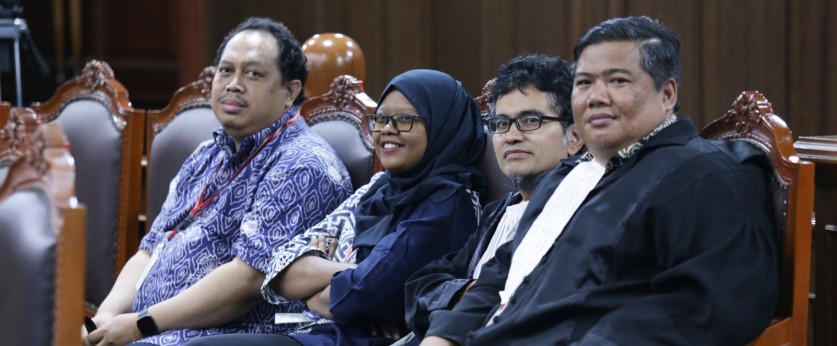
The Petitioners accompanied by their legal counsel at the ruling hearing for the judicial review of Advocate Law, Friday (1/3/2025). Photo by MKRI/Bayu.
JAKARTA (MKRI) — In Decision No. 150/PUU-XXII/2024, the Constitutional Court (MK) granted part of the judicial review petition of Article 3 paragraph (1) letter c and Article 20 paragraph (2) of Law No. 18 of 2003 on Advocate (Advocate Law). The Court ruled that civil servant lecturers teaching in public or private universities are allowed to work as advocates in a limited capacity as community service, which is one of the three pillars of higher education.
“Therefore, their main duty as teaching and research staff would be maintained since practical experience can enrich teaching and research materials,” Chief Justice Suhartoyo stated, reading the legal considerations of the Court at the ruling hearing in the Plenary Courtroom on Friday, January 3, 2025.
Moreover, students will receive more contextual, applicative learning materials since civil servant lecturers have hands-on experience handling concrete legal cases. Therefore, allowing civil servant lecturers to act as advocates would not only enrich the knowledge in fulfillment of the three pillars of higher education but also empower the role of lecturers in impacting positive and real contributions to society and the Indonesian legal system.
Based on these considerations, the Court believes that a civil servant lecturer also has significant responsibilities aside from community service. Lecturers are expected to prepare teaching materials, including lesson plans, extensive literature reviews, and research from proposal to publication in the form of books and articles. These activities are required to develop their academic careers and promote their functional position through professorship.
Strict Rules for Lecturers to Be Advocates
If civil servant lecturers are to be actively engaged in procedural affairs of the court as advocates, they must ensure that they do not neglect their focus and responsibilities as lecturers, such as supervising students, writing books, and other tasks in academia. Hence, strict conditions and requirements must be established for civil servant lecturers to carry out their community service as advocates.
Such strict requirements ensure the implementation of their duties as civil servant lectures and community service as advocates run in harmony with the Three Pillars of Higher Education. Chief Justice Suhartoyo stated the requirements as follows: (1) Having passed the advocate professional examination held by an Advocate Organization; (2) The advocate status may only be given in order to serve the community and only be given to those who have worked in their respective institutions for the minimum of five years; (3) Being affiliated and having served for at least three consecutive years in a legal aid institute or another institute established by the relevant university, not allowed to establish their own law firm, and only giving legal aid free of charge (prodeo/pro bono) for economically underprivileged community that is proven by a certificate issued by the authorized officials; (4) The legal aid institutes of the higher education institutions must receive accreditation from the authorized ministry; (5) The number of advocates in the legal aid institutes or other institutes must not exceed the number of members of the Law Faculty/Department in the corresponding university; (6) Any provision of legal aid as mentioned in point 3 must be carried out with permission and finished with a report to the university rector, in casu, the dean of the Law Faculty; and (7) Not affiliated or actively participated as a member of an advocate association.
Based on the abovementioned legal considerations, the Court ruled the norms of Article 3 paragraph (1) letter c and Article 20 paragraph (2) of Law No. 18 of 2003 need to be interpreted conditionally as contained in the verdict of the a quo decision. Nevertheless, since the interpretation presented by the Court was not as that of petitioned by the Petitioners, the Court ruled the petition to have legal reasonings in part.
“Whereas based on all of the legal considerations above, in the Court’s opinion, Article 3 paragraph (1) letter c and Article 20 paragraph (2) of Law No. 18 of 2003 is in conflict with the right to personal development, manifested through the widest possible opportunities for every citizen to upgrade themselves by means of education and to demand acknowledgment of security, protection, fair legal certainty, and equal treatment before the law as stated in Article 28C paragraph (1) and Article 28D paragraph (1) of the 1945 Constitution, as argued by the Petitioners,” Chief Justice Suhartoyo explained.
However, since the verdict ruled by the Court is not as that of the petitum filed by the Petitioners, the arguments of the Petitioners on the judicial review of the norms of Article 3 paragraph (1) letter c and Article 20 paragraph (2) of Law No. 18 of 2003 have a legal ground in part. Hence, Article 3 paragraph (1) letter c of Advocate Law is in conflict with the 1945 Constitution and not legally binding conditionally if not interpreted as: “Not applicable to civil servant (Pegawai Negeri Sipil or PNS) lecturers in community service in fulfilling the Three Pillars of Higher Education and providing legal aid for free (prodeo/pro bono). The Court also ruled Article 20 paragraph (2) of Advocate Law to be in conflict with the 1945 Constitution and not legally binding conditionally if not interpreted as: “Not applicable to civil servant lecturers in community service in fulfilling the Three Pillars of Higher Education and providing legal aid for free (prodeo/pro bono”).
Also read:
Prohibition for Civil Servant Lecturers to Serve as Advocates Questioned
Petitioners Request to Allow Advocates Serving as Civil Servant Lecturers
The Petitioners consist of two law lecturers from the University of Indonesia (UI), Djarot Dimas Achmad Andaru (Petitioner I) and Achmad Madison (Petitioner II), and UI law student Salsabilla Usman Patamani (Petitioner III).
Author : Mimi Kartika
Editor : N. Rosi
PR : Fauzan F.
Translator : M. Hafidh Al Mukmin/Rizky Kurnia Chaesario (NL)
Disclaimer: The original version of the news is in Indonesian. In case of any differences between the English and the Indonesian versions, the Indonesian version will prevail.
Friday, January 03, 2025 | 20:51 WIB 269