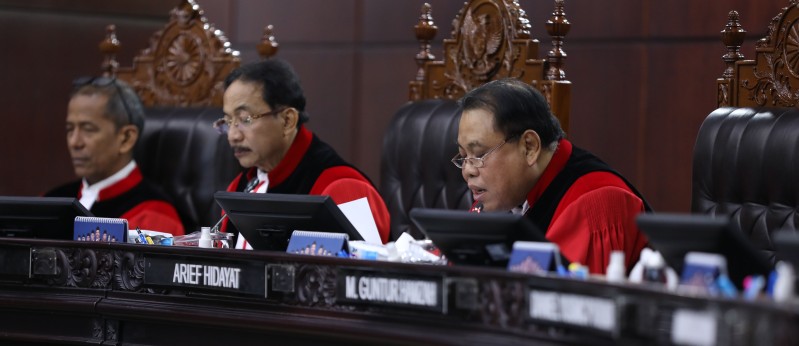
Justice Arief Hidayat reading the legal considerations at the ruling hearing for the judicial review of the Law on the Parliament (MD3), Thursday (1/2/2025). Photo by MKRI/Panji.
JAKARTA (MKRI) — The Constitutional Court (MK) decided to reject the judicial review petition of Law No. 17 of 2014 on the People’s Consultative Assembly (MPR), House of Representatives (DPR), Regional Representatives Council (DPD), and Regional Legislative Council (DPRD), also known as the MD3 Law. The petition was filed by Muhamad Zainul Arifin, an entrepreneur.
“According to the Court, to date, there have been no new developments and need nor strong and fundamental reasons for the Court to change its stance regarding the constitutional issue of limiting the term of office of legislative members,” said Justice Arief Hidayat while reading the Court’s legal considerations in the plenary courtroom on Thursday, January 2, 2025.
Furthermore, he cited the Constitutional Court Decision No. 108/PUU-X/2012 in answering the need to impose limits on the term of office of the legislative members. In the decision, the Court has, in principle, affirmed that this term of office is not necessarily restricted—like that of the president—as argued by the Petitioner, since the legislative branch is a collegial position. Contrast this with the president, who holds a unilateral authority, thus the absence of restriction of their term poses a risk of abuse.
“Restriction on the term of office of the president cannot be equated with that of members of the DPR and DPRD because the two positions are of different natures. The president is a singular position that holds full authority in exercising government power, so it is necessary to have restrictions to avoid abuse of power. Meanwhile, members of DPR and DPRD hold a collegial position where decision-making in their authority is carried out collectively, so it is very unlikely that abuse will occur,” said Justice Arief delivering the Court’s legal considerations.
For that reason, he questioned the constitutional problem of the absence of a limit of the term of office of legislative members. “Is the absence of a limit of the term of office of members of the DPR, DPD, DPRD, and Regency/City Legislative Council (DPRK) under Article 76 paragraph (4), Article 252 paragraph (5), Article 318 paragraph (4), and Article 367 paragraph (4) of Law No. 17 of 2014 in conflict with the 1945 Constitution?” he asked.
Restriction by Political Parties
Should it be necessary to limit the term of office of legislative members in order to deter potential negative consequences, the Court recommended that such restrictions be carried out by political parties. This is because political parties have the authority to limit the term of office of their members by issuing internal decrees.
“Political parties can limit the term of office of their members to serve in the DPR and DPRD. This is an internal discretion of each political party that is not in conflict with the Constitution,” said Justice Arief.
“The Constitution has presented political parties with a role to ensure that the nomination process for DPR/DPRD members be carried out through democratic elections. In this context, political parties are expected to have an ideal institutional design in recruitment and regeneration mechanism that is measurable, structured, and systematic in order to obtain candidates for DPR/DPRD members who possess integrity and capacity, while still prioritizing the principles of democratic elections,” Justice Arief said.
In the end, the Court ruled to reject the petition. “[The Court] adjudicated, rejects the Petitioner’s petition for its entirety,” said Chief Justice Suhartoyo delivering Decision No. 157/PUU-XXII/2024.
Also read:
Petitioner Wishes House Members’ Terms of Office Limited
Petition on House Members’ Terms of Office Revised
Author : Nawir Arsyad Akbar
Editor : N. Rosi.
PR : Raisa Ayuditha Marsaulina
Translator : M. Hafidh Al Mukmin/Yuniar Widiastuti (NL)
Disclaimer: The original version of the news is in Indonesian. In case of any differences between the English and the Indonesian versions, the Indonesian version will prevail.
Thursday, January 02, 2025 | 21:24 WIB 290