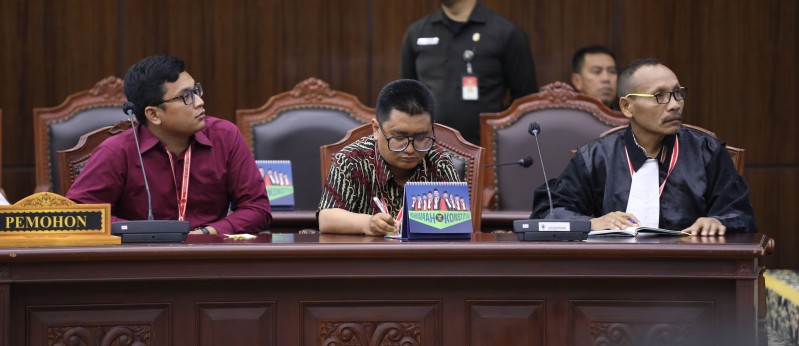
The Petitioners and their legal counsels during the ruling hearing of the judicial review of Law No. 13 of 2003 on Manpower and Law No. 39 of 1999 on Human Rights in the Plenary Courtroom, Thursday (1/2/2025). Photo by MKRI/Panji
JAKARTA (MKRI)—The Constitutional Court rejected the petition for judicial review of Article 35 paragraph 1 of Law No. 13 of 2003 on Manpower (Manpower Law) and Article 1 point 3 of Law No. 39 of 1999 on Human Rights (Human Rights Law). The Court considered that age restrictions cannot be absolutely prohibited or allowed; instead, they must follow the specific needs of the work nature.
“The diverse nature and conditions of work cannot be regulated or specified within a single provision. Instead, more detailed arrangements on the requirements of each field of work should be articulated in legislation under the law by the institutions overseeing manpower,” Justice Enny Nurbaningsih said, delivering the verdict for Decision Number 124/PUU-XXII/2024 on Thursday, January 2, 202, in the Plenary Courtroom.
Justice Enny added that it is difficult to grant the Petitioners’ petition to eliminate the gender, age, or religion categories from job requirements. It is due to many jobs that, if prohibited to require specific requirements, including gender, age, and religion, will diminish the job nature itself and cause injustice.
“For example, for construction work, it is certainly more humane to hire young workers who typically have strong physiques or hire individuals of a specific religion for work related to religious services.” Justice Enny explained.
The Petitioners requested that employers be “prohibited from posting job vacancies that require a certain age, good appearance, race, color, sex, religion, political view, nationality, or ancestry.” In response, the Court stated that the Petitioners are questioning the job availability that follows the conditions of each job seeker, such as that of older people, persons with physical and mental disabilities, various education levels, and others. The solution is to create new jobs in both formal and informal sectors.
In addition, the Court views the age restrictions in manpower recruitment must be fair and supported by relevant reasons, considering jobseekers’ interest and their work period before retirement, without harming their constitutional rights. The Court views that the provisions under Article 1 point 3 of Law No. 39 of 1999 on Human Rights have defined discrimination as differentiation based on religion, tribe, race, ethnicity, group, class, social status, economic status, sex, language, and political view without stating that age restriction as a form of discrimination.
As such, age restrictions in the recruitment process are more related to the employer’s needs, which are tailored to certain job characteristics. Conditions, including age restrictions, generally ensure that candidates possess certain competencies or qualifications to perform their duties effectively and efficiently. As such, such age requirements cannot necessarily be considered a form of discrimination based on Article 1 point 3 of Law No. 39 of 1999.
In this context, age restrictions in the recruitment process are not an explicitly prohibited category under Law No. 39 of 1999 or international conventions, in this case, the ICCPR and ILO Convention No. 111. Differential treatment based on age restrictions in the recruitment process is often based on the needs related to certain job characteristics. This matter is relevant to the ‘doctrine of reasonable classification,’ where differential treatment may be acceptable based on reasonable grounds and legitimate aims.
“In the context of the doctrine implementation, age restriction in job recruitment functions as an instrument to ensure that the candidates possess certain capabilities and competencies that align with the job demands, especially if such jobs demand certain qualities or physiques that are closely related to age,’ Justice Enny said.
On the other hand, there was a dissenting opinion from Justice M. Guntur Hamzah who viewed that the petition should have been partially granted.
Also read:
Discrimination in Recruitment Questioned
Petitioners Argue Discriminatory Job Requirements Cause High Unemployment
Leonardo Olefins Hamonangan, Max Andrew Ohandi, and Martin Maurer challenged the phrase “may recruit by themselves the workforce they need” in Article 35 paragraph (1) of the Manpower Law. They also challenge Article 1 point 3 of the Human Rights Law.
The Petitioners argued that the Manpower Law does not regulate equality in the recruitment process, which can lead to discrimination against certain groups based on factors such as age, gender, or regional origin. Injustice in the recruitment process can undermine public confidence in the company and contradict the principle of non-discrimination, which is widely recognized in Manpower Law. There is no guarantee that the recruited workforce will be selected based on qualifications or merit. It could lead to widespread social impacts because there are often unreasonable requirements that result in many job seekers having difficulty getting a job.
The Petitioners argued that Article 1 point 3 of the Human Rights Law has perpetuated age discrimination in job vacancies and harmed the constitutional rights of every citizen. They argued that including the word “age” in the definition of discrimination would not weaken protection from discriminatory practices, but instead strengthen the protection of Indonesian citizens from all forms of ageism. Age restrictions in job vacancies are often based on negative stereotypes of the abilities of older individuals. In fact, the Petitioners argued, research shows older individuals remain capable of learning new things and adapting to technology, especially if they are given adequate training and support. Meanwhile, there are also examples of younger workers who may not have the maturity or experience required for certain positions.
In one of the petitums, the Petitioners requested that the Court declare Article 35 paragraph (1) of the Manpower Law unconstitutional and not legally binding if not interpreted as, “Employers who need workforce may recruit by themselves the workforce they need or have them recruited through job placement agencies. They shall be prohibited from posting job vacancies that require certain age, good looks, race, skin color, sex, religion, political views, nationality or origin of ancestry, unless otherwise provided by laws and regulations.”
They also request that the Court declare Article 1 point 3 of the Human Rights Law unconstitutional and not legally binding if not interpreted as, “Discrimination means all limitations, affronts, or ostracism, both direct and indirect, on grounds of differences in age, religion, ethnicity, race, group, faction, social status, economic status, sex, language, or political belief, that results in the degradation, aberration, or eradication of recognition, execution, or application of human rights and basic freedoms, of both individuals and collective, in political, economic, legal, social, cultural, or any other aspects of life.”
Author : Mimi Kartika
Editor : N. Rosi
PR : Raisa Ayuditha Marsaulina
Translators : Ryan Alfian/Rizky Kurnia Chaesario/Yuniar Widiastuti (NL)
Disclaimer: The original version of the news is in Indonesian. In case of any differences between the English and the Indonesian versions, the Indonesian version will prevail.
Thursday, January 02, 2025 | 19:28 WIB 487