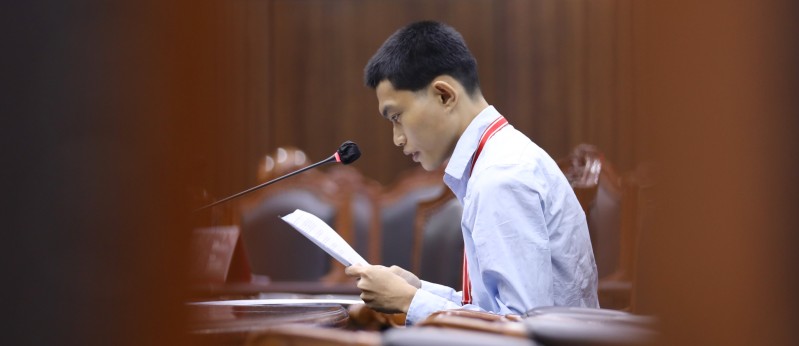
The preliminary hearing for the judicial review of Law No. 17 of 2023 on Health, Tuesday (12/24/2024). Photo by MKRI/Ifa.
JAKARTA (MKRI) — The Constitutional Court (MK) held the preliminary hearing for the material judicial review of Law No. 17 of 2023 on Health on Tuesday, December 24, 2024. In case No. 179/PUU-XXII/2024, Astro Alfa Liecharlie questions the regulation on the production and distribution of tobacco products and electronic cigarettes in the Law, which he believes has put economy above public health.
At the hearing, he expressed understanding that the Health Law does not fully prohibit the production and distribution of tobacco products and/or electronic cigarettes due to considerations related to the economy and state finances. However, economic and financial interests should not come at the expense of public health, he argued.
“If the consideration were indeed for the sake of economy and finance, only production for export should have been allowed. Meanwhile, the circulation, import, and use of products that are not only detrimental to health but also detrimental to the economy and the state should be prohibited, because it clearly contradicts Article 28H paragraph (1) of the 1945 Constitution of the Republic of Indonesia, which reads, ‘Each person has a right to a life of well-being in body and mind, to a place to dwell, to enjoy a good and healthy environment, and to receive medical care,’” he said.
Sanctions Disproportionate
The Petitioner also argued that the sanctions imposed by Article 437 of the Health Law are much lighter than those for the circulation and use of other addictive substances such as narcotics.
“While in fact, tobacco products and/or electronic cigarettes not only harm the users but also other people around them who become passive smokers. This means that tobacco products and/or electronic cigarettes are more dangerous than type I narcotics, so the sanctions imposed should be heavier or at least equal to those for the circulation and use of type I narcotics,” he said.
He asked that the Court declare the following unconstitutional and not legally binding: Article 150 paragraph (1) of the Health Law if not be interpreted as, “Every person is prohibited from entering the territory of the Unitary State of the Republic of Indonesia and/or distributing addictive substances in the form of tobacco products and/or electronic cigarettes as referred to in Article 149 paragraph (3);” Article 150 paragraph (2) of the Health Law if not be interpreted as, “Every person who produces addictive substances in the form of tobacco products and/or electronic cigarettes as referred to in Article 149 paragraph (3) must include health warnings in the form of a text along with an image.”
“[The Petitioner requests that the Court] declares Article 151 paragraph (3) of Law No. 17 of 2023, which reads, ‘The manager, organizer, or person in charge of the workplace, public places, and other places as referred to in paragraph (1) letter f and letter g must provide a special place for smoking’ unconstitutional and not legally binding,” the Petitioner said.
Justices’ Advice
In response, Constitutional Justice Arsul Sani advised the Petitioner to read the Constitutional Court Regulation (PMK) No. 2 of 2021. “There is no need to look in bookstores or other places. It can be downloaded off of the Constitutional Court’s website. Although the format of the petition has followed the provision of Article 10 of PMK No. 2 of 2021, it is good to see other petitions on the Court’s website to know what a good petition looks like. You can also read the Court’s decisions regarding [similar cases],” he said.
Meanwhile, Constitutional Justice Daniel Yusmic P. Foekh said that to argue his legal standing, the Petitioner needs to elaborate on the five conditions for constitutional impairment. “The reason for the petition is not strong enough; it still needs further elaboration. Perhaps it can be supported by theories, doctrines, or comparisons,” he said.
Before concluding the session, Justice Foekh gave the Petitioner 14 days to revise the petition and submit it by Monday, January 6, 2024.
Author : Utami Argawati
Editor : Lulu Anjarsari P.
PR : Tiara Agustina
Translator : Yuniar Widiastuti (NL)
Disclaimer: The original version of the news is in Indonesian. In case of any differences between the English and the Indonesian versions, the Indonesian version will prevail.
Tuesday, December 24, 2024 | 13:30 WIB 698