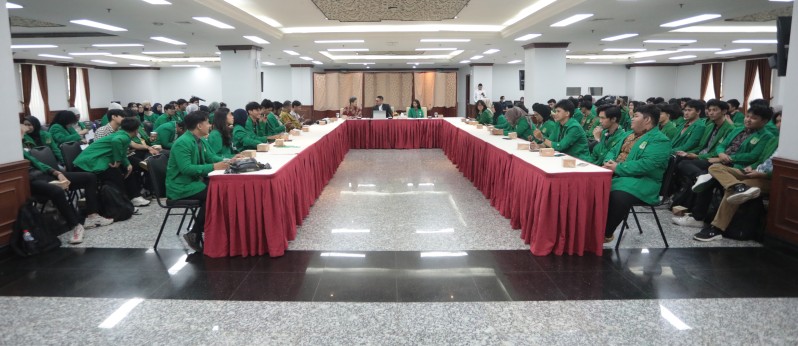
100 law students from Universitas Nasional (Unas) during their study visit to the Court on Wednesday (13/11/2024). Photo by MKRI/Ilham W.M.
JAKARTA (MKRI) — Wednesday, November 13, 2024
The Constitutional Court (the Court) welcomed 100 students from the Faculty of Law, Universitas Nasional (Unas), on Wednesday (13/11/2024). The group was warmly received by the Court’s Legal Analyst, Muhammad Ramlan Aminuddin, at the Ground Floor Hall of Building 1 in Jakarta. Through a presentation titled "Understanding and Getting to Know the Constitutional Court," Alan invited first, third, fifth, and seventh-semester students to gain practical insights into the Court's role and functions.
Alan explained the Court’s historical development, particularly the evolution of constitutional adjudication in Indonesia. He traced this back to the early days of independence, when M. Yamin proposed establishing the Supreme Council (Balai Agung) as an institution authorized to review laws. However, this proposal was rejected on the grounds that Indonesia adhered to the separation of powers, where judges merely applied the law, and because it conflicted with the supremacy of the People’s Consultative Assembly (MPR). Over time, particularly following the Reform Era and the rise of constitutional supremacy, the 2003 constitutional reforms eliminated the distinction between supreme and high state institutions. Instead, all state institutions' positions are determined by the functions and powers assigned to them by the 1945 Constitution, operating within a checks-and-balances framework.
"One of the key reasons for establishing the Constitutional Court was the lack of clarity in mechanisms for dissolving political parties through the Supreme Court. Additionally, problematic laws had no constitutional review mechanism, presidential impeachment (pemakzulan) was based purely on political considerations, intergovernmental conflicts were often resolved solely under the President’s authority, and there was no clear forum for resolving electoral disputes," Alan explained.
Alan further elaborated on the judicial principles the Court applies in carrying out its constitutional duties, including ius curia novit (the court knows the law), open court proceedings, judicial independence and impartiality, fast and cost-free proceedings, audi et alteram partem (the right of all parties to be heard), active judicial involvement, presumptio iustae causa (presumption of validity), final and binding decisions, erga omnes (decisions applicable to all), and praesumtio iustae causa (presumption of validity and legitimacy).
Recognizing the legal background of the visiting students, Alan highlighted several cases filed before the Court where the petitioners were students. One such case was Decision No. 70/PUU-XXII/2024, which challenged the material provisions of Law No. 10 of 2016 on the Election of Governors, Regents, and Mayors against the 1945 Constitution. Although the petition was ultimately rejected, it signaled that students, as Indonesian citizens, could act as petitioners in cases before the Court. As a modern judicial institution, the Court continuously strives to reach all segments of society and regions, ensuring that justice seekers can fight for their constitutional rights.
Following the presentation, students were invited to ask questions and share their thoughts on the topics discussed. To conclude the visit, they were taken on a tour of the Constitutional History Center, where they had the opportunity to explore dioramas showcasing the historical development of Indonesia’s constitution.
Author : Sri Pujianti
Editor : Lulu Anjarsari P.
Translator : Agusweka Poltak Siregar (NL)
Disclaimer: The original version of the news is in Indonesian. In case of any differences between the English and the Indonesian versions, the Indonesian version will prevail.
Wednesday, November 13, 2024 | 15:29 WIB 101