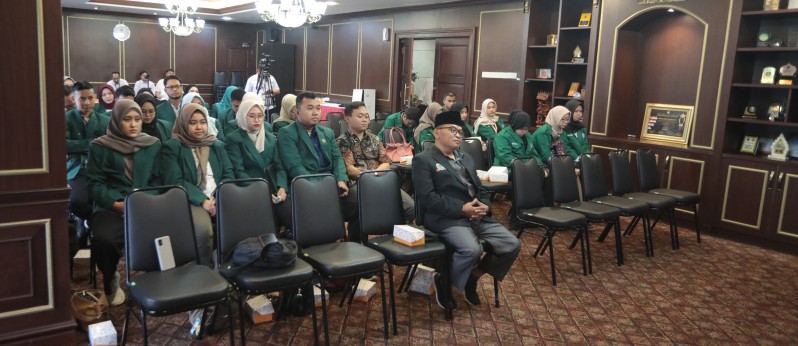
A total of 30 students from Prof. Dr. Hamka Muhammadiyah University conducted a study visit to the Constitutional Court, Monday (11/11/2024). Photo by MKRI/Ilham W.M.
JAKARTA (MKRI) — The Constitutional Court (MK) received a study visit from Diploma, Undergraduate, and Postgraduate Program Students of Muhammadiyah Prof. Dr. Hamka University Jakarta, on Monday, (11/11/2024). The participants were received by the Expert Assistant for Constitutional Justice M. Reza Winata. He later explained about the constitution and constitutionalism, the history of judicial review of laws (UU), and the dynamics of case handling at the Constitutional Court.
Reza said the constitution as the highest law is a mutual agreement that has many functions, including regulating the protection of human rights, regulating state institutions, relations between state institutions and citizens, and other state arrangements. "The constitution as the highest law guarantees that the constitutional rights of citizens are protected, and ensures that the state does not abuse its power," said Reza.
"The constitution has many expert opinions in the highest hierarchy of a country's law," said Reza. The basic principle is that laws under the constitution must not conflict with the constitution, therefore the presence of the Constitutional Court is to ensure that the Law (UU) must not conflict with the 1945 Constitution of the Republic of Indonesia (UUD NRI 1945).
The Court has classified 66 constitutional rights regulated in the 1945 Constitution, and the basis of the rights regulated in the articles of the 1945 Constitution is the touchstone in the Testing of the Law. The presence of the Constitutional Court is also a mechanism of checks and balances between political and legal interests.
Related to the history of the Constitutional Court, from the case of Marbury versus Madison, then in Austria a judicial institution was formed to examine laws separate from the Supreme Court. In Indonesia, the idea of establishing a judicial institution authorized to examine laws has long emerged in the discussion of the Investigative Body for Preparatory Work for Indonesian Independence. Mohamad Yamin proposed a Supreme Court that is authorized to compare laws against the Constitution.
The Court has the authority to test laws against the Constitution, decide on disputes over the authority of state institutions whose authority is stated in the Constitution, the dissolution of political parties, decide on disputes over general election results, and decide on the opinion of the House of Representatives that the President and/or Vice President have committed violations according to the Constitution.
The nine Constitutional Justices, each three of whom were proposed by the House of Representatives, the President, and the Supreme Court, as representatives of the three branches of state power. "Most importantly, even though they were proposed by the three state institutions, the executive, legislative, and judicial branches of power, they are not representatives of the institutions that elected them," Reza said.
Next, Reza explained the general principles that apply in the Constitutional Court, namely that it may not reject a case, "even if there is a strange request, the Constitutional Court may not reject the case application," Reza explained. In the hearing, the Court listens to all parties, both from the petitioner and the state institution that made the law. The Constitutional Court's decision is final and binding so that it can be immediately enforced since it was decided in a plenary session for the pronouncement of the decision.
Public participation is essential in protecting citizens' constitutional rights through petition filed to the Court. According to Reza, the Constitutional Court will not be able to test norms in the Law without a petitioner filed a petition for testing the Law to the Court. Reza said that currently the political sector dominates the testing of the Law, although there are many other sectors that are also tried by the Constitutional Court including tax, electricity, employment, and so on.
After the explanation about the Constitutional Court, the visiting participants had the opportunity to visit the Constitutional History Center located on the fifth and sixth floors of Building One of the Constitutional Court.(*)
Author : Ilham W.M.
Editor : Lulu Anjarsari P.
Translator : Sherly Octaviana Sari (NL)
Disclaimer: The original version of the news is in Indonesian. In case of any differences between the English and the Indonesian versions, the Indonesian version will prevail.
Monday, November 11, 2024 | 20:04 WIB 143