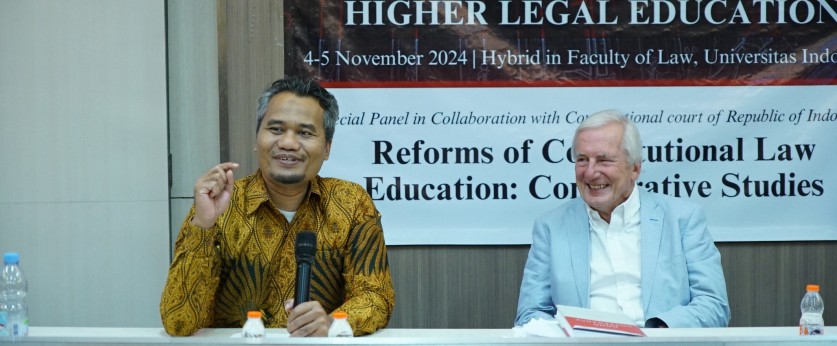
Assistant Expert to the Constitutional Justice, Bisariyadi, and Professor Henk Addink served as speakers at the *6th International Conference on Law and Governance in Global Context (icLave) 2024*, organized by the Faculty of Law, Universitas Indonesia, on Monday (4/11/2024). Photo: MKRI/Bayu.
JAKARTA (MKRI) — Assistant Expert to the Constitutional Justice, Bisariyadi, discussed the history of legal education in Indonesia. He delivered this presentation at the 6th International Conference on Law and Governance in Global Context (icLave) 2024, organized by the Faculty of Law, Universitas Indonesia (FH UI) with the support of the Constitutional Court (MK).
Bisariyadi, who has served as a researcher at the Court for 20 years, began his presentation by highlighting the establishment of Rechtshoogeschool in 1924 under Dutch colonial rule. This institution has since evolved into the Faculty of Law at Universitas Indonesia. Rechtshoogeschool (RHS) was the first legal education institution in Indonesia, producing more than 1,200 graduates, including indigenous scholars. It not only provided instruction in Western law but also promoted an understanding of Indonesia’s customary law (hukum adat).
"The concept of hukum adat, according to Cornelis van Vollenhoven, is essential for developing a legal system that remains relevant to Indonesian society," stated Bisariyadi on Monday (4/11/2024) at the Boedi Harsono Room, Faculty of Law, Universitas Indonesia.
In short, Indonesia declared its independence in 1945. During the period from 1945 to 1960, the country's history was primarily centered on political dynamics. Behind the scenes, however, the development of legal education continued. Several state universities were established, including their respective faculties of law.
"The question that still lingers in my mind, and unfortunately, I have yet to find an answer to, is what kind of curriculum was envisioned for law schools during those years. I assume—though I must emphasize that this is merely an assumption—that during that period, law professors delivered lectures based on their knowledge and their access to certain types of books," said Bisariyadi.
"This assumption is at least based on the notes taken by students such as Djokosoetono and Harun Alrasid. In constitutional law classes, Alrasid compiled lecture notes throughout the entire semester, which were later published as a book. The practice of taking lecture notes and publishing them as books was commonly referred to as dictation (diktat)."
"And if a student was diligent enough to take good notes in multiple classes, they would be referred to by their peers as a dictatur (a slang term for dictator)," he remarked.
According to Bisariyadi, it was difficult for students to access original references, especially if they lacked proficiency in foreign languages such as Dutch and English. In civil and criminal law classes, the Dutch Civil Code and Penal Code were still used as positive law in the country.
During those years, there was a shift in legal references. In constitutional law classes, Djokosoetono instructed his students to read Robert MacIver on Web of Government and the Modern State instead of literature from Dutch scholars. Gradually, the academic orientation shifted towards the United States (US), moving from Leiden to Cornell University.
Then, in the mid-1950s, George McTurnan Kahin initiated a project called the Cornell Modern Indonesia Project. Kahin supported many individuals, particularly Indonesian scholars, in visiting the United States and even pursuing their studies there through scholarships.
"In connection with this project, you may have heard of prominent figures such as Miriam Budiardjo and Selo Soemardjan. This project also produced many influential Indonesian scholars, including Ruth McVey, Harry Benda, Benedict Anderson, Herbert Feith, Harold Crouch, and many others," said Bisariyadi.
Furthermore, it would be incomplete not to mention the stories of two other prominent figures, Mochtar Kusumaatmadja from Universitas Padjadjaran and Satjipto Rahardjo from Universitas Diponegoro. According to Bisariyadi, both initiated legal reform ideas based on American legal realism. He noted the transition of legal education from Dutch influence to American influence in the 1950s, as well as the legal reform efforts pioneered by Mochtar and Satjipto. Although both introduced progressive ideas in legal thought, Bisariyadi emphasized that Indonesia’s legal identity remains in a state of exploration.
During Suharto's administration, Mochtar Kusumaatmadja was appointed as Indonesia’s Minister of Justice (1974–1978). He established a special legal reform unit known as the National Legal Development Agency (Badan Pembinaan Hukum Nasional). Later, Mochtar was appointed as Minister of Foreign Affairs (1978–1988). He also introduced the Development Law Theory (Teori Hukum Pembangunan).
The same applies to Satjipto Rahardjo, who introduced the concept of Progressive Law (Hukum Progresif). Both figures took different paths to achieve their goals or, at the very least, to disseminate their legal thoughts. While Kusumaatmadja utilized public institutions, Satjipto Rahardjo remained in academia, relying primarily on his writings as a means to share his views and knowledge.
However, both ideas share the same roots—legal realism—since both scholars pursued legal education in the United States. Their writings can be traced back to the thoughts of Roscoe Pound, Philip Nonet, and Philippe Selznick.
"However, in my view, both theories remain unfinished products. They have yet to be identified as part of Indonesia's legal identity. Discussions within the legal community surrounding these theories have merely scratched the surface rather than building a solid foundation for them. For instance, discussions on Satjipto Rahardjo’s progressive law primarily focus on its application in law enforcement," said Bisariyadi.
Shifting to the early second millennium, Indonesia undertook a major political agenda to amend its constitution. With its legal identity still a work in progress, the country restructured its constitutional system. These changes had a significant impact on the fundamental values of Indonesian society.
One example of this transformation can be seen in the issue of human rights. The inclusion of human rights as a distinct chapter in the Constitution was regarded as a significant advancement in strengthening the protection of rights in Indonesia.
However, the chapter on human rights has largely been interpreted in relation to the universal values of human rights. On the other hand, there is also an urgent need to emphasize the unique characteristics of Pancasila in the context of human rights protection. The question remains: does the protection of human rights require the state to fully adhere to international instruments, or should human rights be interpreted based on the unique values of the society in the name of state sovereignty?
For instance, regarding the protection of the right to life, the international community has largely chosen to abolish the death penalty. However, the Constitutional Court has interpreted that the right to life is not absolute and may be restricted in cases of severe criminal sanctions, particularly for those involved in drug abuse and trafficking.
The Constitution allows for the possibility of fundamental rights being restricted or even derogated. Naturally, this type of legal construction is a transplant from other jurisdictions. However, there has been limited discussion within the Indonesian legal community distinguishing between the restriction and derogation of constitutional rights.
The constitutional clause stipulates that restrictions on rights must be established by law. However, what happens if the legal objectives deviate and ultimately fail to adhere to morality, religious values, security, and public order in a democratic society? How should the Court address such issues? Should the Court also adopt the proportionality test?
“The fundamental issue, in my view, is that we, as Indonesians, are still in search of our legal identity. We have yet to find a definitive answer to this question, and we must ask whether it is one we can resolve in our time, or if it should be regarded as an enduring inquiry. Should we continue the longstanding project of identifying and integrating customary legal principles as the foundation of our legal identity? Or can we adopt and adapt legal concepts from other legal traditions, transforming them into our own legal identity, much like modifying legal realism?” said Bisariyadi.
2024 icLave
icLave 2024 was held in a hybrid format, taking place at the Faculty of Law, Universitas Indonesia (FH UI), and virtually via Zoom over two days, Monday-Tuesday (4-5/11/2024). Various topics were discussed during the event. The keynote speaker was Prof. Harkristuti Harkrisnowo (FH UI), with other speakers including Prof. Andri Gunawan Wibisana (FH UI), Prof. Joanne Van Der Leun (Leiden University), Sriprapha Petcharamesree (Chulalongkorn University), Prof. Sulistyowati Irianto (FH UI), Jeremy Kingsley (Western Sydney University), and Prof. Jeff Giddings (Monash University).
Author : Mimi Kartika
Editor : N. Rosi
Translator : Nazila Rikhusshuba/Agusweka Poltak Siregar (NL)
Disclaimer: The original version of the news is in Indonesian. In case of any differences between the English and the Indonesian versions, the Indonesian version will prevail.
Monday, November 04, 2024 | 16:13 WIB 183