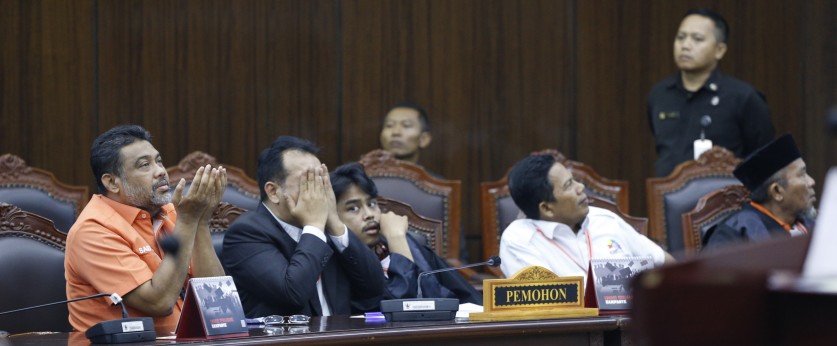
The petitioners, accompanied by their legal counsels, during the Decision Pronouncement Hearing of Case Number 168/PUU-XXI/2023 on the material judicial review of Law Number 6 of 2023 on the Stipulation of Government Regulation in Lieu of Law Number 2 of 2022 on Job Creation (Job Creation Law), Thursday (31/10). Photo by MKRI/Bayu
Jakarta, MKRI – The Constitutional Court partially granted the petition of material judicial review on Law Number 6 of 2023 on the Stipulation of Government Regulation in Lieu of Law Number 2 of 2022 on Job Creation (Job Creation Law). Case Number 168/PUU-XXI/2023 was filed by the Labor Party, the Indonesian Metal Workers Federation (FSPMI), the All-Indonesian Workers Union Confederation (KSPSI), the Indonesian Labor Union Confederation (KPBI), the Confederation of Indonesian Trade Unions (KSPI), and two individuals—Mamun and Ade Triwanto.
In the 168-page decision, the Court also request lawmakers to immediately create a new labor law and separate or exclude it from Law Number 6 of 2023. Justice Enny Nurbaningsih pronounced the Court’s legal consideration. The Court considered that there is the possibility of norms overlapping between Law Number 13 of 2003 on Labor and the Job Creation Law. Especially related to the norms under the Labor Law, which are changed (both in articles and paragraphs) are challenging to understand by the general public, especially by workers/laborers. If all the issues remain unsolved, labor governance and law will be easily mired and then trapped in a prolonged threat of legal uncertainty and injustice.
“With the new law, the issue with the disharmony and unsynchronized substance of Labor Law can be unraveled, reorganized, and immediately resolved. In addition, several laws and regulations substance which hierarchically fall under the law, including several government regulations, are included in the substances of the labor law,” Justice Enny said.
In the decision, the Court divided the legal considerations into six clusters based on the petition: (1) Arguments on the Foreign Workers; (2) Arguments on the temporary agreement; (3) Arguments on the Outsourced Workers; (4) Arguments on the salary; (5) Arguments on the Work Termination; and (6) Arguments on severance, reimbursement, and long service award pay.
Prioritizing Indonesian Workers
Related to arguments on the use of foreign workers, the Court partially granted the petition, especially on the norms in Article 42 paragraph (4) of Law Number 13/2003, which are amended in Article 81 point 4 of Law Number 6 of 2023 which reads, “Foreign Workers can be employed in Indonesia only in Employment Relationships for certain positions and specific times and have competence in accordance with the position to be occupied.” which does not regulate limitation strictly and rigidly and only use the phrase “only in” is a norm formulation which creates uncertainty (multi-interpretation) as concerned by the petitioners. Therefore, in order to avoid deviation in the implementation, it is important for the Court to declare Article 42 paragraph (4) in Article 81 point 4 of Law Number 6 of 2023 contradicts the 1945 Constitution of the Republic of Indonesia as long as it is not interpreted as “Foreign Workers can be employed in Indonesia only in Employment Relationships for certain positions and certain times and have competence in accordance with the position to be occupied, with due regard to the prioritization of the use of Indonesian labor”.
Based on the elaboration of the legal considerations above, the petitioners’ arguments related to the constitutionality of norms of Article 42 paragraph (4) in Article 81 point 4 of Law Number 6 of 2023 is partially reasonable according to law,” Justice Arief Hidayat pronounced the legal considerations.
Five Years Period of PKWT
Subsequently, the Court also considered the time period for fixed-term employment agreement (PKWT). The issue with the provision that regulates the period or the settlement of a specific job is part of the distinctive aspect separating from the permanent employment agreement (PKWTT) is determined based on the work agreement. Then, the work agreement is based on the work period or the settlement of the specific work, which the government regulation will further regulate. Such delegation is becoming the concern of the Petitioners because it does not give clear legal protection to the workers/laborers. Initially, the regulation is included in Law Number 13 of 2003, which reads, “A fixed-term employment agreement based on a specific period of time may be made for a maximum of 2 (two) years and may only be extended 1 (one) time for a maximum period of 1 (one) year”.
According to the Court, the norms overlap with Article 59 paragraph (1) letter b of Law Number 13 of 2003, which regulates the completion of PKWT as “work that is estimated to be completed within a short period of time and a maximum of 3 (three) years.” This means that the period of PKWT, which is determined in Law Number 13 of 2003, including its extension, shall not be longer than three years. Accordingly, the Court can understand the concern of the petitioners because the norm in Article 59 paragraph (1) and paragraph (4) of Law Number 13 of 2003 is clearer in determining the period of PKWT in law. Meanwhile, the norms in Article 56 paragraph (3) in Article 81 point 12 of Law Number 6 of 2023 regulates the period of PKWT based on the work agreement.
To provide protection on the fulfillment of rights to work and a decent livelihood for workers/laborers before Article 81 point 12 of Law Number 2023 is amended, the Court decides that for the existing PKWT, the PKWT period must be within the maximum of five years, including If there is an extension of PKWT as the basis of work agreement as intended in Article 56 paragraph (3) in Article 81 point 12 of Law Number 6 of 2023, it must be emphasized as contained in the verdict of the decision a quo.
“Therefore, based on the legal considerations above, the arguments of the petitioners related to the constitutionality of norms of Article 56 paragraph (3) in Article 81 point 12 of Law Number 6 of 2023 are partially reasonable based on law,” Justice Enny Nurbaningsih said.
Determining Outsourced Types of Work
Regarding outsourced workers, the Petitioners questioned the absence of a clear legal basis and the type of work that can be outsourced. In the legal considerations delivered by Justice Daniel Yusmic P. Foekh, the Court emphasized that there needs to be certainty in the law, which stated that the minister determines the types of work that can be outsourced in outsourcing agreements. Hence, related parties with outsourcing agreements, such as employer companies, outsourcing companies, and workers, will have clear standards for the types of work that can be outsourced. Based on the outsourcing agreement, the outsourced workers will only work in outsourced jobs. This certainty will give fair legal protection to workers related to their work status and basic rights, such as salary, social security, and decent working conditions because the work agreement has determined the types of outsourced work.
In addition, the law provisions regarding the type of outsourced work determined by the minister will ensure certainty about whether the outsourcing practices are permissible. This will avoid mistakes when switching types of work that may cause legal issues because there are clear boundaries on the type of work that can be outsourced. Also, the regulation may help to reduce conflict possibilities between companies and their workers/laborers.
“Therefore, the petitioners’ arguments related to the constitutionality of Article 64 paragraph (2) in Article 81 point 18 of Law Number 6 of 2023 as long as it is not interpreted as ‘Minister determine part of the implementation of the work as referred to in paragraph (1) in accordance with the type and field of outsourcing work agreed in the written outsourcing agreement’, is reasonable. However, since the Court does not grant the petitioners’ petition, the petitioners’ arguments are partially reasonable according to law,” Justice Daniel explained.
Five working days
The petitioners also questioned the violation of workers/laborers’ rights who work for five days a week with two days of rest. Related to the arguments of the petitioners, the Court cited Article 79 paragraph (2) letter b of Law Number 13 of 2003, which reads, “Rest and leave periods as referred to in paragraph (1), include: b. weekly rest of 1 (one) day for 6 (six) working days in 1 (one) week or 2 (two) days for 5 (five) working days in 1 (one) week”. After an amendment, Article 79 paragraph (2) letter b in Article 81 point 25 of Law Number 6 of 2023 states, “weekly rest 1 (one) day for 6 (six) working days in 1 (one) week”. However, Article 22 of Government Regulation Number 35 of 2021, as mandated by Article 79 in Article 81 point 25 of Law Number 6 of 2023, further regulates the rest day by stating, “Employers who employ Workers/Laborers during working hours as referred to in Article 21 paragraph (2), “Rest and leave time as referred to in paragraph (1), include: b. weekly rest of 1 (one) day for 6 (six) working days in 1 (one) week or 2 (two) days for 5 (five) working days in 1 (one) week”. It depends on the company’s need to improve productivity while still paying attention to workers’ rights.
By providing rest time with a choice according to the conditions of the company, whether the company will choose a weekly rest time of 1 (one) day for 6 (six) working days in 1 (one) week or a weekly rest time of 2 (two) days for 5 (five) working days in 1 (one) week. The existence of alternative provisions that a company may have implemented becomes no choice because the actual number of working hours per week in accordance with the provisions of laws and regulations can be applied with a weekly rest period pattern of 1 (one) day for 6 (six) working days in 1 (one) week or a weekly rest period of 2 (two) days for 5 (five) working days in 1 (one) week.
Based on the explanation above, because the petition is granted not as requested by the petitioners, the petitioners’ arguments are partially reasonable based on law.
Arguments on Wages
Regarding wages, the Petitioner questioned the removal of the Elucidation of Article 88 paragraph (1) of Law Number 13 of 2003 by the enactment of Article 88 paragraph (1) in Article 81 point 27 of Law Number 6 of 2023. Initially, the norms in the body are determined by the phrase “income that meets a decent livelihood”, which the norm then explains “is the amount of revenue or income of workers/laborers from the results of their work so as to be able to meet the needs of workers/laborers and their families reasonably, which includes food and drink, clothing, housing, education, health, recreation, and old age security”. The petitioners questioned the removal of the elucidation because they deemed that it does not give clarity on the wage protection for workers/laborers.
After perusing the Eludicadion of Article 88 paragraph (1) of Law Number 13 of 2003, the Court did not find any substance containing the norms because it only explains “income that meets a decent livelihood.” However, in the enactment of Article 88 in Article 81 point 27 of Law Number 6 of 2023, which amended Article 88 of Law Number 13 of 2003, especially in paragraph (1), the word “income” is omitted, so it removes the complete explanation of norms contained in Article 81 paragraph (1) of Law Number 13 of 2003. Meanwhile, the elucidation is imperative to clarify the intention of meeting a decent livelihood. The removal of the word “income” does not mean that it also removes the aspect of “meeting a decent livelihood”. The reason for the removal is because the word “income” in Article 88 paragraph (1) of Law Number 13 of 2003 is deemed to be absorbed in the title of the article regarding “wages,” so the new norm was amended into “Every worker/laborer has the right to a livelihood that is decent for humanity.”.
“Related to the new norm, the Court deemed that the elucidation of the phrase “livelihood that is decent for humanity” is needed because the explanation is an important part of giving wages. It is because the phrase “livelihood that is decent for humanity” is prevalent in norms under Law Number 13 of 2003 that was amended into Law Number 6 of 2023,” Chief Justice Suhartoyo stated.
The Court also considered the norms in Article 88C in Article 81 point 28 of Law Number 6 of 2023, which removes the provision regarding the sectoral minimum wages (UMS) and Regency/City minimum wages (UMK) in practice may reduce protection to workers/laborers, thus, the state no longer provide adequate protection for workers’ rights. Justice Arsul Sani conveyed that the Court opined that sectoral minimum wages are an important instrument to ensure the workers’ welfare in particular sectors, which have characteristics and risks that distinguish them from other sectors. The regulation on sectoral minimum wages provides more specific and fair protection to workers in such sectors, especially where the type of work requires higher wage standards due to more demanding work and specialization.
“With the removal of provisions on the sectoral minimum wages in Law Number 6 of 2023, there is the potential of reducing the protection standards once given to the workers, especially in particular sectors that require special attention from the state. Therefore, the removal of sectoral minimum wages contradicts the principles of protection of workers’ rights, which is part of human rights, especially rights to work and obtain fair and equitable rewards and treatment in work relations, as stipulated in Article 28D paragraph (2) of the 1945 Constitution of the Republic of Indonesia,” Justice Arsul said.
Also read:
Labor Party, Workers Unions Challenge 12 Clusters of Job Creation Law
Labor Party Reduces Articles, Strengthen Reasons Why Job Creation Law Unconstitutional
Govt Unprepared, Court Delays Hearing for Job Creation Law
Govt: Work Agreement and Outsourcing Provisions in Job Creation Law Protect Workers
Job Creation Law Undermines Labor Rights and Favors Entrepreneurs
The Petitioners challenge 12 clusters, 3 articles, and 50 norms in the Job Creation Law. The clusters include provisions on job training institutions; workers’ placement; foreign workers; non-permanent contract or work agreement for a specified time (PKWT); outsourced workers; working time; leave; minimum wages and wages; termination of employment (PHK); severance pay (UP), reimbursement of rights (UPH), and long service award money (UPMK); elimination of criminal sanctions; and social security. They believe the articles do not reflect fair legal guarantees and worker protection and, thus, contradict Article 28D paragraph (1) of the 1945 Constitution.
Therefore, in 93 points of their petitum, the Petitioners request the Court to declare the “semicolon (;)” and the word “or” after the phrase “private job training institutions” in Article 81 point 1 of Law No. 6 of 2023 that changed and stipulated the provision of Article 13 of Law No.13 of 2003 on Manpower unconstitutional and not legally binding, so that Article 13 paragraph (1) letter b will read: “b. private job training institutions.” They also request that the Court declare Article 81 No. 3 of Law No. 6 of 2023, which amends and stipulates Article 37 paragraph (1) letter b of Law No.13 of 2003 on Manpower unconstitutional and not legally binding if not interpreted as “legal entity private worker placement institutions.”
Author : Utami Argawati
Editor : Lulu Anjarsari P.
PR : Tiara Agustina
Translators : Rizky Kurnia Chaesario/Putri Ratnasari/Yuniar Widiastuti
Disclaimer: The original version of the news is in Indonesian. In case of any differences between the English and the Indonesian versions, the Indonesian version will prevail.
Thursday, October 31, 2024 | 22:40 WIB 4103