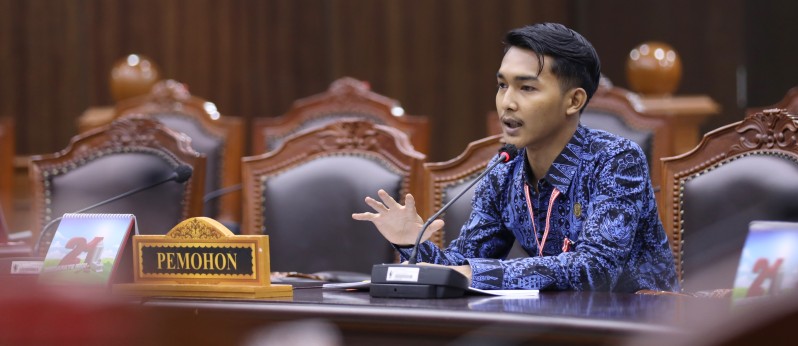
Petitioner Haerul Kusuma explaining the subject matter of his petition during the preliminary judicial review hearing of Advocate Law, Wednesday (21/8/2024). Photo by MKRI/Ifa
Jakarta, MKRI—The Constitutional Court held a preliminary judicial review hearing on Wednesday, August 21, 2024, of Law No. 18 of 2003 on Advocate (Advocate Law) against the 1945 Constitution. The petition registered under case No. 106/PUUXXII/2024 was filed by Haerul Kusuma, a university student. Petitioner argued that the provisions under Article 3 paragraph (1) letter g of the Advocate Law, which requires an internship for at least 2 consecutive years in an advocate’s office, has the potential to harm their constitutional rights factually or potentially.
On the hearing, Haerul argued that the internship requirement aimed to give practical experience in supporting the capacity, skills, and ethics of advocate candidates must not be limited to a formal internship only. The Petitioner also opined that practical experience can be acquired from working at the advocate’s office, both when they are still law students and after they graduate.
“Advocate candidates who have practical experience that supports their capability, skills, and ethics to exercise their profession,” Haerul said.
Haerul further mentioned that the provision creates vagueness and legal uncertainty because it limits practical experience solely based on the internship period without considering other relevant experiences. Therefore, the Petitioner felt that their rights for convenience and special treatment in getting equal opportunities to achieve equality and justice have been significantly harmed – especially in terms of practical experience needed to support capacity and skills since becoming law students.
“There is no limit on whether the internship is done when they are students or after graduating from law school. In this case, there is no clarity regarding the period. In fact, the Petitioner also has experience working at the advocate’s office when he was a student. Of course, in this case, the Petitioner questions whether when the Petitioner has undertaken an internship and working cannot be included when registering as an advocate. Because the provision does not explain the period,” Haerul emphasized.
For that reason, the Petitioner asked the Court to declare that Article 3 paragraph (1) letter g of Advocate Law, which requires an internship for at least 2 consecutive years at the advocate’s office, is conditionally contradictory to the 1945 Constitution and not legally binding unless interpreted as working experience or internship for 2 years at advocate’s office starting from becoming a law student in bachelor's degree at the fourth semester or before appointed as an advocate.
In addition, the Petitioner also requested that Article 26 paragraph (1) of the Advocate Law, which regulates the ethic codes of advocate organizations, be interpreted to mean that the Advocates Organization Honor Council would draft the code. So does Article 27 paragraph (1) of Advocate Law, which must be interpreted that the People’s Representative Council (DPR), with the approval of the President, to establish a single and independent Advocates Organization Honor Council. Moreover, Article 29 paragraph (1) of the Advocate Law must be interpreted that the determination and enforcement of ethic codes is carried out by the Honor Council. The Petitioner also asked that DPR and the President immediately establish a single and independent Advocates Organization Honor Council and amend the Advocate Law within 1 year and 5 months from the date of the Court’s decision.
Responding to the petition, Justice Enny Nurbaningsih advised that the Petitioner strengthen his legal standing by explaining clearly the relationship between the loss suffered and the enactment of the law.
“First, the qualification must be clear. Mentioning the status as a student of university student is not necessary; instead, focus on [your] position as a legal consultant who is registering in PKPA. There, you have to explain the harm; it currently seems infactual, except you have registered then disadvantaged,” Justice Enny added.
Before closing the hearing, the Justices’ panel said that Petitioners have 14 days to revise their petitions. Meanwhile, the deadline for the revision submission is Tuesday, September 3, 2024, at 1 p.m.
Author: Utami Argawati
Editor: Lulu Anjarsari P.
PR: Fauzan Febriyan
Translator: Rizky Kurnia Chaesario (NL)
Disclaimer: The original version of the news is in Indonesian. In case of any differences between the English and the Indonesian versions, the Indonesian version will prevail.
Wednesday, August 21, 2024 | 16:15 WIB 192