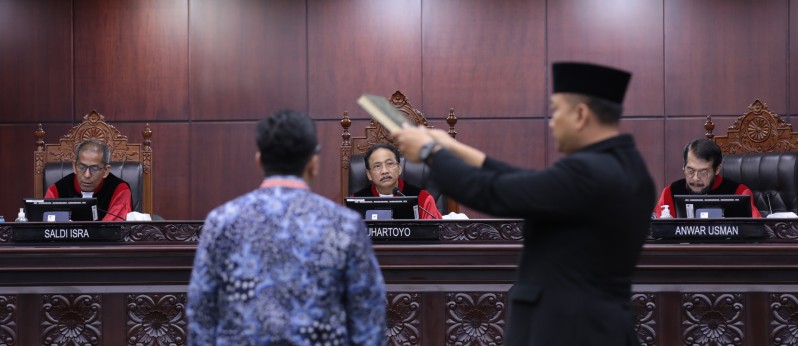
The Relevant Party’s expert taking an oath at a judicial review hearing of the Law on the Management of Coastal Zone and Small Islands, Tuesday (12/5/2023). Photo by MKRI/Ifa.
JAKARTA (MKRI) — Mining activities are significantly different from agriculture, which the community has mastered for generations. Mining necessitate new knowledge and abilities, as well as physical power that is distinct from that needed for agriculture. As a result, it is not surprising that many members of the community lost their jobs when their agricultural land was transformed into a mining area. This, of course, has shattered the lives of people who have lost their livelihoods due to loss of land and crops.
This was conveyed by Rilus A. Kinseng, professor of rural sociology at IPB University Bogor as an expert for Idrus et al. as Relevant Party, at a material judicial review hearing of Article 23 paragraph (2) and Article 35 letter k of Law No. 1 of 2014 on the Amendment to Law No. 27 of 2007 on the Management of Coastal Zones and Small Islands (Coastal Management/PWP3K Law) on Tuesday, December 5, 2023 in the plenary courtroom.
Social Conflict in Wawonii Island
Rilus explained mining activities in Wowanii island had caused social conflict, which was originally a vertical conflict between the local communities and companies. However, horizontal conflict among members of society also occurred, including between those supporting and rejecting the mining activities. Mining by PT Gema Kreasi Perdana (PT GKP) have divided the local community. Divided community groups are not only limited to “quasi groups”, but have become “conflict groups” (Dahrendorf, 1958 and Wallace and Wolf, 2006).
“PT GKP’s mining activities on Wawonii Island do not meet the conditions stated in [Article 35] letter k [of the PWP3K Law]. Mining activities on Wawonii Island by PT GKP have clearly harmed the surrounding community in terms of social, economic, and environmental/ecological factors. In addition to disturbing and even ruining some residents’ livelihoods, these mining activities have harmed the local community’s harmony and social cohesiveness,” he said.
Rilus emphasized that the conditions stated in Article 53 letter k of the PWP3K Law are in line with the latest developments related to any development activities, including mining activities. Therefore, they must be maintained, not revoked.
Discrimination and Marginalization
The repeal of Article 35 letter k and Article 23 paragraph (2) of the PWP3K Law, according to Rilus, could potentially promote prejudice against and marginalization of coastal and small islands communities in development activities, as has frequently occurred in the past. Indeed, Rilus has repeatedly said that coastal communities, particularly indigenous peoples and traditional communities, are still in a vulnerable position and are frequently evicted, implying that affirmative policies are required.
He also explained that coastal and small islands communities often experience marginalization due to loss of control and access to natural resources, both as a place of work/business and as a place of settlement. They really need protection.
“One of the instruments that can protect them is Article 35 letter k and Article 23 paragraph (2) of the PWP3K Law. Both of the articles are not contrary to any articles in the 1945 Constitution. On the contrary, the cancellation of these two articles would open up opportunities for discrimination, marginalization, and even oppression of residents of coastal and small islands communities, especially by parties with great power, such as the authorities and entrepreneurs. Therefore, these two articles must be retained,” Rilus stressed.
Also read:
Provisions on Ban on Mineral Mining in Coasts and Isles Challenged
PT Gema Kreasi Perdana Revises Petition on Mineral Mining in Coasts and Isles
Meanwhile, the House through Commission XI member Wihadi Wiyanto conveyed that coastal areas and small islands are part of the state’s territory that must be conserved. To protect resources and natural systems therein, the state must govern those areas. The industrialization of those areas frequently marginalizes the local population, necessitating equitable control.
Also read:
Provisions on Management of Small Islands Serve to Protect and Conserve
Customary Community’s Rights in Coastal and Small Island Areas
Firmer Interpretation
Meanwhile, Charles Simabura, another expert for the Relevant Party, explained that Article 35 letter k has caused regulatory inconsistencies with Article 23, so it is appropriate that the a quo article be interpreted as unconstitutional because it makes way for the use of small islands for other activities, in this case mineral mining.
“To fulfill legal certainty, philosophical, sociological foundations, objectives and principles of the a quo law, Article 35 letter k must be interpreted more strictly by eliminating the word ‘if’ and the next article. Thus, in the exploitation of coastal areas and small islands, every person is directly or indirectly prohibited from conducting mineral mining,” Simabura stressed.
Also read:
Govt Has Good Control over Small-Island Mining
Legal Politics of Coastal and Small Islands Management
The case No. 35/PUU-XXI/2023 on the judicial review of Article 23 paragraph (2) and Article 35 letter k of the PWP3K Law was filed by PT Gema Kreasi Perdana, represented by executive director Rasnius Pasaribu. The Petitioner is a limited liability company (PT) with a mining business permit for small islands. It feels its constitutional rights had been violated by the enactment of Article 23 paragraph (2) and Article 35 letter k of the Coastal Management Law, which the Supreme Court interpreted as an unconditional ban on mining activities in small islands, while the Petitioner has a valid permit by the mining authority to mine nickel in the area. Its permit has undergone changes from the initial permit No. 26 of 2007, issued prior to the enactment of Law No. 27 of 2007.
The Petitioner asserted that if Article 23 paragraph (2) and Article 35 letter k of Law No. 1 of 2014 be interpreted as an unconditional ban on mining activities, all spatial planning for coastal zones and small islands regulated in regional regulations would conflict with the a quo Law and must be revised. As a consequence, all activities by mining companies in those areas must be ceased. This would be detrimental to those companies, including the Petitioner, who had paid their dues to the state.
Author : Utami Argawati
Editor : Nur R.
PR : Tiara Agustina
Translator : Nyi Mas Laras Nur Inten Kemalasari/Yuniar Widiastuti (NL)
Disclaimer: The original version of the news is in Indonesian. In case of any differences between the English and the Indonesian versions, the Indonesian version will prevail.
Tuesday, December 05, 2023 | 15:15 WIB 476