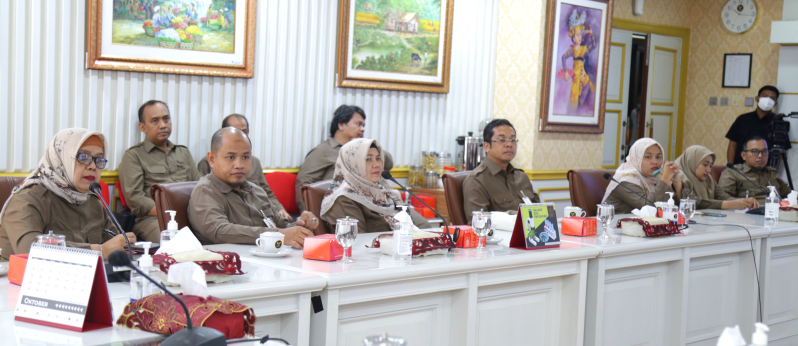
The MPR’s Library visiting the Court to benchmark its library management, Tuesday (10/10/2023). Photo by MKRI/Fauzan.
JAKARTA (MKRI) — For the development and preparation of accreditation, the Library of the People’s Consultative Assembly (MPR) visited the Constitutional Court’s (MK) Library for benchmarking on Tuesday, October 10, 2023 at the meeting room on the 11th floor of the Court’s main building. They were welcomed by library coordinator Hanindyo.
The MPR Library delegation consisted of associate librarian Yusniar along with 10 other librarians. The purpose of the visit was to find out the Court’s Library’s work programs and budgeting, as well as its methods and strategies in preparing for library accreditation.
“Today we visit the [Court’s Library] to see its work programs and budgeting, and its strategies for library accreditation and to procure both physical and digital books. The MPR’s Library has not been accredited,” Yusniar said when opening the discussion.
In his presentation, the Court’s library coordinator Hanindyo explained the library’s importance for supporting the constitutional justices by providing references for the sake of quality rulings. He said that the Court’s Library is the pride of the Court because it often serves a reference for the development of libraries in other institutions.
Hanindyo stated that the Court’s Library always receives visits from those visiting the Court, even elementary and kindergarten students. He further explained this was the Library’s dream. “Since the Library was built, it has had a dream to become the library with most complete collection of legal literature,” he said.
He added that the Court has a Constitution History Center on the 5th and 6th floors of the Court’s main building. It was the result of the Court’s cooperation with the National Library and the National Archives (ANRI) that displays a collection of documents showing the history of the Constitutional Court and the Constitution of the Republic of Indonesia.
In line with the Constitutional Court’s vision to uphold the Constitution as a modern and reliable judicial institution, the Court’s Library also has a vision to become the most complete and modern legal reference center. It also has a mission to provide library services based on information and communication technology, provide information and reference materials on law and the Constitution, and to provide references for resolving constitutional cases.
“The main duty of the Court’s Library is to assist the constitutional justices in producing quality decisions. The Library’s task is preparing plans for library publication activities. For publication, we often collaborate with other institutions, and publication activities have an impact on the budget which must be allocated in advance,” Hanindyo added.
Kampus Merdeka
Hanindyo also revealed the Library’s achievement as an institutional library that not only carries a collection of 22 thousand physical books and 420 e-books but has also become a Kampus Merdeka (Independent Campus) for students of library science and law programs. Recently, the Court and the State Islamic University of Jakarta (UIN Jakarta) had a collaborative lecture that involved the Court’s librarians.
“This year [the Court’s Library] started Merdeka Belajar (Independent Learning) in response to a request from UIN Jakarta, where we participated in a lesson for one semester, which ended last August 2023. Our librarians also became lecturers to the students. We have all of the learning materials they needed, including materials for managing the library, processing books until they are ready for use, promoting and maintaining the library. All can be practiced. We were not only involved with the Merdeka Belajar program, but also guide interns and also guide students preparing for their final project,” Hanindyo added.
Important Steps for Library Accreditation
In addition, Hanindyo also explained the important things to meet accreditation, such as library management and organization, maintenance of spatial layout, collection development, facilities and infrastructure development, development of library personnel, and library cooperation.
“The most important aspect is managing information and library materials to developing collection, maintenance and development of libraries and facilities institutionally. In addition, the development of library personnel aims to increase the competence of human resources and involvement in activities in the librarian professional association as well as participation in education and training, workshops, and seminars,” he said.
Author : Fauzan F.
Editor : Lulu Anjarsari P.
Translator : Najwa Afifah Lukman/Yuniar Widiastuti (NL)
Disclaimer: The original version of the news is in Indonesian. In case of any differences between the English and the Indonesian versions, the Indonesian version will prevail.
Tuesday, October 10, 2023 | 15:32 WIB 299