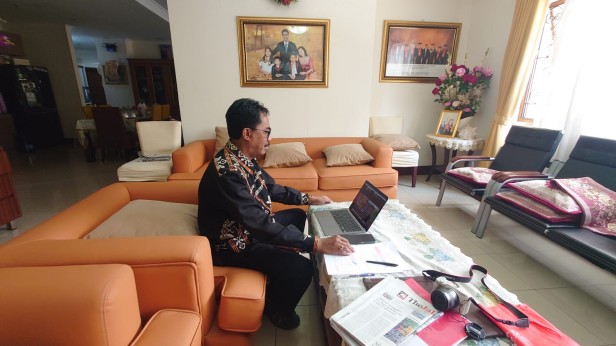
Constitutional Justice Daniel Yusmic P. Foekh speaking virtually at a training for professional advocates in collaboration between West Jakarta Peradi and Al-Azhar University Indonesia, Sunday (9/3/2023). Photo by MKRI.
JAKARTA (MKRI) — Constitutional Justice Daniel Yusmic P. Foekh delivered a presentation on “The Constitutional Court’s Procedural Laws” online at a training for professional advocates (PKPA) Batch II in collaboration the West Jakarta branch executive board (DPC) of the Association of Indonesian Advocates (Peradi) and Al-Azhar University Indonesia on Sunday, September 3, 2023.
He said that before the amendment to the 1945 Constitution, the peak of judicial power in Indonesia used to be hold by the Supreme Court (MA). However, after the amendment, the Constitutional Court (MK) emerged, with a position equal to the Supreme Court as a judicial institution in Indonesia.
The authority of the Constitutional Court is embodied in Article 24 paragraph (2) of the 1945 Constitution. Then it is further regulated by Constitutional Court regulations (PMK). The authority of the Constitutional Court is to review laws against the 1945 Constitution, decide disputes between state institutions, decide the dissolution of political parties, and decide general election disputes. Moreover, in its development, the Constitutional Court also gained additional authority to resolve disputes over regional head election results and to examine government regulations in lieu of laws (perppu).
Furthermore, Justice Foekh explained the general aspects of the Constitutional Court’s procedural law, including the petition, evidence, hearings, and decisions. The petition is submitted in writing in the Indonesian language with several requirements. Filing a petition is free of charge. The evidence could be letter or text, witness testimony, expert testimony, testimony of litigating party, and other pieces of evidence that may be stored electronically. The proceedings consist of a panel preliminary hearing, a panel petition revision hearing, followed by plenary examination hearings with all nine justices or at least seven justices.
“If there are only six justices, the plenary hearing cannot be held,” he said.
He also emphasized that there are no legal remedies after the Court has handed down its ruling and that its decisions have permanent legal force since their pronouncement at a plenary hearing that is open to the public, pursuant to Article 47 of the Constitutional Court Law. The litigants can even read the decision on the Court’s website fifteen minutes after it is pronounced.
The Court can review both laws and government regulations in lieu of laws (perppu) formall and/or materially. A formal judicial review should be filed within 45 days after the law or perppu is promulgated in the State Gazette and the Court should decide it within 60 workdays since the case is registered. Meanwhile, material judicial review concerns the content of articles, paragraphs, or part of laws or perppu that is deemed in conflict with the 1945 Constitution.
Justice Foekh also said the term “petition”, not “lawsuit,” is used for the judicial review cases in the Constitutional Court because it concerns public interests and not relates to contentious interests. As such, the House of Representatives (DPR) the Government, and the DPD (Regional Representatives Council) are not the petitioner’s adversaries but are informants who give testimonies on the norms being petitioned.
During the Q&A session, a participant called Steven asked about the current chief justice who is related to the president. “How do the constitutional justices and the Constitutional Court ensure that the Court remains independent as mandated by the 1945 Constitution? Also, should there be an amendment to the selection or appointment of constitutional justices to avoid such conflict of interest?” he asked.
In response, Justice Foekh said the Constitutional Court has a code of ethics for its justices, which stipulates that the justices are not only responsible for themselves but also to God. Moreover, the Court’s decisions start with the phrase “For justice based on the One Supreme God.” “Before being sworn in, justices must maintain their independence. The concern is actually unnecessary because indeed the constitutional justices maintain their independence. Besides, the accountability of the decisions is in the legal considerations,” he said. (*)
Author : Utami Argawati
Editor : Lulu Anjarsari P.
Translator : Tahlitha Laela/Yuniar Widiastuti (NL)
Disclaimer: The original version of the news is in Indonesian. In case of any differences between the English and the Indonesian versions, the Indonesian version will prevail.
Monday, September 04, 2023 | 09:30 WIB 162