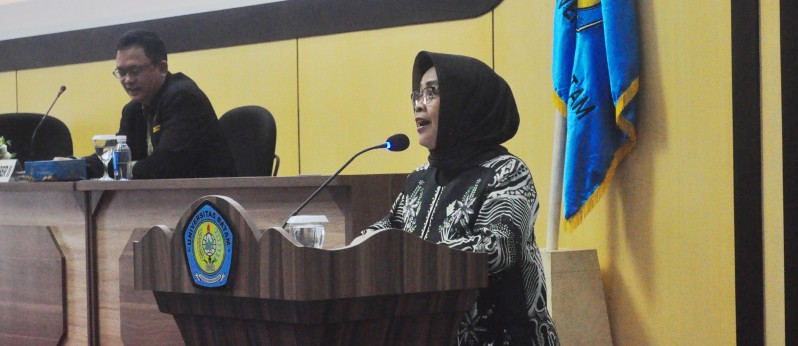
Constitutional Justice Enny Nurbaningsih speaking at a national seminar organized by the Constitutional Court (MK) in collaboration with the Law Faculty of the University of Batam (Uniba), Friday (8/4/2023) in Batam, Riau Islands. Photo by MKRI.
BATAM (MKRI) — The 2024 simultaneous election cannot be separated from the Constitutional Court (MK) Decision No. 55/PUU-XVII/2019, handed down on February 26, 2020 and reaffirmed in Decision No. 67/PUU-XIX/2021, which concerns the alternative designs for simultaneous elections. For 2024, based on the Election Law and the Pilkada Law, the election is to be carried out simultaneously in two stages. First, an election on February 14, 2024 to select members of the House of Representatives (DPR), Regional Representatives Council (DPD), and Regional Legislative Council (DPRD), as well as the president and vice president. The next will be held on November 27, 2024.
This statement was made by Constitutional Justice Enny Nurbaningsih in her presentation at a national seminar on “Simultaneous Elections of 2024 and the Settlement of Disputes over Election Results by the Constitutional Court,” which the Court held in collaboration with the Law Faculty of the University of Batam (Uniba) on Friday, August 4, 2023 in Batam, Riau Islands Province. Uniba Law Faculty dean Fadlan and Uniba rector Yuliansyah, as well as supervisor of Yayasan Griya Husada Batam Indrayani were in attendance.
“These dates are fixed and if they were shifted, it would shift the system. Hopefully there will be no changes because the risks would be great, starting from the early stages to election certification. Any shifts would be very troublesome. This designed has been determined by the Constitutional Court and the simultaneity has been planned,” Justice Enny explained before the head of the Riau Islands Ombudsman Lagat Parroha Patar Siadari.
She also said that the authority of institutions that resolve violations had been divided. Violations relating to the administration and election process are resolved by the KPU (General Elections Commission) and Bawaslu (Elections Supervisory Body); state administrative disputes are resolved by the State Administrative Court (PTUN); criminal violations are resolved by the Integrated Law Enforcement (Gakkumdu); while violations of the election organizer's code of ethics are resolved by Election Organizer Ethics Council (DKPP). Lastly, disputes over the results of the election are resolved by the Constitutional Court.
“So, the Constitutional Court resolves disputes over election results that have been determined by the KPU nationally, where numbers are questioned by election participants. For example, in the event of proven election fraud, supervision that does not go well, where else to go to fight for constitutional rights? To the Constitutional Court. Therefore, in the event of any issue that affects the election results, the Court will not hesitate to disqualify candidates, order a recount of the ballots, and even order a re-vote, and this has been done many times. The Court must resolve these issues as the guardian of the Constitution,” Justice Enny explained alongside moderator Cristiani Prasetiasari, head of Uniba’s Law Study Program, from the Rumengan Hall in Uniba’s building.
Next, Justice Enny explained several things related to the legal basis for PHPU hearings; the time for filing a petition and resolving disputes; the stages of filing a petition; case hearings; the ruling of the Constitutional Court; and the legal consequences of the Court’s decisions, including deciding the correct vote recapitulation, ordering a recount, ordering a re-vote, and disqualifying candidates.
Author : Sri Pujianti
Editor : Lulu Anjarsari P.
Translator : Tahlitha Laela/Yuniar Widiastuti (NL)
Disclaimer: The original version of the news is in Indonesian. In case of any differences between the English and the Indonesian versions, the Indonesian version will prevail.
Friday, August 04, 2023 | 15:13 WIB 136