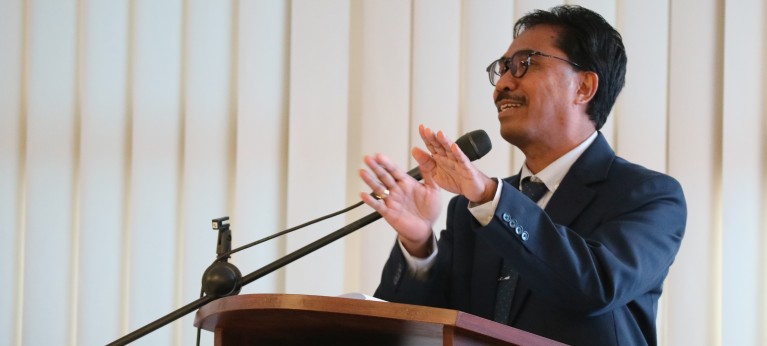
Constitutional Justice Daniel Yusmic P. Foekh speaking at an academic discussion at the Law Faculty of Maranatha Christian University of Bandung, Friday (7/28/2023). Photo by MKRI/Hendy P. Wiguna.
JAKARTA (MKRI) — Constitutional Justice Daniel Yusmic P. Foekh appealed to students of the Law Faculty of Maranatha Christian University of Bandung to have a discussion about the Constitutional Court’s (MK) authority of the judicial review of government regulations in lieu of laws (perppu), which is regulated in Article 22 of the 1945 Constitution and the concept of state of emergency in constitutional law.
Perppu is a law stipulated by the president in the event of a compelling urgency. It is a type of law in Indonesia mentioned in Article 7 of Law No. 12 of 2011 on Lawmaking. However, Justice Foekh said, in practice, the perppu has not always been issued during an emergency.
Usually, he continued, in ordinary circumstances, the DPR (House of Representative) participates as a party that expresses approval of a bill of law and not on the ratification. Meanwhile, Article 12 of the 1945 Constitution juxtaposes the state of emergency, while Article 22 states “in case of compelling urgency” as a counterpart to the issuance of Perppu by the President.
“If you look at the concept of emergency constitutional law, perppu can be simplified to be born with conditions including the highest interests of the state, that is, the existence of the state itself; the regulation must be absolute or very necessary; it is temporary as long as there is still an emergency; and after that common rules are needed and the emergency regulation no longer applies; and when the emergency regulation is issued, the House cannot hold a session or meeting, or be in a recess,” explained Daniel.
Then to help the students understanding his explanation, Justice Foekh explained the comparison of regulations similar to perppu in Indonesia and the principles of legislation according to experts. He said perppu should be equated with emergency laws, during which it is part of the law so it must be carried out the same way ordinary laws are.
“So the formal and material principles as mentioned in Article 12 of the Lawmaking Law need to be studied more comprehensively. Quoting Hans Kelsen who categorized norms, including the perppu, and in my dissertation, I stated that there is a cluster of regulations and a cluster of emergency regulations (perppu included) as referred to in Soepomo’s concept because its contents are contrary to the Constitution,” he said before Rev. Hariman Andrey Pattianakotta (pastor at UK Maranatha) and Pan Lindawaty Suherman Sewu, one of the lecturers at UK Maranatha’s Law Faculty.
After providing a basic understanding of perppu and the Constitutional Court’s authority to review it, Justice Foekh also invited the participants of to discuss legal concepts related to perppu that could develop and have an impact on the legal life of the community. A question from student by the name of Salsabila was, “If perppu is not included in the hierarchy of laws and regulations, then can the Constitutional Court review it against the 1945 Constitution?”
Justice Foekh responded to this question by saying that perppu belongs to emergency laws because its nature is temporary so it does not need to be enforced for a long period and does not need to be judicially reviewed. Meanwhile, in relation to the Constitutional Court’s authority to review perppu, it can be done as long as the president declares the country in a state of emergency or danger.
Friday, July 28, 2023 | 22:55 WIB 1936