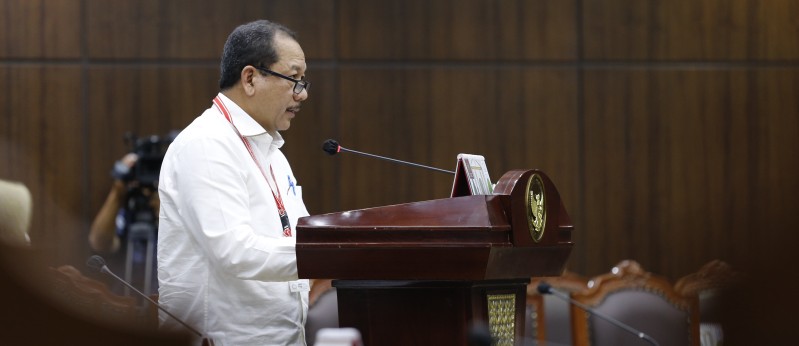
Deputy Attorney General for Development Bambang Soegeng Rukmono testifying at the judicial review hearing of Law No. 16 of 2004 on Prosecution, Tuesday (6/20/2023). Photo by Humas MK/Ifa.
JAKARTA (MKRI) — The attorney general (AG), who has a central, strategic role in solving complex legal issues, so a law degree is not enough for the position. Technical, managerial, organizational, and case handling abilities are required by prosecutors in the Prosecution Office in the Republic of Indonesia.
This statement was made by Deputy Attorney General for Development from the Attorney General’s Office (AGO) Bambang Soegeng Rukmono at the sixth hearing for the material judicial review of Article 1 point 3, Article 19 paragraph (2), Article 20, and Article 21 of Law No. 16 of 2004 on the Prosecution on Tuesday, June 20, 2023. The case No. 30/PUU-XXI/2023 was filed by Jovi Andrea Bachtiar, a prosecution analyst and prospective prosecutor at the Tojo Una-Una Prosecution Office, Central Sulawesi Province.
In more detail, Bambang said the Petitioner’s wish that the AG be appointed in a closed system where only active or retired principal prosecutors can enter would be against the political wish of the legislatures. Articles 20 and 21 of the Prosecution Law regulates an open system and provides an opportunity for everyone to become the AG.
Concurrent Positions Allowed
Representing the AGO, Bambang also said that the AG may concurrently serve as a member of a political party. He referred to the AG conference in Seoul, South Korea, where 25 countries attended, which produced criteria for an independent and professional AG. As such, anyone including members of political parties can apply to become the AG in 1990. These criteria are also regulated in Article 20 letters b, c, d, and f of the Prosecution Law by making the president in charge of selecting the AG.
“In relation to the Petitioner’s concern that the Attorney General from a political party could intervene with prosecutors in carrying out their duties and authorities, the AGO is of the opinion that this has absolutely no basis in concrete legal regulations. The independence of prosecutors in carrying out their duties is not related to whether the Attorney General is from a political party. This is because the Prosecution Law has given independence and legal protection to prosecutors in carrying out their duties,” he explained at the plenary hearing chaired by Chief Justice Anwar Usman from the plenary courtroom.
Regarding the Petitioner’s request for Article 21 of the Prosecution Law to prohibit concurrent positions for the AG in political party, Bambang explained that the Prosecution Law provides independence and legal protection for prosecutors in carrying out their duties, as well as Article 2 paragraph (1), Article 8 paragraph (2), Article 8 paragraph (4), elucidation to Article 8 paragraph (5), and Article 34A of the Prosecution Law. These various norms, he added, are legal instruments that protect prosecutors in carrying out the duties and authority granted by the AG. Thus, the prosecutor profession has been equipped with a series of regulations that guarantee the prosecutors’ independence in carrying out their duties and authority.
Appointment of Attorney General
Furthermore, the AGO believes the appointment of the AG without going a fit and proper test by the House of Representatives (DPR), which is part of checks and balances, not unconstitutional. It is the prerogative of the president, who holds government power based on law. The AG’s position within the executive power is a manifestation of the need for synergy of vision and mission set by the president and vice president throughout their term of office. The uniformity of vision and mission in legal policies and other policies set by members of the cabinet makes it easier for the president to realize the vision and mission that has been set for one term, for the public interest and national development.
“[In] the current legislation, the appointment of the Attorney General does not go require the House’s approval, which does not prevent the House from supervising the Attorney General as the head of the Prosecution Office. The implementation of checks and balances by the House on the Prosecution Office is carried out in mechanism for conducting hearings (RDP) and working visits to the Prosecution Office work units,” Bambang said.
Prosecution’s Challenge
Responding to the AGO’s statement, Deputy Chief Justice Saldi Isra asked several questions on the appointment of the retired AG. He asked whether the last 3 terms of the AG had represented the Prosecution Office, given that the AG once occupied the highest position in the Prosecution Office, retired then was active in various other fields, then was called again by the Prosecution Office.
“There is a movement in the Prosecution [that wishes that] the AG is [appointed] from within, although it is not generally accepted because the AG’s position is different because there is a sense of filling part of the cabinet. So, what are the Prosecution’s difficulties if the AG is not from among public prosecutors? What problems are faced by the Prosecution in carrying out independence in law enforcement if the AG is not from within?” Justice Saldi asked.
Meanwhile, Constitutional Justice Suhartoyo questioned the Petitioner’s position as a prospective prosecutor who is currently a prosecution analyst. He also asked for more detailed information on the AGO’s statement of the AG’s central, strategic role, meaning that the requirement that the AG is not a prosecutor means that it contradicts this rule. In response, Bambang said that an analyst can become the AG as long as they meet the requirements. “We say that a prosecution analyst is a functional position. To become a prosecutor, you must meet certain requirements, including health requirements and education requirements,” he replied. He asked more time to provide additional written statement to answer other questions.
Also read:
Prospective Prosecutor Requests Revision of Definition of Public Prosecutor
House: Attorney General Responsible to President
At the preliminary hearing, the Petitioner requested that the Court provide a constitutional interpretation to revise the definition of public prosecutor in Article 1 point 3 of the Prosecution Law to also include the Attorney General aside from civil servant (PNS) prosecutors as the Attorney General is a retired prosecutor who is no longer a civil servant. Therefore, the a quo norm would not be in violation of Article 18 paragraph (1) of the Prosecution Law. He also requested that the Court provide interpretation of the appointment of the Attorney General that is without a fit and proper test by the House of Representatives (DPR), which is a form of checks and balances. This, he asserted, could jeopardize the Attorney General’s Office’s independence as a law enforcement institution.
The Petitioner alleges that Article 20 of the Prosecution Law had allowed anyone who had not had any experience as a prosecutor to become an Attorney General. He revealed that he had worked very hard to build a career as a prosecution analyst for 1-2 years and participated in prosecutor education and training (PPPJ) for months so that he could become a prosecutor. He argued that the norm was in violation of Article 27 paragraph (1), Article 28D paragraph (1), and Article 28H paragraph (2) of the 1945 Constitution.
Author : Sri Pujianti
Editor : Lulu Anjarsari P.
PR : Fitri Yuliana
Translator : Yuniar Widiastuti (NL)
Disclaimer: The original version of the news is in Indonesian. In case of any differences between the English and the Indonesian versions, the Indonesian version will prevail.
Tuesday, June 20, 2023 | 15:58 WIB 522