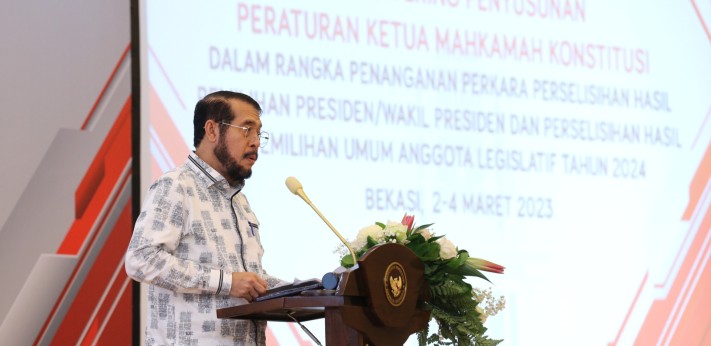
Chief Justice Anwar Usman giving his opening remarks at a meeting for drafting new chief justice regulations, Thursday (3/2/2023) in Bekasi. Photo by MKRI/Ifa.
BEKASI (MKRI) — The Constitutional Court (MK) held a meeting for the drafting of new chief justice regulations (PKMKs) for the resolution of disputes over the results of presidential and legislative election of 2024 on Thursday, March 2, 2023 in Bekasi, West Java Province. Chief Justice Anwar Usman opened the meeting officially.
In his opening remarks, the chief justice said that the Court had anticipated the 2024 Simultaneous Election by listing potential violations, so that when examining election results disputes (PHPU) cases, the taskforce team would find it easier to identify those violations and decide the most appropriate course of action.
He revealed three types of potential violations. First, the distribution of remaining election invitations to ineligible voters. Second, the transfer of votes from one candidate to another of the same or different another party. Third, vote buying, especially among parties who passed the parliamentary threshold.
“We hope that the first type of violation can be settled in stages by Bawaslu (Elections Supervisory Body), Gakkumdu (Integrated Law Enforcement), and DKPP (Election Organizer Ethics Council) in relation to ethics violations by commissioners. If those potential violations can be resolved before the national vote recapitulation, they will not have to be settled by the Constitutional Court,” he said.
The second type of violation has also ended up in the Constitutional Court in the 2009, 2014, and 2019 elections. It could potentially occur in the upcoming election as well.
In order to examine the third type of violation, caution and thoroughness is crucial. Small parties would not lose anything by selling their votes to other parties, but it would impact the region’s votes and the national votes.
Chief Justice Anwar also revealed that the new chief justice regulations would regulate technical matters such as registration, case consultation, case reception, petition revision, reception of evidence and additional evidence, notification to the respondent and relevant parties, summons, placement of litigating parties at the courtroom, etc. “It is important to evaluate and anticipate these technical matters, so they would not be loopholes for those with bad intention. They might not impact the substance of the cases, but negatively impact public perception,” he said.
At the end of his remarks, he said that the drafting of these new regulations could anticipate and optimize the 2024 PHPU. “We do not want the upcoming 2024 PHPU to not be better than that of the previous election. Therefore, contributions by the attendees of this meeting hopefully can elaborate the evaluation of the 2019 election case resolution, which is then put into the PKMKs,” he stressed.
Chief registrar Muhidin also said that during PHPU, the Court must prepare everything thoroughly. “The election will be an important milestone for Indonesia. Therefore, the Constitutional Court, who is authorized to adjudicate PHPU, must do its best to perform its duties,” he emphasized.
Assessment of Court Services
In the first session, state finance auditor III of BPK (Audit Board) Yophi Setiawan talked about the assessment of the performance of court services in the Constitutional Court. He explained that BPK assesses the management and accountability of state finances by the central government, the regional governments, other state agencies, the central bank (Bank Indonesia), SOEs (BUMNs), public service agencies (BLUs), region-owned enterprises (BUMDs), and other agencies that manage state finances. “In assessing the management and accountability of state finances, BPK discusses findings following state financial assessment standards,” he said.
BPK assesses performance using the 3E concept: economy, efficiency, and effectiveness. Economy means minimizing cost of inputs. These inputs must be available on time, in the right quantity and quality, and at economic prices. Efficiency concerns the relationship between the inputs used and the outputs produced with regard to quantity, quality, and time. Efficiency is related to obtaining the most output with certain inputs or producing certain outputs with the least input. Effectiveness concerns the achievement of goals (operational goals, short-term, medium-term, and long-term goals).
PKMK Drafting Guidelines
Meanwhile, middle-rank legislative drafter of the Directorate-General of Legislation of the Law and Human Rights Ministry Rahayu talked about the guidelines for drafting the PKMKs on the 2024 PHPU resolution. The Court issued three PKMKs: PKMK No. 1 of 2020 on the technical guidelines for resolving disputes over the results of the election of governors, regents, and mayors; PKMK No. 1 of 2018 on the technical guidelines for resolving disputes over the results of the election of governors, regents, and mayors; and PKMK No. 1 of 2017 on the submission of official wealth reports of constitutional justices.
Rahayu also gave a piece of advice. “If there has not any secretary-general regulation on the procedure to draft PKMKs (Article 16 paragraph (3) of PMK No. 3 of 2019), since it is a regulation, the drafting of PKMKs can refer to lawmaking guidelines in Appendix II of the Lawmaking Law,” she concluded.
In the next session, Triyono Edy Budhiarto and Ida Ria Tambunan led the preparation of PKMK the draft on the technical guidelines for resolving disputes over the results of the election of DPR, DPD, and DPRD members. The PKMK must formulate the need for examination of the petitioner’s documents and the procedure for petitioners who do not bring those documents. In addition, PMK No. 2 of 2023 regulates the return of list of evidence and evidence when they do not match. There must be a mechanism for returning documents if the list of evidence and evidence do not match. Remote hearings should also be regulated in the PKMKs.
Author : Bayu Wicaksono
Editor : Nur R.
Translator : Yuniar Widiastuti (NL)
Disclaimer: The original version of the news is in Indonesian. In case of any differences between the English and the Indonesian versions, the Indonesian version will prevail.
Thursday, March 02, 2023 | 22:34 WIB 124