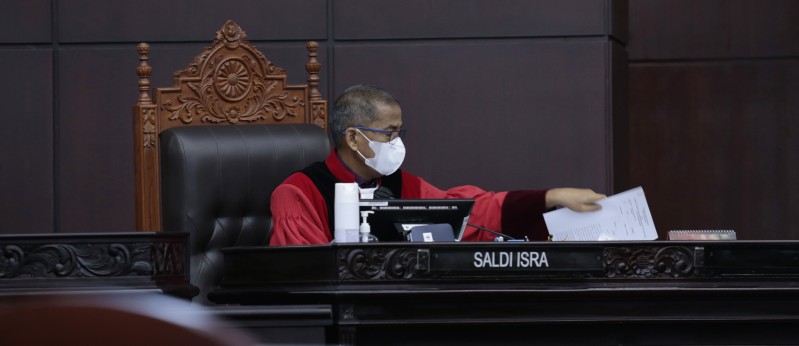
Constitutional Justice Saldi Isra reading out the Court’s legal considerations at the ruling hearing of the judicial review of Law No. 7 of 2020 on the Constitutional Court, Thursday (9/29/2022). Photo by MKRI/Ifa.
Thursday, September 29, 2022 | 13:31 WIB
JAKARTA—The Constitutional Court (MK) dismissed the judicial review petition of Law No. 7 of 2020 on the Third Amendment to Law No. 24 of 2003 on the Constitutional Court filed by Zainal Arifin Hoesein, Fardiaz Muhammad, and Resti Fujianti Paujiah (Petitioners I-III) through Decision No. 72/PUU-XX/2022 at a ruling hearing on Thursday, September 29, 2022 in the plenary courtroom.
Also read: Retirement Age of Chief and Deputy Registrars Questioned
In its legal considerations read out by Constitutional Justice Saldi Isra, the Court asserted that while they correctly detailed that Petitioner I was the Constitutional Court’s chief registrar in 2009-2011 who had to resign at 56 on January 18, 2011, he could not explain his actual, specific, or at least potential constitutional impairment caused by the enactment of Article 7A of the Constitutional Court Law. He could not detail clearly what his losses were.
“Therefore, the causality between the enactment of Article 7A of the Constitutional Court Law and the alleged loss of constitutional rights as enshrined in Article 27 paragraph (1) and Article 28D paragraphs (1), (2), and (3) of the 1945 Constitution was not apparent. As such, Petitioner I did not have legal standing to file the a quo petition. Meanwhile, Petitioner II, who just graduated and is working at a law firm, and Petitioner III, a graduate of the Litigation Institute of Indonesia, both could not explain their constitutional impairment,” Justice Saldi added.
The Court asserted that the Petitioners only expressed their wish to work as state civil apparatus (ASN) of the Constitutional Court’s Registrar’s Office and Petitioner II explained the Court’s swift, transparent, and accountable services, but could not explain its correlation with the enactment of Article 7A of the Constitutional Court Law. Thus, the Court could not find the Petitioners’ direct and indirect constitutional impairment due to the enactment of the a quo law.
“Therefore, the Court is of the opinion that Petitioners I, II, and III did not have the legal standing to file the petition as per Article 51 of the Constitutional Court Law. Considering whereas although the Court had the authority to hear the a quo petition, because the Petitioners did not have the legal standing to file the a quo petition, the Court did not consider their subject matter,” Justice Saldi stressed.
Also read: Former Chief Registrar Revises Petition on Constitutional Court Law
The Petitioners feel their constitutional rights were harmed or will potentially be harmed due to the article being petitioned because Petitioner I was a former chief registrar appointed based on the Presidential Decree No. 143 and so on. Due to the ambiguity of the retirement age for chief registrars in the Constitutional Court as referred to in Article 7 paragraph (1) of Law No. 24 of 2003 in conjunction with Article 7A paragraph (1) of Law No. 8 of 2011, the constitutional rights of Petitioner I were violated.
On September 3, 2010, Petitioner I turned 56, thus must resign and retire from his chief registrar position. Referring to the registrar offices (chief registrar, deputy chief registrar, deputy registrar, and substitute registrar) in courts under the Supreme Court (MA) whose retirement age is clearly stipulated at 60 years for chief registrars, deputy registrars, and substitute registrars in first-instance courts and 62 years for chief registrars, deputy registrars, and substitute registrars in appellate courts, Petitioner I was not supposed to retire or resign from his position as chief registrar of the Constitutional Court.
Petitioners II and III could potentially become state civil apparatus (ASN) of the Constitutional Court’s Registrar’s Office and then build a career as registrars in the Constitutional Court because they were still young. This potential impairment, the Petitioners alleged, could be avoided through the judicial review petition. Therefore, they requested that the article be declared unconstitutional.
Writer : Utami Argawati
Editor : Lulu Anjarsari P.
PR : M. Halim
Translator : Yuniar Widiastuti (NL)
Translation uploaded on 10/14/2022 19:57 WIB
Disclaimer: The original version of the news is in Indonesian. In case of any differences between the English and the Indonesian versions, the Indonesian version will prevail.
Thursday, September 29, 2022 | 13:31 WIB 190