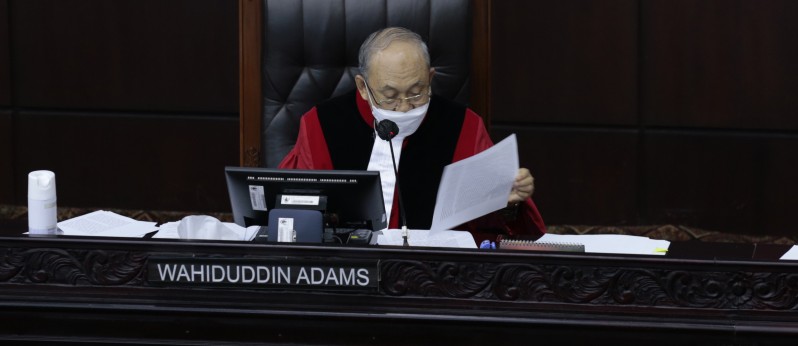
Constitutional Justice Wahiduddin Adams reading out the Court’s legal considerations at the ruling hearing of the judicial review of the Mineral and Coal Mining Law and the Job Creation Law, Thursday (9/29/2022). Photo by MKRI/Ifa.
Thursday, September 29, 2022 | 19:31 WIB
JAKARTA (MKRI)—The Constitutional Court (MK) granted part of the petition No. 37/PUU-XIX/2021 on Law No. 3 of 2020 on the Amendment to Law No. 4 of 2009 on Mineral and Coal Mining (Minerba) as amended by Law No. 11 of 2020 on Job Creation, filed by the Indonesian Forum for Living Environment (WALHI), the East Kalimantan Mining Advocacy Network (JATAM Kaltim), Nurul Aini, and farmer and fisherman Yaman (Petitioners I-IV). The public ruling hearing took place on Thursday, September 29, 2022 both on site and virtually, presided over by Chief Justice Anwar Usman and the other eight constitutional justices.
The Petitioners argued that Article 17A paragraph (2), Article 22A, Article 31A paragraph (2), and Article 172B paragraph (2) of the Minerba Law, which guarantee no change in the use of spaces and areas in mining business permit areas (WIUP), special mining permit areas (WIUPK), or people’s mining areas (WPR), had violated Article 28H paragraph (1), Article 28C paragraph (2), and Article 28D paragraph (1) of the 1945 Constitution. They believed the word “guarantee” gave a false impression that the central and regional governments would not change the use of those spaces.
Also read:
Regional Government’s Role in Mineral and Coal Mining Law Questioned
Petitioners of Mineral and Coal Mining Law and Job Creation Law Revise Petition
Govt Requests Hearing on Mineral and Coal Mining Law and Job Creation Law Be Postponed
House Denies Reduction of Regional Govt Authority on Mining Business
Use of Mining Space and Area
In the legal considerations read out by Constitutional Justice Wahiduddin Adams, the Court asserted that Article 17A paragraph (1) of the Minerba Law emphasizes that the determination of metal mineral and coal WIUP can only be made after it meets the criteria for the use of space and area for mining business activities. Only after that will the central and regional governments ensure that there is no change in the utilization of space and area.
“[The regulation] cannot be separated from the grand design of the National Mineral and Coal Management Plan, which is valid for a period of five years and can be reviewed one time in five years, in which these are considered: the capacity of natural resources and the environment according to basic and thematic geospatial data and information, environmental conservation, regional spatial plan and/or zoning plan, development of science and technology, economic growth rate, priority for the provision of mining commodities, the number and area of 324 WP, availability of mining land, the amount of resources and/or reserves of mineral or coal, and facilities and infrastructure. This management plan is used as a guideline in the implementation of mineral and coal management,” Justice Wahiduddin said.
The Court added that the mining area (WP) issue was part of the national spatial plan, thus cannot be separated from the regional spatial plan and/or zoning plan. In fact, Law No. 26 of 2003 as well as Article 23 paragraphs (3) and (4), Article 26 paragraphs (3) and (4) of Law No. 26 of 2007 determine the period review to be twenty years. This correlated with the National Mineral and Coal Management Plan, in which regional spatial plans and/or zoning plans are necessary. Moreover, No. 26 of 2007 has emphasized that the Regional Spatial Plan be one of the guidelines for national long-term development planning and national medium-term development as well as guidelines for determining the location and function of space for investment.
The Court asserted that the same principle applied to long-term spatial planning for the province and regency/city, which guides regional development planning, including determining the location and function of space for investment. Therefore, in the event that a WP is to be designated as a mining business activity, it cannot be separated from the spatial planning (RTR) as an instrument that regulates the allocation of resources in a space where the spatial arrangement in the RTR is manifested in its designated zones, for example for mining. This has also been confirmed in the National Mineral and Coal Management Plan.
The Court also asserted that with regard to the Petitioners’ question on the constitutionality of Article 172B paragraph (2) of Law No. 3 of 2020, guarantees no change in the use of space and area in WIUP, WIUPK, or WPR whose permits have been granted because they are considered to eliminate the review aspect. periodically as referred to in the Spatial Planning Law and not in line with the fulfillment of the substantive aspect of the right to a good and healthy environment, the article was not supposed to be read independently, but was an inseparable part of paragraph (1), which determines that WIUP, WIUPK, or WPR which permission has been granted in the form of IUP, IUPK, or IPR must be delineated in accordance with the use of space and area for mining business activities in accordance with the provisions of laws and regulations.
Therefore, it is impossible for the central and regional governments to guarantee that there will be no change if the requirements in paragraph (1) have not been fulfilled. Moreover, the normative provision of Article 172B of Law No. 3 of 2020 is part of the “Transitional Provisions” that affirms the status and position of permit holders in the form of IUP, IUPK, or IPR after the enactment of the a quo Law. This is because the a quo Law amended Law No. 4 of 2009 on mining business permits, including changes to processes, procedures, activities, obligations, period of time for IUP, IUPK, or IPR holders. The adjustment was to ensure legal certainty, provide legal protection for parties affected by the changes, and regulate transitional or temporary matters [vide point 127 of Appendix II of Law No. 12 of 2011], then Article 172B was intended to carry out the function of said transitional provisions.
Before Law No. 3 of 2020 was enacted, there were already areas that had obtained mining permits in the form of IUP, IUPK, or IPR. In the context of adjusting to Law No. 3 of 2020, mining business activities that have obtained previous permits in the form of IUP, IUPK, or IPR must be delineated according to the use of space and area, because there is a possibility, for example, that the permits have been expanded or reduced so that it is no longer suitable for the use of space and area. Based on Article 172B paragraph (1) of the Minerba Law, this is done in accordance with the provisions of the legislation. The Minerba Law does not state the provisions, but by observing the essence of mining business permits, the provisions referred to include statutory regulations relating to spatial planning.
The Petitioners feared that the area would continue to be used for mining while the environment could no longer able to accommodate it. In this regard, it is important to understand that only space use for an activity that has a permit can be accommodated in the RTR zoning. The permit can only be issued if it has met specified requirements and the potential impacts have been anticipated. This is in line with the legal doctrine of licensing that permits are preventive as well as repressive juridical instruments that function as control, so they can only be issued if all the specified requirements have been met. Therefore, activities that already have permits need to be guaranteed by the RTR through appropriate zoning.
If the activity that already has the permit disrupts the environmental and social balance in the future, there must be a mechanism for evaluating the permit without evaluating the RTR zoning. This is because the RTR zoning has taken into account various factors including needs, capacity, space suitability, and stakeholder aspirations. The Court understood the Petitioners’ wish for a review or re-evaluation of the RTR and the development needs and space utilization because WIUP, WIUPK, and WPR are basically areas to accommodate mining activities that have obtained permits, which constitute part of the WP, which is part of the national spatial layout. As such the RTR can be reviewed in accordance with statutory laws and regulations.
If the results of the review recommend a revision of the RTR where any of the 329 mining activities with permit must be reviewed, the permit can be revoked if it is proven that there is an error on the part of the licensee, in accordance with the provisions of the legislation, and the zone in the RTR can be adjusted to a new permit. Law No. 3 of 2020 regulates administrative penalties on IUP, IUPK, or IPR holders in the event of violation.
Thus, the provisions on the guarantee of the use of space and area in Article 17A paragraph (2), Article 22A, Article 31A paragraph (2), and Article 172B paragraph (2) of the Minerba Law can only be carried out if they do not conflict with laws and regulations, including those on spatial planning. Although permit has been issued and all processes and procedures have been passed, to provide certainty for the central government and governments in providing the guarantee of no change in the use of space and areas that have been granted permits, evaluation can be done to ensure the implementation does not conflict with laws and regulations.
Therefore, Justice Wahiduddin added, in order not to cause constitutional issue in the implementation of Article 17A paragraph (2), Article 22A, Article 31A paragraph (2), and Article 172B paragraph (2) of the Minerba Law, the Court deemed it necessary to emphasize in the verdict the necessity of not violating laws and regulations in ensuring the use of space and areas so that this provides clarity relating to the word “guarantee.” The Court is of the opinion that the petition on the unconstitutionality of Article 17A paragraph (2), Article 22A, Article 31A paragraph (2), and Article 172B paragraph (2) of the Minerba Law was legally grounded in part. That is, Article 17A paragraph (2), Article 22A, Article 31A paragraph (2), and Article 172B paragraph (2) of the Minerba Law were contrary unconstitutional if not interpreted “as long as it does not conflict with the provisions of the legislation.”
Also read:
Govt: Mineral and Coal Mining Law Amended to Rehabilitate Mining Sector
Expert: Mineral and Coal Mining Law Criminalizes Human Rights Activists
Expert: Mining Control by Central Govt a Setback
Verdict
In Decision No. 37/PUU-XIX/2021, the Court ruled Article17A paragraph (2) of the Minerba Law unconstitutional as long as it is not interpreted “The central and regional governments guarantee that there is no change in the use of space and area as referred to in paragraph (1) in the metal mineral and coal WIUP as long as they do not conflict with the legislation”; Article 22A of the Minerba Law unconstitutional as long as it is not interpreted “The central and regional governments guarantee that there is no change in the use of space and area in the WPR as long as it does not conflict with the legislation”; Article 31A paragraph (2) of the Minerba Law unconstitutional as long as it is not interpreted “The central and regional governments guarantee that there is no change in the use of space and area in the WIUPK as referred to in paragraph (1) as long as it does not conflict with the legislation”; Article 172B paragraph (2) of the Minerba Law is contrary to the 1945 Constitution and has no binding legal force, as long as it does not mean “The central and regional governments guarantee that there is no change in the use of space and area as referred to in paragraph (1) in WIUP, WIUPK, or WPR whose permit has been granted as long as it does not conflict with the legislation.”
Also read:
Witnesses Explain Impacts of Loss of Regional Govt’s Authority in Mineral and Coal Mining Law
Public Participation Accessible in Mineral and Coal Mining Authority
Govt Presents Experts and Witness at Hearing on Mineral and Coal Mining Law
Putu Gde Ariastita: Spatial Plans Can Be Revisited
The Petitioners challenged Article 4 paragraphs (2) and (3), Article 17A paragraph (2), Article 22A, Article 31A paragraph (2), Article 169A paragraph (1), Article 169B paragraph (3), Article 172B paragraph (2), and Article 162 of the Minerba Law as amended by Article 39 point 2 of the Job Creation Law. They believed the articles to be multi-interpretive and harmful to their constitutional rights. Therefore, they requested that the Court repeal those articles.
Writer : Utami Argawati
Editor : Nur R.
PR : Andhini S. F.
Translator : Yuniar Widiastuti (NL)
Translation uploaded on 10/17/2022 12:56 WIB
Disclaimer: The original version of the news is in Indonesian. In case of any differences between the English and the Indonesian versions, the Indonesian version will prevail.
Thursday, September 29, 2022 | 19:31 WIB 440