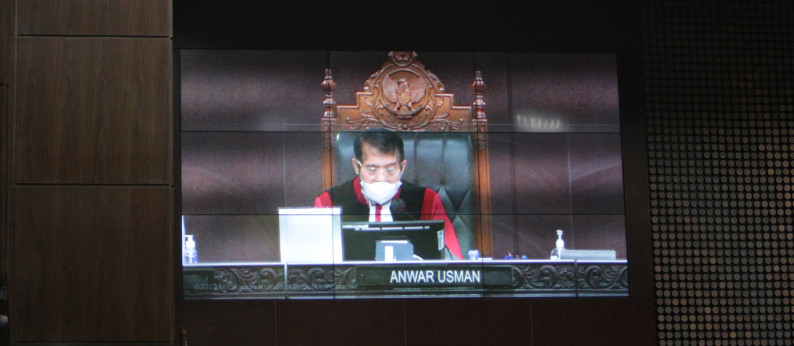
Chief Justice Anwar Usman chairing the ruling hearing of the Election Law, Wednesday (4/20/2022). Photo by Humas MK/Ilham W. M.
Wednesday, April 20, 2022 | 16:36 WIB
JAKARTA, Public Relations—The Constitutional Court (MK) ruled that the judicial review petition of Law No. 7 of 2017 on General Elections (Election Law) was inadmissible. The petition was filed by Adang Suhardja, Marwan Batubara, Ali Ridhok, and Bennie Akbar Fatah.
“[The Court] adjudicated, declares the Petitioner’s petition inadmissible,” said plenary chair Chief Justice Anwar Usman reading out the verdict in Decision No. 20/PUU-XX/2022 at a virtual ruling hearing on Wednesday, April 20, 2022.
In the legal considerations read out by Constitutional Justice Arief Hidayat, the Court asserted that the rules regarding the threshold for endorsing presidential-vice presidential candidates as stipulated in Article 222 of the Election Law, which the Petitioners challenged, had been implemented since before the 2019 Election. By then, the Petitioners had the right to vote and had known the results of their voting rights in the 2019 legislative election, and that they would be used as a threshold requirement for endorsing presidential tickets in the 2024 Election.
“With such an analogy, the perceived constitutional impairment, in casu the restriction of the right to vote that the Petitioners experienced was unreasonable according to law,” Justice Arief said.
In addition, he added, the Petitioners’ arguments on the threshold were irrelevant to their perceived constitutional impairment because Article 222 of the Election Law did not at all limit or hinder their right to cast votes in the presidential election.
Also read: Provision on Presidential Threshold Challenged Once More
The Court was of the opinion that the Petitioners’, particularly Petitioner I, legal standing in relation to their constitutional right to participate in the state defense as guaranteed in Article 30 paragraph (1) of the 1945 Constitution was irrelevant because the article reads, “Every citizen shall be shall be entitled and obligated to participate in the state defense and security,” not “to participate in state protection” as the Petitioners elaborated.
“Even if what the Petitioners meant was the right to participate in the state defense and security as guaranteed in Article 30 paragraph (1) of the 1945 Constitution, the Court did not find a causal relationship between the norm whose constitutionality was petitioned and the perceived impairment of the a quo Petitioners’ constitutional rights, both actual and potential. Based on the considerations, the Court is of the opinion that the Petitioners did not have the legal standing to file the a quo petition,” he stressed.
Thus, although the Court had the authority to hear the a quo petition, because the Petitioners did not have the legal standing to file the a quo petition, the Court did not consider the subject matter.
Also read: Petitioners of Provision on Presidential Threshold Revise Legal Standing
At the preliminary hearing for case No. 20/PUU-XX/2022 on Monday, March 14, 2022, the Petitioners challenged Article 222 of the Election Law, which reads, “A presidential candidate ticket shall be nominated by a political party (or a coalition thereof) contesting in an election that has managed to win at least 20% (twenty percent) of DPR seats or 25% (twenty-five percent) of national valid votes in the previous election of members of the DPR.” They considered it to be in violation of Article 6 paragraph (2), which reads, “The requirements of being the President and Vice President shall be further stipulated by virtue of law.”
“Interpreted systematically and grammatically, the presidential-vice presidential candidacy requirement should have referred to Article 6 of the 1945 Constitution, especially Article 6 paragraph (2),” said counsel Herman Kadir.
In addition, he added, it would not be accurate to call the presidential threshold an open legal policy. It is a closed legal policy because the 1945 Constitution has determined the restrictions and requirements for the candidacy.
He further stressed that in formulating the 20 percent seat or 25 percent votes requirement based on the previous election, the legislatures did not base it on the fulfillment of the people’s right to vote or to get as many choices of presidential candidates.
The Petitioners believed that in formulating the presidential threshold, the legislatures should not have used the voting mechanism but should have involved all elements of society (especially those disagreeing with the presidential threshold) and accommodated the minority within the parliament proportionally.
In the petition, the Petitioners also argued that in a democracy, every decision cannot only be based on the majority vote without respecting or fulfilling the people’s (electorate) right to more and quality presidential tickets. In determining the presidential threshold, the legislatures tend to base it on political interests (eliminating opposition) and not on the electorate’s interest and for the substantial development of democracy.
https://www.youtube.com/watch?v=oTbCPEdQlGU
Writer : Utami Argawati
Editor : Nur R.
PR : Muhammad Halim
Translator : Yuniar Widiastuti (NL)
Translation uploaded on 4/21/2022 08:45 WIB
Disclaimer: The original version of the news is in Indonesian. In case of any differences between the English and the Indonesian versions, the Indonesian version will prevail.
Wednesday, April 20, 2022 | 16:36 WIB 298