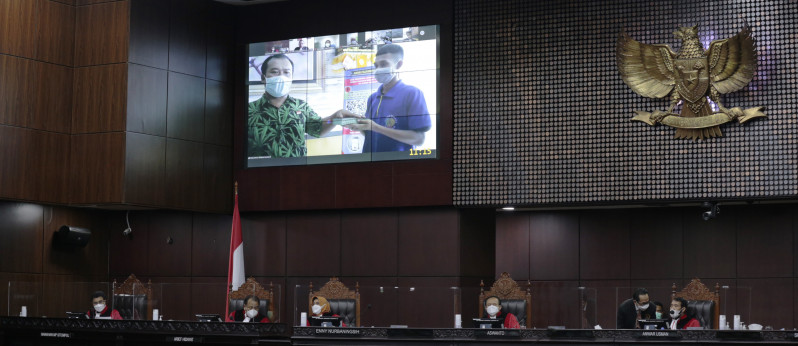
The material judicial review hearing of Law No. 35 of 2009 on Narcotics, Thursday (1/6/2022). Photo by Humas MK.
Thursday, January 6, 2022 | 13:38 WIB
JAKARTA, Public Relations—The material judicial review of Law No. 35 of 2009 on Narcotics continued in the Constitutional Court (MK). The eight hearing for case No. 106/PUU-XVIII/2020 took place on Thursday, January 6, 2022 virtually.
At the hearing chaired by Chief Justice Anwar Usman, the Petitioners presented witness P. Ridanto Busono Raharjo to testify regarding his use of cannabis for chronic neuropathic pain. Ridanto was involved in an accident in 1995, which paralyzed his right hand and left him with lasting pain. He started using cannabis in 1996 to deal with the pain.
“When using cannabis, I feel relaxed. Chronic neuropathic pain like what I have is [characterized by] intense pain. Almost all parts of my body, my muscles, have to anticipate pain in high frequency. When I use cannabis, I become relaxed and I feel calm,” he said.
Also read:
The Constitutionality of Type I Narcotics for Medicine
House Says Legalization of Cannabis for Medical Purposes Different in Each Country
Ridanto claimed none of the treatments he had tried could help him alleviate the pain. All of them focused on his paralysis, while failing to treat the most debilitating impact of the accident—the pain. The legal medicine that he had consumed had had side effects on his body. None of them, he stressed, had given satisfactory treatment to his pain. He expressed hope that in the future there would be a more rational Narcotics Law that is in line with Pancasila.
Also read:
Asmin Fransiska: Indonesia Misinterpreted Single Convention on Narcotic Drugs, 1961
Stephen Rolles: All Medicine Have Risks
South Korean and Thai Experts Talks Legalizing Medical Cannabis
The case No. 106/PUU-XVIII/2020 was filed by Dwi Pertiwi, Santi Warastuti, Nafiah Murhayanti, Perkumpulan Rumah Cemara, the Institute for Criminal Justice Reform (ICJR), and the Community Legal Aid Institute (LBHM) (Petitioners I-VI). They requested the material judicial review of the elucidation to Article 6 paragraph (1) letter a and Article 8 paragraph (1) of the Narcotics Law, which prohibits cannabis use for medical purposes. They believe this has harmed their constitutional rights as it kept the Petitioners’ children from receiving treatment that can improve their health and quality of life.
At the preliminary hearing on Wednesday, December 16, 2020, the Petitioners stated that three of them are mothers of cerebral palsy patients. Dwi Pertiwi have given her child cannabis oil in a therapy in Victoria, Australia in 2016. She couldn’t continue with the therapy in Indonesia due to threat of criminal sanctions by the a quo norm. This was also true of the other two petitioners.
Meanwhile, Perkumpulan Rumah Cemara, ICJR, and LBHM are nonprofit organizations formed to give society access to healthcare. The Petitioners argue that the elucidation to the a quo norm has led to the loss of the Petitioners’ right to health services as regulated in Article 28H paragraph (1) of the 1945 Constitution. Such a right has been adopted in Article 4 letter a of the Narcotics Law, which states that the law serves to guarantee the availability of narcotics for the interest of health services and/or development of science and technology. Meanwhile, Article 7 regulates the sole legal use of narcotics for health services and/or development of science and technology. This means narcotics use can be legal and is inseparable from the right to health services guaranteed by the Constitution.
Writer : Utami Argawati
Editor : Lulu Anjarsari P.
PR : M. Halim
Translator : Yuniar Widiastuti (NL)
Translation uploaded on 01/06/2022 14:56 WIB
Disclaimer: The original version of the news is in Indonesian. In case of any differences between the English and the Indonesian versions, the Indonesian version will prevail.
Thursday, January 06, 2022 | 13:38 WIB 319