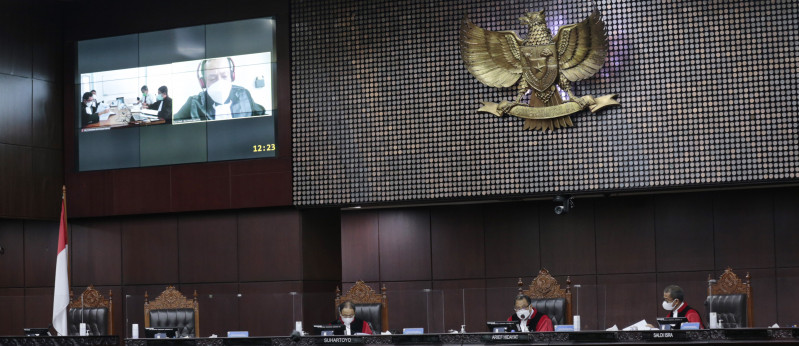
Constitutional Justices Arief Hidayat (panel chair), Suhartoyo, and Saldi Isra at the judicial review hearing of Law No. 11 of 2020 on Job Creation, Tuesday (10/26/2021). Photo by Humas MK/Hendy.
Tuesday, October 26, 2021 | 16:46 WIB
JAKARTA, Public Relations—The Constitutional Court (MK) held a judicial review hearing of Law No. 11 of 2020 on Job Creation on Tuesday, October 26, 2021. The virtual preliminary hearing, which was chaired by Constitutional Justice Arief Hidayat, heard petition No. 55/PUU-XIX/2021, filed by HAkA (Hutan, Alam dan Lingkungan Aceh/Forest, Nature, and Environment of Aceh) Foundation, represented Farwiza and colleagues.
On behalf of the Petitioner, Harli said environmental organizations have a constitutional right to provide specific information about the environmental impact assessment (AMDAL) of certain projects, which can have positive impacts—improving the beauty of the environment—or negative ones—threatening the environment or posing potential environmental risk of or loss of biodiversity. Therefore, he said, AMDAL documents are legal documents used to inform decisions or follow-ups on projects, which depend on the risks they pose.
The Petitioner believes that any effort to minimize negative impacts are important and that they have the responsibility to be involved in AMDAL, Harli said. Assessment on the impacts of a business and/or activity is a prerequisite to decision-making by the executors of that business and/or activity.
“So that it can be concluded that AMDAL is an important instrument in the development of any business or activity, [as it] contains assessment of the impacts, evaluation of the planned location, suggestions, input, and responses by the community, estimate of the magnitude of the impacts and the importance of the impacts if the planned business or activity is carried out, a holistic evaluation of the impacts that occur to determine the feasibility or unfeasibility of the environment and processing plans, [and] environmental monitoring of a business plan,” Harli added.
He further said that the preparation of AMDAL is part of a procedure that consists of screening, mandatory AMDAL, public announcement, scooping, drafting of AMDAL-TOR, drafting of environmental management and monitoring plans (RKL, RPL), and environmental agreement.
Harli stressed that the Petitioner had been involved in a regional AMDAL commission to provide their input. “So, when the Job Creation Law was passed, all of that [AMDAL procedure] was eliminated. It only requires that the directly-impacted community be involved, while it [does not require the involvement] of those not directly impacted,” he added.
Harli said the elimination of the prerequisite community input to AMDAL documents, as referred to in Article 26 paragraph (3) of Law No. 32 of 2009, which has been amended by Article 22 point 5 of Law No. 11 of 2020, indicates the factual or potential loss of the Petitioner in preventing the environment against any damage due to big-scale projects where AMDAL is mandatory.
Because the Petitioner represents the interest of the environment that might be negatively impacted by environmental damage today or in the future, according to Article 92 of Law No. 32 of 2009 they can represent those impacted by such environmental damage. Meanwhile, the state has the obligation to respect, protect, and fulfill the Petitioner’s constitutional rights pursuant to Article 28I paragraph (4) of the 1945 Constitution, which reads, “Protection, improvement, reinforcement, and fulfilment of human rights shall be the responsibility of the state, particularly the government.”
As Article 22 point 5 of Law No. 11 of 2020 on Job Creation will restrict the Petitioner’s involvement in preparing AMDAL and preserving the environment, the Petitioner requested that the Court declare it unconstitutional and not legally binding insofar as not interpreted as “The preparation of the AMDAL document is carried out by involving the community freely and voluntarily to protect their interests and needs.”
Justices’ Advice
In response to the petition, Constitutional Justice Saldi Isra asked the Petitioner to simplify their legal standing and affirm their constitutional loss. “Please simplify the legal standing so that the constitutional loss is clearly visible in the petition. Do not elaborate everything. The most important is the explanation of who the Petitioner is, what they do, what their constitutional loss due to the enactment of the norm being petitioned,” he said.
Meanwhile, Constitutional Justice Suhartoyo requested that the legal standing be revised and the posita be simplified. “The [Petitioner] always has legal standing, but in the Constitutional Court it is special in that it concerns the loss of constitutional [rights] guaranteed by the Constitution due to the enactment of the norm. The norm restricts [the rights]. How do you explain that in order to have legal standing? In the elaboration in the revisions, so that [the constitutional justices] are convinced that [the Petitioner] really suffers actual or potential loss due to the enactment of the norm. The [judicial review of the] norm is restricted to the people who are directly impacted,” he explained.
Before concluding the hearing, Constitutional Justice Arief Hidayat requested that the Petitioner submit the revised petition by Monday, November 8, 2021, 2 hours before the next hearing.
Writer : Utami Argawati
Editor : Lulu Anjarsari P.
PR : Raisa Ayudhita
Translator : Yuniar Widiastuti (NL)
Translation uploaded on 10/27/2021 09:58 WIB
Disclaimer: The original version of the news is in Indonesian. In case of any differences between the English and the Indonesian versions, the Indonesian version will prevail.
Tuesday, October 26, 2021 | 16:46 WIB 394