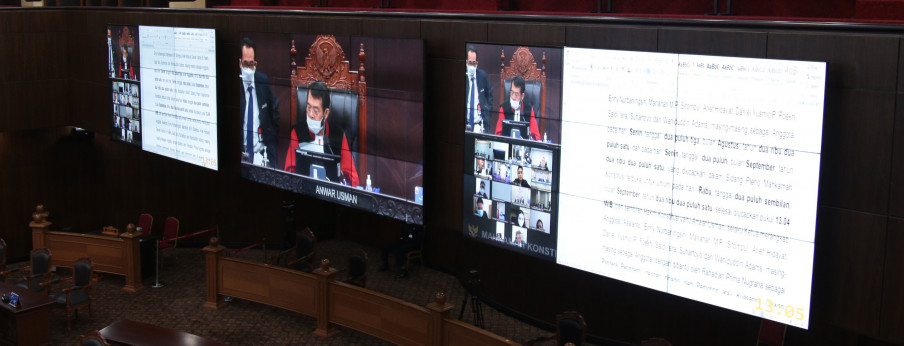
Chief Justice Anwar Usman presiding over the plenary ruling hearing of the judicial review of No. 19 of 2003 on State-Owned Enterprises (BUMN), Wednesday (9/29/2021). Photo by Humas MK/Ilham W.M.
Wednesday, September 29, 2021 | 23:11 WIB
JAKARTA, Public Relations—The establishment of BUMN (SOE) subholdings does not mean that BUMNs and its subsidiaries are separated and compete with each other in carrying out business activities. Even though some shares in subsidiaries are transferred to private parties, which reduces the shares in the holding company, the state can still use the golden shares. This means that the state or the holding company still has the veto right, which aims to secure the state’s control over SOE subsidiaries so that they do not deviate from the business objective for the greatest prosperity of the people, said Constitutional Justice Saldi Isra reading out the Court’s legal considerations in Decision No. 61/PUU-XVIII/2020 on the judicial review hearing of Law No. 19 of 2003 on State-Owned Enterprises (SOE/BUMN).
The ruling hearing took place on Wednesday, September 29, 2021. In its verdict, the Court rejected the entire petition of the Petitioner. The case was filed by the Federation of Pertamina United Labor Unions (FSPPB), who challenged Article 77 letters c and d of the BUMN Law, which reads, “Unprivatizable Persero are: c. a Persero that engages in a certain sector and has been given special duty by the government to perform certain activities associated with public interest; d. a Persero that engages in the natural resources sector, which under the provisions of legislation is expressly prohibited from being privatized.”
Under State Control
The Court in its legal considerations also states that in company law, privatization is unavoidable, especially in order to increase performance, company value, and efficiency. Such a government legal political policy, although can lead to private shares in a BUMN subsidiary, allows the subsidiary to remain under state control to provide the greatest benefit for the prosperity of the people.
“Without intending to judge the legality of the implementing regulations, this principle has been implemented in the provision of Article 2A paragraphs (2) and (7) of the Government Regulation (PP) No. 44 of 2005 on Procedures for Participation and Administration of State Capital in State-Owned Enterprises and Limited Liability Companies as amended by PP No. 72 of 2016, which basically stipulates that the state is obliged to own shares with special rights in BUMN subsidiaries and those subsidiaries still receive the same treatment as BUMN in order to receive government assignments or carry out public services,” Justice Saldi said.
Privatization and Employees’ Status
Next, Constitutional Justice Saldi Isra conveyed the Court’s legal considerations relating to the Petitioner’s concerns about the legal uncertainty of the employees’ status at BUMN companies and subsidiaries that are privatized. The Court would like this to receive attention. Although one of the goals of privatization is efficiency, it should not cause anxiety for employees. Therefore, efforts should be made to avoid layoffs. Any layoff in the merger, consolidation, acquisition, and dissolution BUMNs must be a last resort and be resolved in accordance with statutory laws and regulations.
In relation to employees’ status, Article 87 paragraph (1) of Law No. 19 of 2003 stipulates that BUMN employees are those whose appointment, dismissal, position, rights, and obligations are determined based on a collective work agreement in accordance with the provisions of legislation in manpower. Likewise, the status of employees of BUMN subsidiaries that are privatized is subject to the provisions in the regulations, just as that of BUMN employees.
“Based on assessment of the facts and the law, the Court in its Verdict, adjudicated, rejects the Petitioner’s petition in its entirety,” said Chief Justice Anwar Usman reading out the verdict from the plenary courtroom.
Petitioner’s Legal Standing
Meanwhile, Constitutional Justice Daniel Yusmic P. Foekh had a different opinion on the Petitioner’s legal standing. He asserted that as a federation the Petitioner is open to workers unions in PT Pertamina (Persero), including subsidiaries, with provisions as stated in its statute. As such, the Petitioner’s concern of privatization contradicts Article 3 of the federation’s statute, which was an indication of the ambiguity of the Petitioner’s constitutional loss.
In addition, he added, the Petitioner’s concern of lack of state control over PT Pertamina (Persero) subsidiaries was excessive because they had taken over the responsibility of the board of directors. Article 1 No. 5 of Law No. 40 of 2007 clearly states the position and authority of the board of directors.
“Thus, as long as the company’s board of directors carry out their duties with care, loyalty, and adhering to the principles of good corporate governance so that the company progresses and the employees’ welfare improves, the Petitioner’s concerns were unfounded,” he said.
Writer : Sri Pujianti
Editor : Nur R.
PR : Fitri Yuliana
Translator : Yuniar Widiastuti (NL)
Translation uploaded on 10/1/2021 13:27 WIB
Disclaimer: The original version of the news is in Indonesian. In case of any differences between the English and the Indonesian versions, the Indonesian version will prevail.
Wednesday, September 29, 2021 | 23:11 WIB 386