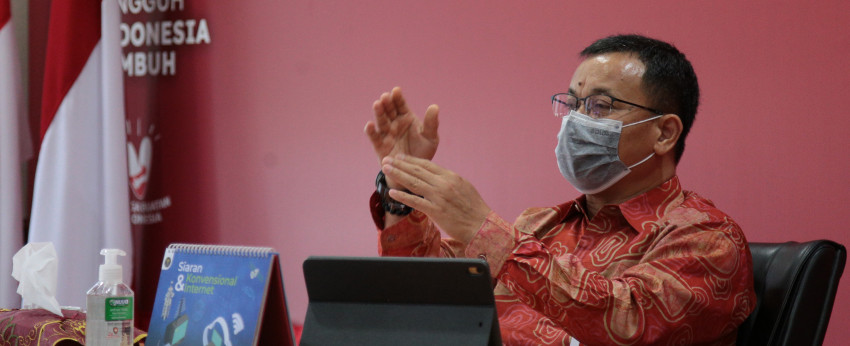
Secretary-General M. Guntur Hamzah talking about “The Challenges and Issues of Judicial Review in the Constitutional Court of Indonesia” at a national webinar by the Sharia Faculty of UIN Kiai Haji Ahmad Siddiq Jember, Wednesday (9/22/2021). Photo by Humas MK/Hamdi.
Wednesday, September 22, 2021 | 17:15 WIB
JAKARTA, Public Relations—There are many challenges and issue with the judicial review in the Constitutional Court, among others with the assumption that it only concerns the material while the public sentiment is moving toward formal judicial review. Therefore, to accommodate it, a legal basis is needed in the form of a Constitutional Court Regulation (PMK), said Secretary-General M. Guntur Hamzah at a national webinar by the Sharia Faculty of the Kiai Haji Achmad Siddiq State Islamic University (UIN KHAS) of Jember on Wednesday, September 22, 2021.
Beginning his presentation on “The Issues and Challenges of Judicial Review in Indonesia,” he explained the reason why the Constitutional Court was founded. “What was the urgency, when there was the Supreme Court? Some countries even only had a Supreme Court but not a Constitutional Court,” he said.
Change of Paradigm
Guntur believes that Indonesia’s administrative system is now more adaptive with the existence of the Constitutional Court. Back when the founders were meeting in the Investigating Committee for Preparatory Works for Independence (BPUPK), the idea emerged. Muhammad Yamin talked about the importance of the Supreme Court that has the authority to review the constitutionality of laws. The idea was rejected by Soepomo because Indonesia did not recognize separation of power but distribution of power. In addition, there were not many qualified law graduates at that time.
Then the 1998 Reform happened, followed by the four-stage amendment to the 1945 Constitution in 1999-2002. The idea was proposed again. The amendment to the Constitution changed the paradigm of the people’s sovereignty from a representation one (“by the People’s Consultative Assembly/MPR)”) to a direct one (“according to the Constitution”). The MPR was the highest state institution, but after the amendment it is a high state institution that is equal to other high state institutions.
“There is no MPR supremacy any longer, but a constitutional supremacy,” Guntur said to more than 300 participants of the webinar.
A body is need to guard the constitutional supremacy. This is why jurist Hans Kelsen initiated the Constitutional Court in Austria in 1920.
Foundation of Constitutional Court
The Constitutional Court was founded based on Article 24 paragraph (2) of the 1945 Constitution, which now reads, “The judicial power is exercised by a Supreme Court with its subordinated judicial bodies within the form of general courts, religious courts, military courts, administrative courts, and by a Constitutional Court.” Guntur stressed that the article affirms that the judicial power in Indonesia is exercised by the Supreme Court and the Constitutional Court.
Article 24 paragraph (1) of the 1945 Constitution regulates the Constitutional Court’s authorities to review laws against the Constitution, to decide on authority disputes between state institutions whose authorities are granted by the Constitution, to decide on the dissolution of political parties, and to decide on disputes over general election results. It is also obligated to decide on the House’s opinion on an alleged violation of law committed by the president and/or vice president.
“Aside from those authorities, the Court has an additional authority to rule on the results of the election of governors, regents, and mayors. The authority is referred to in Law No. 10 of 2016 on Pilkada [Regional Head Election] until a special body is established to take over,” he explained.
Many Challenges
The Court has had many challenges with respect to its judicial review authority, for example, whether it is authorized to review the government regulation in lieu of law (perrpu) and the MPR Decree (TAP MPR). The Court is now also authorized to review the perppu, as it will lead to new legal norms whose force equal that of laws, as well the MPR Decree.
The Constitutional Court has declared Article 50 of Law No. 24 of 2003 on the Constitutional Court unconstitutional in Decision No. 066/PUU-II/2004 regarding the judicial review of Law No. 1 of 1987 on the Indonesian Chamber of Commerce and Industry (Kadin). The article stipulates that the laws that the Constitutional Court can review are only those promulgated after the amendment to the 1945 Constitution.
“This is a constitutional ijtihad in order to provide protection of the citizens’ constitutional rights. The Court can review laws promulgated before 2003. This received a lot of appreciation from the community,” he said.
These challenges keep increasing along with the increasing number of material and formal judicial review cases lodged to the Court. Therefore, he said, a legal basis in the form of the Constitutional Court Regulations (PMKs) are needed. He said that a PMK on material and formal judicial review is now being revised. The provisions on material and formal judicial review will be separated, including that on the deadline.
Litigating in Constitutional Court
Guntur stressed that in the Constitutional Court the term “petition”, not “lawsuit,” is used for the judicial review cases because there are no defendants unlike in civil and criminal cases. The petitioner does not stand on the opposite of the Government and the House of Representatives (DPR), who are testifiers in the cases.
He also explained that the judicial review concerns the petitioner, the testifiers, and the relevant parties, who can be represented by a legal counsel with a power of attorney and/or be assisted by one with a letter.
Individual citizens, customary law communities that live according to the principles of the Unitary State of the Republic of Indonesia, private and public legal entities, as well as state institutions can file a petition to the Constitutional Court.
The Court may summon the MPR, DPR, DPD, and/or president to testify in the Court or request the minutes of sessions related to the case. A testimony should at least elaborate the facts that happen during the discussion of the bill of law and/or the minutes of sessions of the law/perppu petitioned for review, and other matters that the testifier or the Court deem important or necessary.
The relevant party is one that has direct and/or indirect interest in the subject matter of the petition. One that has indirect interest means that someone whose has concerns over the petition.
Filing Petition Online and Offline
Guntur said the petition can be lodged online or offline (in person). Many tend to choose filing a petition to the Court in person. The Registrar’s Office will check whether the petition and the evidence are complete. Then the petition will be registered in the BRPK (constitutional case registration book). The Registrar’s Office will then examine the petition, review its substance, the articles and law being petitioned, etc.
The petition will then be forwarded to the chief justice, who will appoint a panel of three constitutional justices to examine it. The panel will examine the petition’s substance, format, and so on.
Only then will a panel preliminary examination hearing take place, which aims to check the completeness and clarity of the material. The justices are obligated to provide advice to improve the petition because the case does not concern a conflict of interests. The petition is to be revised within 14 workdays.
The preliminary hearing will be followed by a petition revision hearing. If the petition advances based on the justice deliberation meeting (RPH), plenary examination hearings will take place, where the justices hear the testimonies of the Government, the House, experts, and witnesses. They are followed by a RPH and a ruling hearing.
Writer : Nano Tresna Arfana
Editor : Nur R.
Translator : Yuniar Widiastuti (NL)
Translation uploaded on 10/4/2021 11:24 WIB
Disclaimer: The original version of the news is in Indonesian. In case of any differences between the English and the Indonesian version, the Indonesian version will prevail.
Wednesday, September 22, 2021 | 17:15 WIB 320