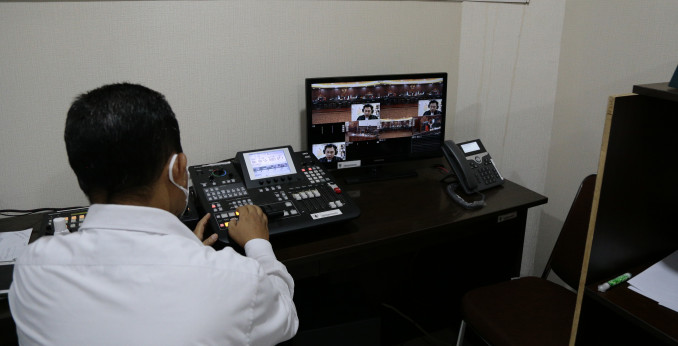
Control room officers operating robot cameras at the courtroom from the control room, for the judicial review hearing of Law on the National Resource Management for State Defense, Thursday (22/07/2021). Photo by Humas MK/Ilham W. M.
Thursday, July 22, 2021 | 21:08 WIB
JAKARTA, Public Relations—The Constitutional Court (MK) held the preliminary hearing of the Law No. 23 of 2019 on the National Resource Management for State Defense (PSDN Law) on Thursday morning, July 22, 2021. The petition No. 27/PUU-XIX/2021 was filed by four civil service organizations (CSOs) and three individual citizens. The CSOs are the human rights group Inisiatif Masyarakat Partisipatif untuk Transisi Berkeadilan (IMPARSIAL), the Commission for Missing Persons and Victims of Violence (Kontras), Kebajikan Publik Indonesia Foundation, the Indonesian Legal Aid and Human Rights Association (PBHI). They challenge Article 4 paragraphs (2) and (3), Article 17, Article 18, Article 20 paragraph (1) letter a, Article 28, Article 29, Article 46, Article 66 paragraphs (1) and (2), Article 75, Article 77, Article 78, Article 79, Article 81, and Article 82 of the PSDN Law.
Before the panel chaired by Constitutional Justice Daniel Yusmic P. Foekh, attorney Muhammad Busyrol Fuad said Article 4 paragraphs (2) and (3) and Article 29 of the PSDN Law have created legal uncertainty, thus violating Article 1 paragraph (3), Article 28D paragraph (1), and Article 30 paragraph (2) of the 1945 Constitution. The legal uncertainty due to these articles mutatis mutandis has also led to the ambiguity of Article 29 of the PSDN Law, which regulates the mobilization of reserve component against military and hybrid threats.
“In fact, Article 7 paragraph (2) of Law No. 3 of 2002 on State Defense, has explicitly provided limitations of reserve component and supporting components that can only be mobilized against military threats,” Busyrol said.
The Petitioners also believe Article 17, Article 28, Article 66 paragraph (2), Article 79, Article 81, and Article 82 of the PSDN Law violate Article 28G paragraph (1), Article 28H paragraph (4), and Article 30 paragraph (2) of the 1945 Constitution.
Busyrol further said that the mention of natural resources, artificial resources, as well as national facilities and infrastructure as supporting components and reserve component in those articles had obscured the meaning of the main power and supporting power as referred to in Article 30 paragraph (2) of the 1945 Constitution, when the article’s norm is limiting in nature.
“The drafters of the Constitution have explicitly stated ‘the Indonesian National Armed Forces and the National Police of the Republic of Indonesia, as the main power, and the people, as the supporting power.’ [They] did not even once mention non-human elements (natural resources, artificial resources, as well as national facilities and infrastructure) as part of either the main or supporting powers of state defense,” he said virtually.
In the petition, the Petitioners also state that Article 18, Article 66 paragraph (1), Article 77, Article 78, and Article 79 of the PSDN Law in violation of Article 28E paragraph (2) and Article 30 paragraph (2) of the 1945 Constitution in relation conscientious objection. In addition, Article 18 and Article 66 paragraph (1) of the PSDN Law violate the principle of conscientious objection (the people’s right to refuse on the grounds of moral or religious principles), which are cardinal principles in the involvement of civilians in state defense, which is acknowledged by many countries and the international communities, as well as part of the international human rights law.
The Petitioners state in the petition that conscientious objection is an implementation of Article 18 of the Universal Declaration of Human Rights (UDHR) and Article 18 of the International Covenant on Civil and Political Rights (ICCPR), which have been ratified in the Indonesian law through Law No. 12 of 2005 on the Ratification of the International Covenant on Civil and Political Rights, which regulates freedom of thought, conscience, and religion—also mandated by Article 28E paragraph (2) of the 1945 Constitution.
Article 20 paragraph (1) letter a of the PSDN Law is seen to be in violation of Article 28D paragraph (1) of the 1945 Constitution as it has led to legal uncertainty. The article, which stipulates that members of the National Police are part of the supporting components, also violates Article 30 paragraph (2), which stipulates that TNI (the military) and the National Police are the main power in state defense.
The Petitioners also claim that Article 46 of the PSDN Law is against Article 27 paragraph (1) and 28D paragraph (1) of the 1945 Constitution as it is against the principle of equality before law. It stipulates that military laws will be imposed on reserve component during active duty, which is a contrario to the statement that military laws will not be imposed on reserve component during inactive duty.
The inequal treatment of reserve component during active and inactive duty actually starts with the ambiguity of civilians’ status as reserve component, which has led to the ambiguity on the stage to which the people can be involved in state defense and on which power they belong to, main or supporting.
In addition, Article 75 of the PSDN Law, which determines that the funding for natural resource management for state defense may also come from the regional budget (APBD), is contrary to the separation of authority between the central and regional governments, thus in violation of Article 18 paragraph (5) of the 1945 Constitution and creating legal uncertainty, which is against Article 28D paragraph (1) of the 1945 Constitution.
Therefore, in order to prevent any violation to the Petitioners’ constitutional rights due to the enactment of the PSDN Law, they requested that the Court issue an interlocutory decision that declares that the enactment of the law, especially on the recruitment of the reserve component, is delayed until the judicial review in the Court is completed.
Justices’ Advice
In response to the petition, Constitutional Justice Arief Hidayat questioned the urgency of the Petitioners’ request of an interlocutory decision. “As a panel justice, I have not found any explanation of the urgency of the Petitioners’ request of an interlocutory decision, a provisional decision, to delay [the enactment] of this law. The reason being, if we delay it, there will likely be legal vacuum in national resource management for state defense when the current national and global situation is still unstable. The COVID-19 pandemic has led to instability at the national and global levels,” he said.
Meanwhile, Constitutional Justice Suhartoyo advised the Petitioners to strengthen the argument on their legal standing. “Please review whether the ones who give power of attorney or who filed the petition in this case are in accordance with the [organization’s] statute/bylaws. Although the statute/bylaws are explained in the petition, I would like to remind you so that when the Court review it [your petition] is eliminated due to the lack of legal standing,” he said.
Before concluding the hearing, Justice Daniel Yusmic P. Foekh reminded the Petitioner to revise the petition within 14 working days since the preliminary hearing.
Writer : Utami Argawati
Editor : Nur R.
PR : Muhammad Halim
Translator : Yuniar Widiastuti (NL)
Translation uploaded on 7/23/2021 17:09 WIB
Disclaimer: The original version of the news is in Indonesian. In case of any differences between the English and the Indonesian version, the Indonesian version will prevail.
https://youtu.be/7igN-H1njCU
Thursday, July 22, 2021 | 21:08 WIB 489