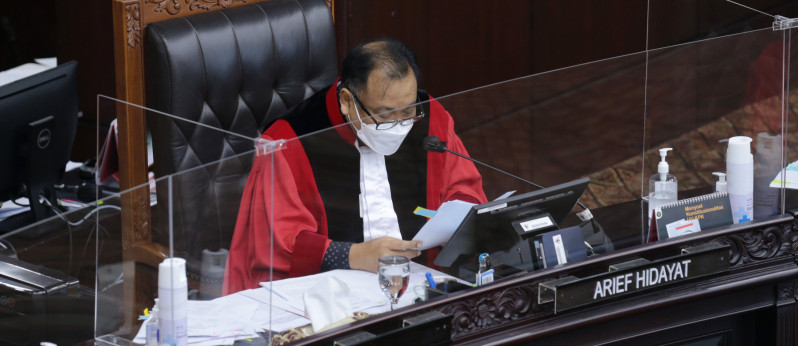
Chief Justice Anwar Usman reading the Court’s opinions at the ruling hearing of the material judicial review of the Civil Code, Tuesday (29/6/2021) in the plenary courtroom. Photo by Humas MK/Ifa.
Tuesday, June 29, 2021 | 15:55 WIB
JAKARTA, Public Relations—The Constitutional Court (MK) rejected an entire petition by Ambon-Lease customary law community representative Wielfried Milano Maitimu at a ruling hearing of the material judicial review hearing of the Civil Code (KUHPer) on Tuesday, June 29, 2021 in the plenary courtroom. The Petitioner of case No. 1/PUU-XIX/2021 challenged Articles 831, 832, 834, 849, 852, 852a, 857, 862, 863, 864, 865, 867, 869, 872, 913, 914, 916, 916a, 920, and 921 of the Civil Code against Article 18B paragraph (2) and Article 28 paragraph (3) of the 1945 Constitution.
The Court in its legal considerations read out by Constitutional Justice Arief Hidayat held that a customary law was a subsystem of the national legal system, meaning that it is one of the legal sources in deciding a case in the Indonesian judiciary. Therefore, in examining and deciding on a case, judges must also explore the legal values within society.
Such judicial discretion is regulated in Article 5 paragraph (1) of Law No. 48 of 2009 on the Judicial Powers. However, if the customary law no longer matches the legal needs of society, judges may also pass a decision that is not in line with the existing customary law.
“As such, emerged decisions by judges that indirectly contain new legal norms that are more reflective of justice, benefit, and legal certainty,” Justice Arief said before the litigants who attended the hearing virtually.
The Court held that there was no paradox between the customary law and the provision on inheritance in the Civil Code as alleged by the Petitioner, especially if the parties agree to follow the Civil Code entirely. Therefore, the Court believed the adoption of customary laws in the Civil Code to be irrelevant. It also held that the articles on inheritance in the Civil Code, which the Petitioner challenged, had no constitutionality issue.
Also read: Ambon-Lease Customary Law Community Challenges Civil Code on Inheritance
Unification of Inheritance Laws
Constitutional Justice Arief Hidayat also read out the Court’s legal consideration on the Petitioner’s petition regarding Articles 832, 849, 852, 852a, 857, 914, and 916 of the Civil Code. The Court understood the Petitioner’s impression that the norms in the code had negated the local Passo (Ambon-Lease) customary law on inheritance. However, it viewed the petition as not being in line with the concept of legal plurality in Indonesia, which aspires to collaborative and harmonious relations between national legal subsystems.
Justice Arief further explained that in Indonesia, inheritance is regulated in the Islamic law, the western Civil Code, and customary laws. The legal diversity is more apparent as customary inheritance laws are not singular. He added that there has been an idea to unify existing inheritance laws into one that can accommodate all aspirations, values, and needs of society while taking into account diversity of cultural and religious backgrounds as well as the needs in society. However, it must be formulated with extreme caution so as to prevent conflict.
“Therefore, in case of the absence of inheritance dispute, the people are given the right to chose the inheritance law to use in agreement with the other parties. Meanwhile, in case of any dispute that ends in trial, the judge will choose which law to apply. Legal choices on inheritance is important in the development of the national legal system because by giving different communities the same options of legal subsystems and by negating other legal subsystems, there will be an even wider gap between the law and the sense of justice in society,” Justice Arief explained.
Also read: Petitioner of Civil Code Case Conveys Revisions
At the preliminary hearing, the Petitioner alleged that the norms in question are in violation of the customary law on inheritance practiced in Maluku, especially Ambon. The reason being that the customary law on inheritance no longer applies since the courts refer to the Civil Code. As a consequence, the Petitioner, failed to receive housing inheritance as ‘anak rumah’ (or ‘rumahtua’ in the Moluccan customary law)—a term in the Moluccan kinship system that means a child that is not acknowledged by the paternal relatives but acknowledged by the maternal relatives and, thus, can continue the matrilineal line.
After the Petitioner’s mother passed away in 2018, a house previously belonging to the ‘rumahtua’ fell to the hands of his mother’s husband. It was to be sold and the proceeds be distributed according to the norms in the Civil Code. The Petitioner believes that this shouldn’t apply in the Moluccan customary law. In his petitum, he requests that the Court declare all norms in contention unconstitutional and not legally binding or conditionally constitutional insofar as not be used to rule on disputes within customary law communities.
Writer : Sri Pujianti
Editor : Lulu Anjarsari P.
PR : Andhini S. F.
Translator : Yuniar Widiastuti (NL)
Translation uploaded on 6/29/2021 22:03 WIB
Disclaimer: The original version of the news is in Indonesian. In case of any differences between the English and the Indonesian version, the Indonesian version will prevail.
Tuesday, June 29, 2021 | 15:55 WIB 451