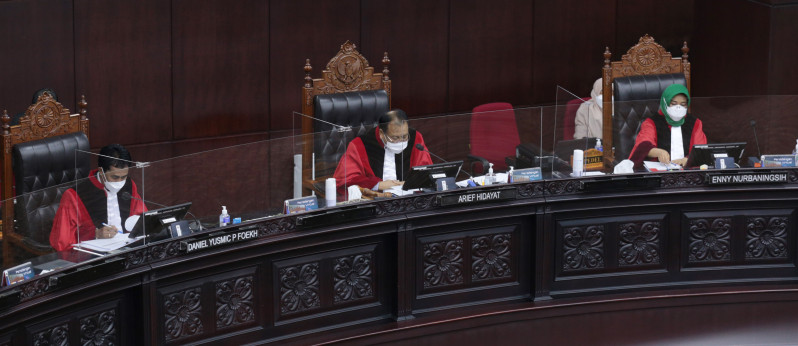
Constitutional Justices Arief Hidayat, Enny Nurbaningsih, and Daniel Yusmic P. Foekh opening the petition revision hearing of the judicial review of Law No. 44 of 2008 on Pornography, Tuesday (25/5/2021). Photo by Humas MK/Ifa.
Thursday, May 27, 2021 | 08:56 WIB
JAKARTA, Public Relations—The second judicial hearing of Law No. 44 of 2008 on Pornography was held by the Constitutional Court (MK) virtually on Tuesday, May 25, 2021. The justices heard the revision to the petition in case No. 13/PUU-XIX/2021, petitioned by Elok Dwi Kadja.
Constitutional Justice Arief Hidayat (panel chair) informed the floor that the Petitioner had officially emailed the Court on May 24, 2021 to withdraw the petition. the Petitioner’s attorney Muhammad Sholeh confirmed this.
“We review the same articles as [those in the case ruled in] the Court Decision No. 48//PUU-VIII/2010, where [the petition] was rejected. After careful consideration, [we observed that] it is difficult to use any other touchstones. We agree with the principal [Petitioner] to withdraw the petition,” Sholeh said.
Also read: Elucidation to Provision on Pornographic Content for Self-Consumption Challenged
At the preliminary hearing, Constitutional Justice Arief Hidayat said the Petitioner challenges the elucidation to Article 4 paragraph (1) of the Pornography Law against Article 28J paragraphs (1) and (2) of the 1945 Constitution. He reminded the Petitioner to review the Court’s decision on the same article. The Court has adjudicated on the elucidation to the article with the similar touchstones in case No. 48/PUU-VIII/2010, so the Court can declare the present case nebis in idem.
At the previous hearing, the Petitioner’s attorney Muhammad Sholeh said that the Petitioner is an advocate who resides in Surabaya. She challenges the a quo norm because it allows anyone to make pornographic videos or photos for self-consumption. Article 4 paragraph (1) of the Pornography Law bans all pornographic content, but the elucidation makes an exception for self-consumption.
The petition was inspired by a case involving celebrity Gisella Anastasya, whose explicit video went viral. She lost a phone containing the video, which was then allegedly spread without her knowledge.
In her petition, the Petitioner claims that because the a quo norm excludes the making of pornographic content for self-consumption, any person who do such an action cannot be charged criminally. This means that people such as Gisella cannot be charged. She claims that the definition of self-consumption is very vague and therefore the a quo norm could protect any person who records explicit content of other person(s), such as when bathing, from a criminal charge.
The Petitioner claims that the petition wasn’t only prompted by Gisella’s case, but rather to protect the public from such content. She believes that the elucidation to Article 4 paragraph (1) of the Pornography Law allows the public to create pornographic content for self-consumption.
Writer : Nano Tresna Arfana
Editor : Nur R.
PR : Muhammad Halim
Translator : Yuniar Widiastuti (NL)
Translation uploaded on 5/27/2021 13:21 WIB
Disclaimer: The original version of the news is in Indonesian. In case of any differences between the English and the Indonesian version, the Indonesian version will prevail.
Thursday, May 27, 2021 | 08:56 WIB 437