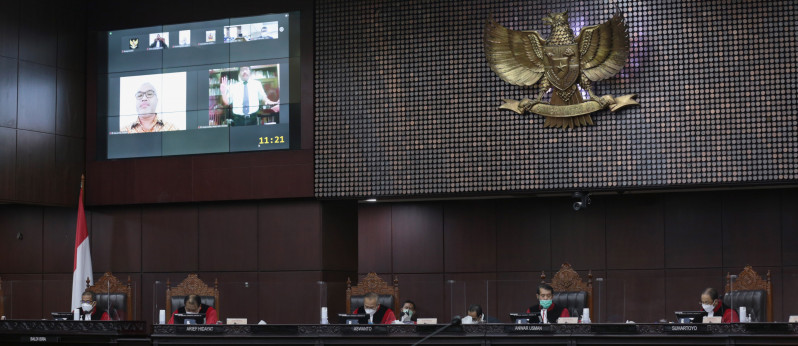
Aan Eko Widianto and Benediktus Hestu Cipto Handoyo, experts presented by the Petitioners, taking oath virtually for the judicial review hearing of the Mineral and Coal Mining Law, Tuesday (25/5/2021).
Thursday, May 27, 2021 | 08:37 WIB
JAKARTA, Public Relations—For the sake of legal certainty, it must be discovered early whether a law is passed legally or not, because a formal judicial review may invalidate it from the start. Therefore, the formal and material judicial review must be separate, said Aan Eko Widianto, an expert presented by Alirman Sori and the other seven petitioners of the case No. 60/PUU-XVIII/2020.
The seventh judicial review hearing of Law No. 3 of 2020 on the Amendment to Law No. 4 of 2009 on Mineral and Coal Mining took place on Tuesday, May 25, 2021 for cases No. 59/PUU-XVIII/2020, No. 60/PUU-XVIII/2020, and No. 64/PUU-XVIII/2020.
Also read: Court Adjudicates Three Cases on Mineral and Coal Mining
Aan believes that the formal judicial review must be prioritized over the material review when a law is challenged both formally and materially. “The legal reasoning is that the material review of a law would be useless if the Court declare the law null and void because it didn’t meet lawmaking requirements,” he explained before Chief Justice Anwar Usman and the other eight constitutional justices in the plenary courtroom.
On the other hand, he added, the simultaneous formal and material judicial review indicates that the Court would not grant the formal judicial review because the law is deemed valid, and it wouldn’t be reviewed materially.
“Of course, this is only an opinion, but the assessment of the evidence shouldn’t be like that,” Aan stressed at the hearing virtually from his residence.
Also read: Tiga Perkara UU Minerba Perbaiki Permohonan
Reverse Burden
Next, Aan said that in formal judicial review, reverse burden should apply because it examines a concrete case. Therefore, the evidence focuses more on facts and concrete documents, which the public may typically has difficulty proving in relation to lawmaking.
Therefore, without reverse burden or reversal of the burden of proof, all evidence of the lawmaking process, especially in the a quo case, falls on the Government, the House (DPR), and the DPD (Regional Representatives Council). At least, the testimony should follow the provision set forth in Article 54 of the Constitutional Court Law.
“[I] believe that the word ‘can’ in Article 54 in the context of formal judicial review should be interpreted as ‘order, obligatory, not recovery and facultative,” Aan said.
Also read: Mineral and Coal Mining Law Challenged
Rules of Ethics
The next expert for the Petitioners of case No. 60/PUU-XVIII/2020, law expert Benediktus Hestu Cipto Handoyo from Atma Jaya University of Yogyakarta, said that the lawmaking procedure and process is not only guided by the principles of the rule of law, conformity of content and form, and conformity with predetermined procedure, but also by the principles in the rules of ethics.
“Therefore, when lawmakers ignore the rules of ethics in lawmaking, [they] violate the Constitution because it is nothing but the philosophical representation of the ethics of a power structure that is outlined in the norms of the human law, the separation of powers, the legality of government, and the free judiciary,” Benediktus said.
Therefore, Benediktus added, the government’s intervention in the people’s lives is through the lawmaking process that is based not only on the principles of the rule of law, but also of the rules of ethics.
Also read: Petitioners of Mineral and Coal Mining Law Revise Petition
The case No. 60/PUU-XVIII/2020 was filed by H. Alirman Sori and seven other petitioners. They claimed that their constitutional rights were violated because the formation of the law was discussed exclusively and privately without transparency as stipulated by existing laws and regulations. The discussion of the bill didn’t involve the DPD when it has the authority mandated by the Constitution in discussing bills relating to the relationship between the central and regional government as well as the exploration of natural resources and other economic resources.
Also read: Hearing on Mineral and Coal Mining Law: House and DPD Absent, Govt Asks for Delay
The petition No. 59/PUU-XVIII/2020 was filed by Kurniawan, a researcher at Sinergi Kawal BUMN, an organization focusing on monitoring, responding to, and providing input to SOEs in mining and coal. He believes the Mineral and Coal Mining Law regulates the relationship between the central and regional government as well as the exploration of natural resources. This means that the discussion of the Mineral and Coal Mining bill required the involvement of the Regional Representatives Council (DPD) as the people entrusted the DPD to represent regional interests in the formation of the law.
Also read:
Govt: Revision to Mineral and Coal Mining Law to Improve Mining Sector’s Contribution
Experts: Mineral and Coal Mining Law Formally Defective
Meanwhile, the petition of case No. 64/PUU-XVIII/2020 was filed by by Helvis, an advocate specializing on mining, and Muhammad Kholid Syeirazi, the secretary of Nahdlatul Ulama’s Scholars Association (ISNU). They challenge Article 169A, which they believe has granted the minister too broad an authority to guarantee the extension to extend special mining business license (IUPK) and reduced the role of BUMN (SOEs) and BUMD (Regional Government-Owned Enterprises). They believe it to be against Article 75 of the Mineral and Coal Mining Law.
Before concluding the hearing, Chief Justice Anwar Usman informed that the hearing would resume on Tuesday, June 8, 2021 at 11:00 WIB to hear the statements of the House (DPR) and the witness of the Petitioners of case No. 60/PUU-XVIII/2020.
Writer : Sri Pujianti
Editor : Nur R.
PR : Raisa Ayudhita
Translator : Yuniar Widiastuti (NL)
Translation uploaded on 5/27/2021 12:01 WIB
Disclaimer: The original version of the news is in Indonesian. In case of any differences between the English and the Indonesian version, the Indonesian version will prevail.
Thursday, May 27, 2021 | 08:37 WIB 634