Tuesday, May 11, 2021 | 07:07 WIB
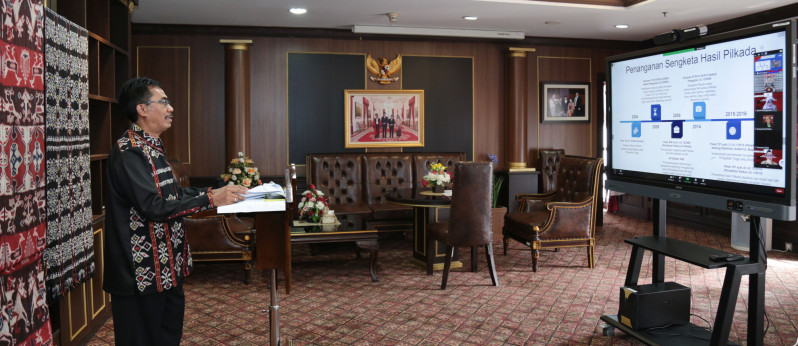
Constitutional Justice Daniel Yusmic P. Foekh speaking at a webinar by the Association of Lecturers on Procedural Law of the Constitutional Court (APHAMK) of the Jakarta DPD, Friday (7/5/2021) from the Constitutional Court. Photo by Humas MK/Ifa.
JAKARTA, Public Relations—Constitutional Justice Daniel Yusmic P. Foekh spoke at a webinar entitled “The Dynamics of the Procedural Law for the Resolution of Regional Head Election Results Amid Pandemic” organized by the Association of Lecturers on Procedural Law of the Constitutional Court (APHAMK) of the Jakarta Special Region DPD (Regional Representatives Council) on Friday, May 7, 2021. He urged the participants to actively participate in virtual discussions to contribute to the improvement of the Constitutional Court Regulations, especially in relation to the resolution of regional head election (pilkada) results disputes.
He began his presentation by talking about the amendment to the 1945 Constitution, which stressed the rule of law and democracy, including in relation to pilkada, which is part of democracy and the realization of the people’s sovereignty. The amendment also stressed the existence of the Constitutional Court. The resolution of pilkada disputes, he said, was an additional authority granted to the Court until a special body is established to handle them.
Dynamics of Procedural Law for Pilkada
Justice Foekh said that pilkada began in 2008 but only from December 1, 2015 did pilkada start to be conducted simultaneously across regions. Pilkada disputes at the time were settled in the Constitutional Court based several regulations, such as PMK No. 1 of 2015 on the Procedural Law in Dispute Cases over the Results of Governor, Regent, and Mayor Election. Today, the Court applies a vote threshold and limit the resolution of cases up to 45 weekdays since they are registered. The Court also allows for election observers and single tickets to file a petition.
Then, in the simultaneous pilkada of 2017, the Court adjusted the threshold based on Law No. 10 of 2016. It revised the mechanism to file a petition and/or testimony online and simplify the mechanism for petition copies, testimonies, and evidence. By 2018, the Court had made innovations by improving the use of ICT and reinforcing the management of court hearings. “In the simultaneous pilkada of 2020, the Court optimized case management with the support of technology and relaxing the enforcement of vote margin threshold,” Justice Foekh explained.
He also talked about the statistics of pilkada cases in 2008–2014 and 2020/2021. He revealed a few verdicts where the Court granted the petitions, such as in the cases of the regencies of Sekadau, Penukal Abab Lematang Ilir (PALI), and Sabu Raijua.
APHAMK Secretary-General Sunny Ummul Firdaus and DKI Jakarta APHAMK DPD Chairman Tri Sulistiyowati delivered their remarks and reported on the event. Law Faculty Dean of the Muhammadiyah University of Jakarta Dwi Putra Cahyawati, South Sulawesi APHAMK member Fahri Bachmid, and the Court’s senior researcher Pan Mohamad Faiz also attended the event.
Writer : Sri Pujianti
Editor : Nur R.
Translator : Yuniar Widiastuti (NL)
Translation uploaded on 5/11/2021 13:46 WIB
Disclaimer: The original version of the news is in Indonesian. In case of any differences between the English and the Indonesian version, the Indonesian version will prevail.
Tuesday, May 11, 2021 | 07:07 WIB 382