Tuesday, May 4, 2021 | 22:22 WIB
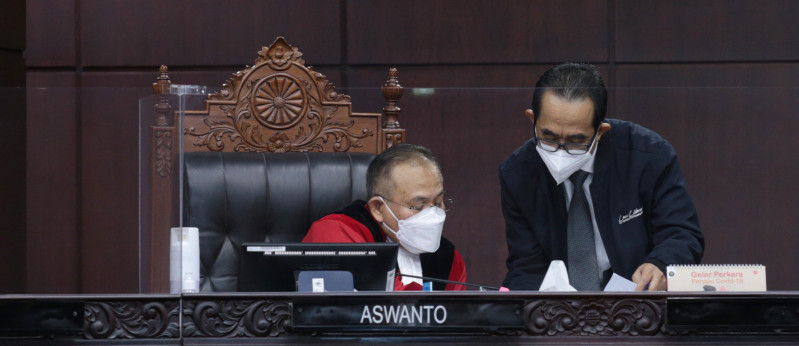
Deputy Chief Justice Aswanto at the ruling hearing of Law No. 19 of 2019 on the Corruption Eradication Commission, Tuesday (4/5/2021) in the Plenary Courtroom. Photo by Humas MK/Ifa.
JAKARTA, Public Relations—In the legal considerations of the Decision No. 70/PUU-XVII/2019 on the material judicial review of Law No. 19 of 2019 on the KPK Law, the Court states that the supervisory board is not authorized to sanction wiretap, search, and/or seizure (judicial/pro Justitia authority) by the Corruption Eradication Commission (KPK). The decision was read out on Tuesday, May 4, 2021 in the plenary courtroom.
In its verdict, the Court granted part of the petition filed by the rector of the Islamic University of Indonesia (UII) Fathul Wahid and several lecturers of UII Law Faculty. It annulled Article 12 B, Article 37B paragraph (1) letter b, and Article 47 of the KPK Law by declaring them unconstitutional and not legally binding.
Also read: KPK Law Challenged Again in Constitutional Court
Not in the Same Hierarchy
The Petitioners argued that Article 12 B, Article 37B paragraph (1) letter b, and Article 47 of the KPK Law were in violation of Article 28D paragraph (1) of the 1945 Constitution. They believe wiretapping, search, and/or seizure are pro Justitia actions, thereby the authority to sanction them shouldn’t fall to the KPK supervisory board.
Reading out the Court’s legal considerations, Deputy Chief Justice Aswanto stated that based on under Article 12 of the KPK Law, the authority to sanction wiretapping, search, and/or seizure is granted by the law to the KPK in judicial process (pro Justitia). In addition, under Article 12B paragraph (1) of the KPK Law, KPK’s wiretap must receive a written permission from the supervisory board.
The Court also considered the position of the supervisory board within the KPK Law, which was inherently the internal scope of the KPK. The supervisory board serves as a supervisor to prevent abuse of authority. As an element of the KPK, it serves and has the authority to oversee the implementation of the KPK’s duties and authorities.
“Therefore, the position of the supervisory board is not within the same hierarchy as the KPK leadership, so in the grand design of corruption eradication, the two are not superior and subordinate to each other, but synergize to perform their functions,” Justice Aswanto said.
Also read: KPK Adviser Calls Corruption an Extraordinary Crime
Not Law Enforcement Apparatus
The KPK, Justice Aswanto added, is independent and free from interference, including during wiretapping, which infringes on the right to privacy—which is a pro Justitia action. The provision that requires the KPK to obtain permission from the supervisory board before conducting a wiretap cannot be seen to be part of checks and balances mechanism, because basically the supervisory board is not a law enforcement apparatus, unlike the KPK leadership, and thus do not have pro Justitia authorities.
“The supervisory board oversees the implementation of the KPK’s duties and authorities in order to prevent violations of such duties and authorities. In this context, integrity cannot be exercised without control from any external party. Based on logical reasoning, the control is a means to prevent the possibility of abuse of power as long as it is unrelated to pro Justitia authority,” Justice Aswanto said.
Also read: Expert Deems Amendment Process of KPK Law Invalid
Overlap of Authority
The Court then stressed the KPK leadership’s obligation to obtain permission from the supervisory board to conduct a wiretap, which signals overlap of law enforcement authority, especially pro Justitia authority that is supposed to belong only to law enforcement agencies and officials. This obligation is a form of intervention in law enforcement apparatus by an agency that functions outside of law enforcement.
The Court also stressed that wiretapping concerns the right to privacy, thus requiring strict supervision. This means, Justice Aswanto added, that the KPK cannot conduct wiretap without control or supervision, although not in the form of permission, which indicates intervention in KPK leadership’s law enforcement by the supervisory board—as if the KPK leadership is subordinate to the supervisory board.
Based on the aforementioned legal considerations, no request of permission from the board is needed before conducting a wiretap, which is required by Article 12B paragraph (1) of the KPK Law. Therefore, the provision must be declared unconstitutional and, as a juridical consequence, Article 12B paragraphs (2), (3), and (4) of the KPK Law is no longer relevant and must be declared unconstitutional.
“Therefore, the Court believes that the Petitioners’ argument relating to the unconstitutionality of Article 12B of Law No. 19 of 2019 is legally grounded. As a juridical consequence, the supervisory board cannot interfere with the [KPK’s] judicial/pro Justitia authority and Article 12B of Law No. 19 of 2019 has been declared unconstitutional, so the phrase ‘be accountable to the supervisory board’ in Article 12C paragraph (2) of Law No. 19 of 2019 must also be declared unconstitutional insofar as not be interpreted as ‘reported to the supervisory board,’” Justice Aswanto said.
Also read: KPK Investigator Says Supervisory Board's Approval Hampers Enforcement of Law
Ultra Petita
The Petitioners also questioned the constitutionality of the supervisory board’s permission for search and/or seizure, as referred to by Article 47 paragraph (1) of the KPK Law. Constitutional Justice Enny Nurbaningsih explained that the Court believes that, as they are pro Justitia actions, permission from the supervisory board—which is not part of the law enforcement—is irrelevant. This is because such authority is a judicial/pro Justitia action.
Justice Enny also said that because no permission from the board is necessary for search and/or seizure and only a notification is needed, it leads to the juridical consequence that the phrase ‘with written permission from the supervisory board’ in Article 47 paragraph (1) of Law No. 19 of 2019 must be interpreted as ‘by notifying the supervisory board.’ In addition, although the Petitioners didn’t question Article 47 paragraph (1) of Law No. 19 of 2019, it must be declared unconstitutional because it is no longer relevant.
“Based on the aforementioned legal considerations, the Court believes that the Petitioners’ argument of the unconstitutionality of Article 47 paragraph (1) of Law No. 19 of 2019 is partially legally grounded,” Justice Enny said.
Moreover, because the supervisory board cannot sanction the KPK’s wiretap, search, and/or seizure, the Court also believes that as a juridical consequence, Article 37B paragraph (1) letter b of Law No. 19 of 2019, which also regulates the supervisory board’s authority to sanction the KPK’s wiretap, search, and/or seizure, must be declared unconstitutional. “Therefore, the Petitioners’ argument regarding the unconstitutionality of Article 37B paragraph (1) letter b of Law No. 19 of 2019 is legally grounded,” Justice Enny said.
Also read: Supervisory Board's Authorities and Status Not Mentioned in KPK Law
Time Limit
In order to avoid abuse of authority in relation to the KPK’s wiretap, search, and/or seizure and the supervising function of the supervisory board, the Court believes that the KPK should notify the board no later than 14 workdays after the wiretap, search, and/or seizure.
“Next, under Article 38 of Law No. 19 of 2019, for a search, the provisions of Law No. 8 of 1981 on the Criminal Procedure Code (KUHAP), permission from the chief judge of the local district court is required and, under an emergency, a search can be conducted first before notifying and receiving permission from [said judge], as regulated by Articles 33 and 34 of KUHAP. Therefore, the KPK’s search and/or seizure no longer requires permission from the supervisory board. Meanwhile, on the basis of a strong suspicion of sufficient preliminary evidence, the KPK may conduct seizure without the permission of [said judge],” Justice Enny explained.
Two Years
The Petitioners also argued that Article 40 paragraph (1) of the KPK Law violated Article 28D paragraph (1) of the 1945 Constitution because the phrase ‘whose investigation and prosecution is not completed by a maximum of 2 (two) years’ would lead to legal uncertainty. This is because investigation and prosecution are two different processes and because there is legal uncertainty concerning the start of the actions.
The Court believes that a two-year time limit for investigation and prosecution as regulated by Article 40 paragraph (1) of the KPK Law is a special authority granted to the KPK as an extraordinary body that is authorized to deal with corruption acts as extraordinary crimes. The authority to terminate an investigation and/or prosecution can be used by the KPK as a reason to determine suspects with strong evidence, so based on legal reasoning, the two-year time limit starts after the issuance of a notice of commencement of investigation (SPDP).
“The counting of two years is accumulated since the investigation, prosecution, to transfer to trial. So, after two years, if the case is not transferred to trial and the KPK doesn’t issue an [investigation termination warrant], the suspect can file for a pretrial motion,” Justice Enny explained.
Based on those legal considerations, the Petitioners’ concern regarding unclear counting of the issuance of investigation termination warrant under Article 40 paragraph (1) of the KPK Law is legally grounded insofar as the phrase ‘is not completed within a maximum of 2 (two) years’ is not interpreted as ‘is not completed within a maximum of 2 (two) years since the issuance of a notice of commencement of investigation (SPDP).’
“As a juridical consequence, the supervisory board cannot interfere with the KPK leadership’s judicial/pro Justitia authority as considered above, so the phrase ‘must be reported to the supervisory board no later than 1 (one) week’ in Article 40 paragraph (2) of Law No. 19 of 2019 must also be declared unconstitutional insofar as not interpreted as ‘by notifying the supervisory board no later than 14 (fourteen) workdays,” Justice Enny read out.
Does Not Weaken KPK’s Independence
The Court also considered the Petitioners’ argument that Article 1 point 1 and Article 3 of the KPK Law violate Article 24 paragraph (3) of the 1945 Constitution. The Petitioners believed the inclusion of the KPK in the executive branch would weaken its independence, in turn impacting its performance in eradicating corrupting. Justice Aswanto stated that the Court had stressed this in previous decisions, such as No. 012-016-019/PUU-IV/2006 and No. 36/PUUXV/2017, both of which state that the KPK’s independence and freedom from outside influence is within its exercise of duties and authorities that must be free from the influence, direction, or pressure from any party.
In considering the a quo article and the KPK as an institution, the Court must also refer to its previous decisions. Therefore, the enactment of the phrase ‘within the executive branch’ in Article 3 of the KPK Law doesn’t interfere with the KPK’s independence. This is because the KPK is not accountable for the holder of the executive power (president) under Article 20 of Law No. 3 of 2002, which reads, “The KPK shall be responsible to the public to perform its duties. The KPK shall also be obliged to convey reports transparently and regularly to the President, the DPR, and the BPK.” “The report to the president doesn’t mean the KPK is responsible to the president,” Justice Aswanto said.
One of the signs of an independent state institution is the lack of relation to any holder of state powers in performing its duties and authorities. The elucidation to Article 3 of the KPK Law even defines ‘any power’ as the powers that may influence the duties and authorities of the KPK or the commission’s members individually—from the executive, judicial, or legislative branches, or other parties that are related to corruption cases, or in any situation with any reason. “Based on the aforementioned legal considerations, the Petitioners’ argument that Article 3 of Law No. 19 of 2019 is unconstitutional is legally groundless,” Justice Aswanto said.
The Petitioners also feared that the KPK employees’ appointment as state civil apparatuses (ASNs) would lead to dualism in its supervision—by the Civil Service Commission (KASN) and the supervisory board—which can lead to legal uncertainty and injustice. The Court believes supervision by the KASN applies to all ASNs in all agencies/institutions without exception, including in law enforcement agencies. The Court saw no relevance of questioning ASN status with supervision by KASN and the supervisory board, because both can complement each other.
Writer : Nano Tresna Arfana
Editor : Lulu Anjarsari P.
PR : Raisa Ayudhita
Translator : Yuniar Widiastuti (NL)
Translation uploaded on 5/5/2021 17:20 WIB
Disclaimer: The original version of the news is in Indonesian. In case of any differences between the English and the Indonesian version, the Indonesian version will prevail.
Tuesday, May 04, 2021 | 22:22 WIB 948