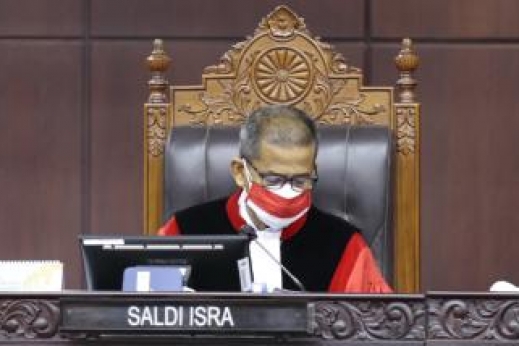
Constitutional Justice Saldi Isra at the ruling pronouncement hearing of case No. 98/PUU-XVIII/2020, Thursday (14/1/2021) in the Plenary Courtroom of the Constitutional Court. Photo by Humas MK/Teguh.
JAKARTA, Public Relations of the Constitutional Court—The Constitutional Court (MK) decided to dismiss the judicial review petition of Law No. 39 of 1999 on Human Rights (HAM) filed by Alamsyah Panggabean, who argued that Article 15 of the Human Rights Law was in violation of Article 28H paragraph (2) of the 1945 Constitution.
“[The Court] adjudicated, declares the Petitioner’s petition inadmissible,” said Chief Justice Anwar Usman at the hearing of Decision No. 98/PUU-XVIII/2020 on Thursday, January 14, 2021 in the plenary courtroom, which took place according to existing health protocols.
Also read: Requesting Appointment into DPRD, Citizen Challenges Human Rights Law
In its legal considerations read out by Constitutional Justice Saldi Isra, the Court stated that the petition was obscure for not meeting the formal requirements as referred to in Article 31 paragraph (1) of the Constitutional Court Law. The Court has reviewed the petition at the preliminary hearing on November 23, 2020. Based on Article 39 of the Constitutional Court Law, the justice panel was obligated to advise the Petitioner to revise his petition and clarify matters.
At the petition revision hearing on December 16, 2020, the Petitioner conveyed the revised petition. While the Court admitted that the revision met the format of a judicial review petition as stipulated in Article 31 paragraph (1) of the Constitutional Court Law and Article 5 paragraph (1) letters a, b, c, and d of the Constitutional Court Regulation (PMK) No. 6/PMK/2005, the elaboration of each part didn’t.
Also read: Human Rights Law Petitioner Affirms Petition Background
Constitutional Court Doesn’t Determine DPRD Members
Justice Saldi then said that, despite the petition being obscure, the Court must stress that at the preliminary hearing the justices had advised the Petitioner that, in relation to his objection to the filling of vacancies of Padang Lawas Regency Regional Legislative Council (DPRD) of 2019-2024 from which he was excluded, the Court is not authorized to determine whether someone may or may not be a DPRD member. In addition, the issue raised by the Petitioner isn’t related to the constitutionality of Article 15 of Law No. 39 of 1999, which in fact provides each person with guarantee of self-development, including the Petitioner, in order to participating in developing the community, nation, and state, as referred to in Article 28C paragraph (1) of the 1945 Constitution.
“Although the Court is authorized to adjudicate on the a quo petition, because the Petitioner’s petition was obscure, the Court did not consider [it] further,” Justice Saldi said at the hearing, which was attended by the litigating parties remotely.
The Petitioner challenged Article 15 of the Human Rights Law. He believed that based on Article 13 paragraph (1) of Law No. 38 of 2007 of the Formation of Padang Lawas Regency in North Sumatera Province, the filling of vacancies of Padang Lawas Regency DPRD for the first time must also through a decree. He requested that he be given equal treatment as stipulated in the article, by being declared a DPRD member, so that the equality and justice mandated by Article 28H paragraph (2) of the 1945 Constitution are realized.
The Petitioner believes from a sociological standpoint the formation of the Human Rights Law contains the hope that every human being would think and act for common interests in the life of society, nation, and state. This is actually an affirmative action for everyone who wants to think and act for common interests and for the sake of upholding human rights for every citizen.
Writer: Sri Pujianti
Editor: Nur R.
PR: Fitri Yuliana
Translator: Yuniar Widiastuti (Editor: Indah Apriyanti)
Translation uploaded on 01/15/2021 15:15 WIB
Disclaimer: The original version of the news is in Indonesian. In case of any differences between the English and the Indonesian version, the Indonesian version will prevail.
Friday, January 15, 2021 | 10:27 WIB 328