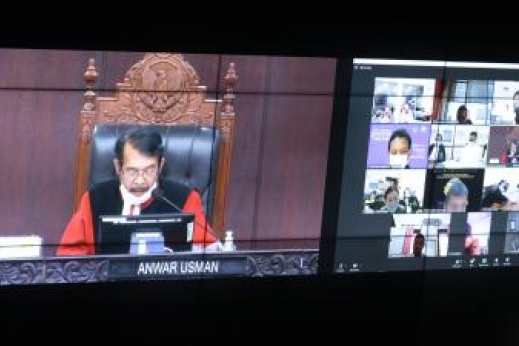
The ruling hearing on the petition for judicial review of Law Number 4 of 1996 concerning Mortgage Rights and Land-Related Objects was held online, Thursday (14/01) in the Courtroom. Photo by PR/Ifa
JAKARTA, Public Relations of Constitutional Court – The Constitutional Court (MK) rejected a petition for judicial review of Law No. 4 of 1996 on Mortgage over the Land and Objects Related to the Land (Mortgage Law) in the pronouncement of the Decision on Thursday (14/1/2021). The application for the case registered Number 84 / PUU-XVIII / 2020 was submitted by Rosmanidar, a housewife who stated that Article 6 of the Mortgage Rights Law is contrary to Article 28D Paragraph (1) and Article 28G Paragraph (1) of the 1945 Constitution.
Justice Manahan M.P. Sitompul, read out the Court’s legal opinion stated that the content of an engagement or agreement is always an obligation that is paired with a right, that is, the obligation of one party is the right of the other party, and vice versa. An engagement or agreement is a balance between achievements which then necessitates counter-performance action from the party who gets the achievement. Regarding this matter, in relation to the credit agreement with inheritance, there are questions that must be answered first by the Court whether the debt can or may be inherited.
Manahan explained, there are several legal schemes regarding the transfer of a debt agreement to another party, including cessie, subrogation, and novation. The three transfer schemes are optional transfers of creditors' rights. This means that the party that will take over the debtor's debt is in a free position to choose whether it will take over the debtor's debt or not. This freedom is based on an understanding of the risk of taking over the debt which places the taker as a new debtor to the creditor. According to the Court, freedom of choice is important in understanding the debt-receivable transfer scheme. The importance of this is based on the accounts receivable situation giving the holder the right to collect or earn achievements, while debt is an obligation to do something.
"So that freedom of choice which is based on awareness or knowledge as contained in the debt-receivable transfer scheme does not always occur in inheritance schemes," said Manahan in a hearing chaired by Chief Justice Anwar Usman accompanied by seven other constitutional justices in the Plenary Court Room of the Constitutional Court with the health protocols standards.
Accounts Receivable Transfer Concept
Furthermore, Manahan explained that in principle the difference between the concept of transfer of rights or obligations in a debt agreement with the concept of transfer of rights or obligations in an inheritance relationship. Debt inheritance, namely inheritance in which the object of inheritance is in the form of debt or certain obligations contained in the concept of positive Indonesian civil law, in which there are two types of legal perspectives, namely Islamic Law and Civil Law.
Considering these two inheritance law perspectives, the Court is of the opinion that an engagement or contractual agreement basically does not bind third parties who do not involve themselves in a contractual agreement. At least the third party also has the right to refuse to be involved in a contractual agreement made without his consent. In relation to inheritance, the Court stated that an agreement between debtors and creditors is not absolutely binding on the debtor's heirs. In the meaning of the word, the existence of an heir after the debtor dies does not automatically and absolutely make the heir a new debtor who replaces the deceased debtor's position.
"This then depends on the choice of civil law of each Indonesian citizen, whether to submit to Islamic Law or to submit to the Civil Code, which in the second a quo case the inheritance provisions are not the object of constitutionality review petitioned by the Petitioner," he explained.
The Needs of Special Provisions
Furthermore, Manahan said that there should be comprehensive provisions governing the execution of mortgage rights when the debtor in a debt agreement that is attached with the security rights has passed away before completing his obligations. This provision must fairly consider Indonesia's legal culture as in the realm of civil law, there are various arrangements regarding inheritance. The Court considers that this matter is none other than for the sake of providing respect or providing legal certainty for parties who in good faith submit themselves to an engagement, namely creditors or debtors who later become heirs.
Considering that the Petitioner argued that after the debtor (H. Mardi Can) passed away, there had been a disbursement of insurance for the repayment of the debtor's credit, but the creditor continued to sell the object of mortgage under Article 6 of Law 4/1996 through the Bandung State Property and Auction Service Office (KPKNL). However, with regard to the above argument, the Petitioner did not explain or further prove the occurrence of such insurance disbursement, such a case is of a casuistic nature which is not related to the constitutionality of norms.
"In other words, the Court is of the view that such problems constitute problems of implementation or application of statutory norms, the resolution of which is not within the authority of the Court," said Manahan.
The absence of provisions in Law 4/1996 regulating the transfer of objects of inheritance in relation to mortgages seems as a legal vacuum. However, the regulation is available in the field of Islamic Civil Law and in the Civil Code. Based on the Court's consideration, the Petitioners' argument that connects the provisions on the execution of mortgage rights with the Petitioner's obstruction of inheriting the debt and all legal obligations of the debtor is groundless. If the provisions of Article 6 of Law 4/1996 are omitted, it can cause other legal uncertainty. Therefore, the Petitioners' petition is groundless according to the law. (*)
Writer: Sri Pujianti
Editor : Lulu Anjarsari
PR : Tiara Agustina
Translator: SO (NL)
Translation uploaded on 15/1/2021 09.52 WIB
Disclaimer: The original version of the news is in Indonesian. In case of any differences between the English and the Indonesian version, the Indonesian version will prevail.
Thursday, January 14, 2021 | 18:31 WIB 661