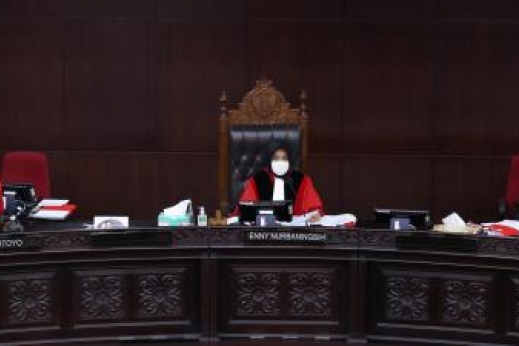
Constitutional Justices Enny Nurbaningsih (chair), Saldi Isra, and Daniel Yusmic P. Foekh at the judicial review hearing of the Construction Services Law, Monday (14/12/2020) in the Plenary Courtroom of the Constitutional Court. Photo by Humas MK/Ifa.
JAKARTA, Public Relations of the Constitutional Court—The Constitutional Court (MK) held the petition revision hearing of the judicial review of Law No. 2 of 2017 on Construction Services on Monday, December 14, 2020. Through attorney Hazmin A. St. Muda, the Petitioner conveyed the revisions to the petition virtually at the hearing chaired by Constitutional Justice Enny Nurbaningsih.
He affirmed the background of the petition. He also stated that based on Article 15 paragraph (1) letter a of the Government Administration Law, Article 105 of the a quo law must be implemented no later than two years since the a quo law was promulgated. Article 105 of the a quo law shows legal uncertainty and restricts the construction service community from fighting for their rights collectively through associations, business entities, and professional associations in order to develop the society, nation, and state, thus is in violation of Article 28D paragraph (1) and Article 28C paragraph (2) of the 1945 Constitution insofar as not be interpreted as “implementing regulations of this law that are stipulated more than 2 (two) years since the promulgation of this law have no legal force.”
Based on the elaborations, the Petitioner requested that the Court grant his petition and declare Article 105 of the Construction Services Law unconstitutional insofar as not be interpreted as “implementing regulations of this law that are stipulated more than 2 (two) years since the promulgation of this law have no legal force.”
Also read: Implementing Provision Past Deadline, Construction Service Law Challenged
The case No. 93/PUU-XVIII/2020 was filed by Andi Amir Husry on behalf of the Indonesian Electricity Contractors Association AKLINDO. He challenged Article 105 of the Construction Services Law, which reads, “Implementing Regulations of this Law must be stipulated no later than 2 (two) years since the promulgation of this Law.”
He believes that Article 105 of the Construction Services Law has created legal issues restricting construction service actors from fighting for their rights collectively along with associations. This, he alleged, violates Article 28C paragraph (2) of the 1945 Constitution insofar as not be interpreted that implementing regulations of this law that are issued more than two years after the law was promulgated is not legally binding.
The Government issued the implementing regulations of Law No. 2 of 2017 on Construction Services: the Government Regulation No. 22 of 2020 on Construction Services; the Regulation of the Minister of Public Works and Housing No. 10 of 2020 on the Accreditation of Construction Services Business Entities, Construction Services Professional Associations, and Accredited Construction Services Supply Chain-Related Associations; the Decree of the Minister of Public Works and Housing No. 1410/KPTS/M/2020 on Construction Services Business Entity Associations, Construction Services Professional Associations, and Construction Services Supply Chain-Related Associations. However, these norms were issued after the deadline stipulated in Article 105 of the Construction Services Law.
The Petitioner believes that these regulations were issued too late, causing legal issues over its legal force. In addition, the economic crisis as a result of the COVID-19 pandemic and the incomplete efforts to accelerate infrastructure and regulations potentially leads to a wave of layoffs. As a result, many business entity associations and construction service professional associations are not accredited, leading to job uncertainty. These regulations are not in accordance with government policies in economic recovery from the impact of the COVID-19 pandemic, on eradicating poverty, empowering MSMEs, and accelerating infrastructure development. In addition, these regulations only accredit a small number of business entity associations and construction service professional associations, potentially causing unfair business competition due to monopolistic practices.
“The legal uncertainty in the a quo article has resulted in the ambiguity of the transitional role played by the National [Construction Services Development Board (LPJK)] in the context of registration, accreditation, and certification," said Arco Misen Ujung, the Petitioner’s attorney, at a virtual hearing on Monday, November 16, 2020, which was presided over by Constitutional Justices Enny Nurbaningsih (chair), Saldi Isra, and Daniel Yusmic P. Foekh.
Writer: Nano Tresna Arfana
Editor: Nur R.
PR: Muhammad Halim
Translator: Yuniar Widiastuti (NL)
Translation uploaded on 12/16/2020 23:17 WIB
Disclaimer: The original version of the news is in Indonesian. In case of any differences between the English and the Indonesian version, the Indonesian version will prevail.
Tuesday, December 15, 2020 | 08:36 WIB 450