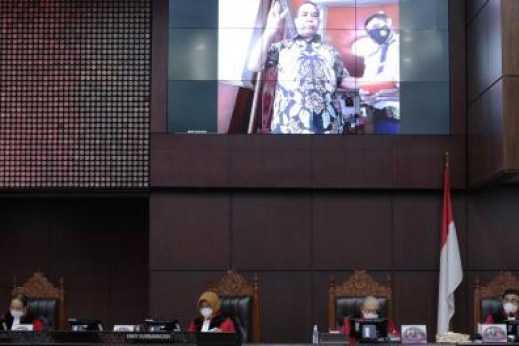
Sonny Keraf taking oath to deliver statement as an expert for the Petitioners at the judicial review hearing of the Mineral and Coal Mining Law, Wednesday (18/11/2020) virtually. Photo by Humas MK/Gani.
JAKARTA, Public Relations of the Constitutional Court—In order to ensure that state-controlled natural resources are used for the maximum welfare of the people, it is time that state-owned enterprises (SEOs) prioritize minerals and coal without limiting private participation because the private sector, especially holders of contracts of work (KK) and coal mining concession work agreements (PKP2B), have been granted mining concessions for such wide areas, it is time that SOEs be assigned to exploit minerals and coal in state reserves (WPN), said Sonny Keraf, an expert for the Petitioners of case No. 64/PUU-XVIII/2020. The sixth judicial review hearing of Law No. 3 of 2020 on the Amendment to Law No. 4 of 2009 on Mineral and Coal Mining was held by the Constitutional Court (MK) on Tuesday, December 8, 2020 for cases No. 59/PUU-XVIII/2020, No. 60/PUU-XVIII/2020, and No. 64/PUU-XVIII/2020.
Also read:
Mineral and Coal Mining Law Challenged
Petitioners of Mineral and Coal Mining Law Revise Petition
Sonny further explained that Article 169 letter b, in which KK and PKP2B are adjusted to Law No. 4 of 2009, which is also maintained in Law No. 3 of 2020, must be understood for the same noble intention to limit KK and PKP2B concession area and period, as stipulated in Law No. 4 of 2009 and is also maintained in Law No. 3 of 2020. In fact, this limitation, he added, has a very broad ideological and constitutional message. One of them is the fifth principle of Pancasila and Article 33 paragraph (4) of the 1945 Constitution. This means that control of mineral and coal resources needs to be regulated to avoid monopoly and ensure the principles of economic democracy, togetherness, efficiency, and justice.
Sonny believes these restrictions will have a positive impact in changing the national economy, particularly the highly oligopolistic mineral and coal. Given that this business is still controlled by a handful few, which is against the principle of justice, it may cause national social and political unrest.
"Therefore, it is very unfair and against Pancasila and the 1945 Constitution if KK and PKP2B holders who have been granted concessions for decades are instead given privileges with mining areas as large as the contracts or agreements as indicated by Article 169A paragraph (2) letter b of the Mineral and Coal Mining Law. So, it is very clear that [it] must be annulled," he explained.
Before concluding the hearing, Justice Anwar informed that the Court will be handling the 2020 regional head election (pilkada) result dispute settlement, thus the hearing to present the expert and witness for the Petitioners of case No. 60/PUU-XVIII/2020 will be postponed. The Registrar’s Office will inform the parties when the hearing resumes.
Also read:
Govt: Revision to Mineral and Coal Mining Law to Improve Mining Sector’s Contribution
Experts: Mineral and Coal Mining Law Formally Defective
The petition No. 59/PUU-XVIII/2020 was filed by Kurniawan, a researcher at Sinergi Kawal BUMN, an organization focusing on monitoring, responding to, and providing input to SOEs in mining and coal. He believes the Mineral and Coal Mining Law regulates the relationship between the central and regional government as well as the exploration of natural resources. This means that the discussion of the Mineral and Coal Mining bill required the involvement of the Regional Representatives Council (DPD) as the people entrusted the DPD to represent regional interests in the formation of the law.
The case No. 60/PUU-XVIII/2020 was filed by H. Alirman Sori and seven other petitioners. They claimed that their constitutional rights were violated because the formation of the law was discussed exclusively and privately without transparency as stipulated by existing laws and regulations. The discussion of the bill didn’t involve the DPD when it has the authority mandated by the Constitution in discussing bills relating to the relationship between the central and regional government as well as the exploration of natural resources and other economic resources.
Meanwhile, the petition of case No. 64/PUU-XVIII/2020 was filed by by Helvis, an advocate specializing on mining, and Muhammad Kholid Syeirazi, the secretary of Nahdlatul Ulama’s Scholars Association (ISNU). They challenge Article 169A, which they believe has granted the minister too broad an authority to guarantee the extension to extend special mining business license (IUPK) and reduced the role of BUMN (SOEs) and BUMD (Regional Government-Owned Enterprises). They believe it to be against Article 75 of the Mineral and Coal Mining Law.
Writer: Sri Pujianti
Editor: Nur R.
PR: Raisa Ayudhita
Translator: Yuniar Widiastuti (NL)
Translation uploaded on 12/11/2020 11:33 WIB
Disclaimer: The original version of the news is in Indonesian. In case of any differences between the English and the Indonesian version, the Indonesian version will prevail.
Wednesday, December 09, 2020 | 14:22 WIB 430