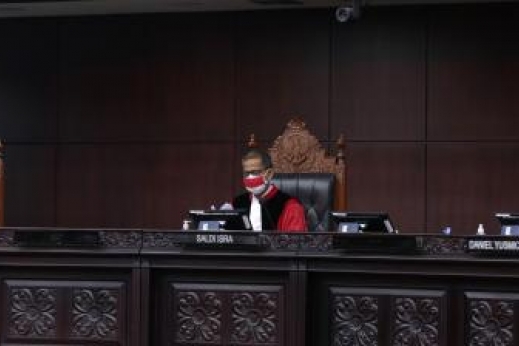
Panel chair Constitutional Justice Saldi Isra with Constitutional Justices Suhartoyo and Daniel Yusmic P. Foekh at the judicial review hearing of Law No. 14 of 2005 on Teachers and Lecturers, Tuesday (8/12/2020) in the Courtroom of the Constitutional Court. Photo by Humas MK/Ifa.
JAKARTA, Public Relations of the Constitutional Court—The petition revision hearing of the judicial review of Law No. 14 of 2005 on Teachers and Lecturers was held by the Constitutional Court (MK) on Tuesday, December 8, 2020. The Petitioner of case No. 94/PUU-XVIII/2020 is Ahmad Amin.
The legal standing was revised. The norms petitioned were reduced to five articles: Article 16 paragraph (2), Article 18 paragraph (2), Article 53 paragraph (2), Article 55 paragraph (2), and Article 56 paragraph (1) of the Teacher and Lecturer Law, which stipulates that the professional allowance and honorarium be set at one or two times of the basic salary of teachers, lecturers, or professors.
“This shows that the DPR [House] as the legislative body has ordered the president to expend the state finance with a certain budget for a specific group, as stipulated by the House in the a quo law in 2005 through its lawmaking authority. This doesn’t comply with the [principle] of equality of high state institutions, the checks and balances in the separation of powers based on 45,” Ahmad said before the panel chaired by Constitutional Justice Saldi Isra.
He also emphasized that as the House had mandated that the expenditure be followed by the president; the Government had limited the independence in drafting annual work plans, development targets, and state finance management by the Government, the House through the a quo law had controlled the Government’s function in planning and managing state finances, especially in education.
“The House’s lawmaking authority has been abused to limit the president’s authority and power as a holder of government power according to the 1945 Constitution, especially in the management of education budget to achieve the state goal to educate the nation. The House tends to control the president’s power, which is not in accordance with the principle of checks and balances in the separation of powers based on the 1945 Constitution. This separation of powers is described in the Constitutional Court Decision No. 35/PUU-XI/2013,” the Petitioner explained.
Also read: Civil Servant Questions Provision on Salaries and Allowances of Teachers and Lecturers
The Petitioner is Ahmad Amin, a civil servant (PNS) at the Pati Regency Education Office (Central Java). He challenges Article 16 paragraph (2), Article 18 paragraph (2), Article 53 paragraph (2), Article 55 paragraph (2), and Article 56 paragraph (1) of the Teacher and Lecturer Law against 19 articles in the 1945 Constitution: Article 1 paragraph (3); Article 4 paragraph (1); Article 5 paragraph (2); Article 18 paragraphs (2) and (5); Article 20 paragraphs (1), (2), and (4); Article 20A paragraph (1), Article 22A; Article 22D paragraphs (1) and (2); Article 23 paragraphs (1) and (2); Article 23C; Article 27 paragraph (1); Article 28D paragraphs (1) and (2); and Article 28H paragraph (4).
He revealed that he currently receives a basic salary based on the Government Regulation No. 7 of 1977 on the Regulation for Civil Servants’ Salaries as amended by the Government Regulation No. 15 of 2019 on the Eighteenth Amendment to the Government Regulation No. 7 of 1977 on the Regulation for Civil Servants’ Salaries, which, directly or indirectly, is within the authority of the executive branch. Therefore, he believes he has the right to challenge the a quo law materially as well as formally, with regards to its formation and the role of the executive and legislative branches in implementing the 1945 Constitution, the authority of the legislative branch as represented by the Regional Representatives Council (DPD) and the House of Representatives (DPR), and the authority of the executive branch (president).
He believes according to logical reasoning, the enactment of the a quo provision, which stipulates basic salary as belonging to the professional allowance budget and state expenditure for teachers and lecturers, has violated his constitutional rights to equality before the law and in government as regulated in Article 27 paragraph (1) of the 1945 Constitution. In addition, the a quo provision, which states that the basic salary of teachers appointed by the education unit administered by the Government according to logical reasoning has violated the Petitioner’s constitutional rights as stipulated in Article 28D Paragraph (1) of the 1945 Constitution.
Writer: Nano Tresna Arfana
Editor: Nur R.
PR: Annisa Lestari
Translator: Yuniar Widiastuti (NL)
Translation uploaded on 12/11/2020 11:32 WIB
Disclaimer: The original version of the news is in Indonesian. In case where any differences occur between the English and the Indonesian version, the Indonesian version will prevail.
Wednesday, December 09, 2020 | 14:12 WIB 474