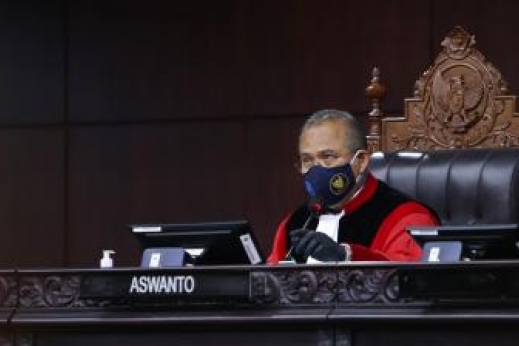
Deputy Chief Justice Aswanto opening the judicial review hearing of Law No. 7 of 2020 on the Constitutional Court, Tuesday (24/11/2020) in the Courtroom of the Constitutional Court. Photo by Humas MK/Ifa.
JAKARTA, Public Relations of the Constitutional Court—The Constitutional Court (MK) held another judicial review hearing of Law No. 7 of 2020 on the Third Amendment to Law No. 24 of 2003 on the Constitutional Court on Tuesday November 24, 2020. The petition No. 90/PUU-XVIII/2020 was filed by Islamic University of Indonesia (UII) law faculty lecturer Allan Fatchan G.W. He argued that Article 15 paragraph (2) letter d, Article 22, Article 23 paragraph (1) letter d, Article 26 paragraph (1) letter b, and Article 87 of the Constitutional Court Law violates Article 1 paragraph (3), Article 24 paragraph (1), Article 28D paragraph (1), and Article 28D paragraph (3) of the 1945 Constitution.
At this second hearing, Allan conveyed the revision to his petition regarding the Court’s authority, the Petitioner’s legal standing, and the argument of the petition. He said that in the formal judicial review of the a quo law he believes, as a citizen and constitutional law educator, he has the voting right in the general elections and the right to give a constitutional mandate to the DPR (House of Representatives). He was disappointed by the drafting and discussion of Law No. 7 of 2020, which flouted the Law on the Formation of Legislation.
“The Constitutional Court Law doesn’t comply with existing provisions. It was proven that the its formation was hasty and [the Petitioner] couldn’t access the [relevant] documents. The Petitioner was disappointed by this product of the legislature,” Allan explained virtually to Deputy Chief Justice Aswanto (panel chair), Constitutional Justice Arief Hidayat, and Constitutional Justice Enny Nurbaningsih.
Allan argued in the background to the petition that he could potentially become a constitutional justice when he reaches 47 years of age. However, due to the a quo law, he would have to wait for 8 more years before he could apply. For this reason, he argued that the provision harmed his constitutional right to equal treatment in government, in this case to be a candidate for constitutional justice.
Also read: Provision on Age of Constitutional Justices Challenged
At the preliminary examination hearing on Tuesday, November 10, 2020, the Petitioner had said that as a taxpayer he was concerned with the development and performance of the Constitutional Court, as well as the fulfillment of constitutional rights and constitutionalism. He believed that the formal process of the newly revised Constitutional Court Law had violated and contradicts the provisions on the procedures for the formation of laws in the Law on the Formation of Laws and Regulations, which implements Article 22A of the 1945 Constitution.
The Petitioner challenged the content of Article 15 paragraph (2) letter d, which raised the age limit for constitutional justices from 47 to 55 years. The Petitioner believes the limit is not urgent and it isn’t mentioned in the academic text for the Constitutional Court bill. Not to mention, it is against the Constitutional Court Decision No. 7/PUU-XI/2013. Therefore, the legislature has violated the rights of citizens to recognition, guarantee, protection, and fair legal certainty and equal treatment before the law for the provision of this norm.
The Petitioner also said the article contradicts Article 28D paragraph (3) of the 1945 Constitution because the 1945 Constitution stipulates that constitutional justices shall have integrity and personality beyond reproach, are just, and are statesman who understand the Constitution and the state administration, and are not concurrently holding state offices. Thus, although a constitutional justice candidate has not met the provisions of the a quo article, as long as they fulfill the requirements contained in Article 24C paragraph (5) of the 1945 Constitution, they must be viewed as having constitutional rights to be appointed a constitutional justice. Therefore, the Petitioner requested that the Constitutional Court declare the formation of Law No. 7 of 2020 Third Amendment to Law No. 24 of 2003 on the Constitutional Court not meeting the provisions in the 1945 Constitution.
Writer: Sri Pujianti
Editor: Lulu Anjarsari
PR: Raisa Ayuditha
Translator: Yuniar Widiastuti (NL)
Translation uploaded on 11/25/2020 14:13 WIB
Disclaimer: The original version of the news is in Indonesian. In case of any differences between the English and the Indonesian version, the Indonesian version will prevail.
Tuesday, November 24, 2020 | 19:02 WIB 259