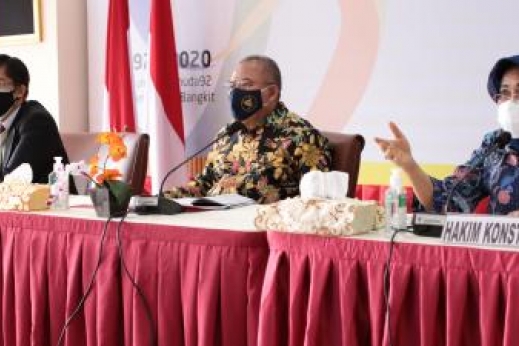
Deputy Chief Justice Aswanto and Constitutional Justice Enny Nurbaningsih speaking at the technical assistance program on the 2020 election of governors, regents, and mayors for the Constitutional Lawyers’ Forum, Wednesday (4/11/2020) virtually from the Constitutional Court. Photo by Humas MK/Gani.
JAKARTA, Public Relations of the Constitutional Court—The second day of the technical assistance program on the 2020 election of governors, regents, and mayors for the Constitutional Lawyers’ Forum ran on Wednesday, November 4, 2020. The program was organized the Constitutional Court's Pancasila and Constitution Education Center in Cisarua, Bogor, West Java both online and offline.
On this day, Deputy Chief Justice Aswanto and Constitutional Justice Enny Nurbaningsih taked about “The Procedural Law of the 2020 Elections of Governors, Regents, and Mayors.” Justice Aswanto explained the Constitutional Court Regulation (PMK) No. 6 of 2020, the latest regulation for the settlement of the 2020 regional head election (pilkada) disputes. “[This PMK] differ from the previous ones. [It] is an improvement of the previous ones. Hopefully [by understanding this PMK], [you] will not make any more technical mistakes,” he said to the participants.
The new PMK regulates the General Elections Commission’s (KPU) authority to accredit election observers, pursuant to Article 124 of Law No. 10 of 2016. In the previous PMK No. 5 of 2020, this authority was granted to Bawaslu (Elections Supervisory Agency). Justice Aswanto also talked about advocates’ changing attitudes toward Article 158 of the Pilkada Law.
“When [representing] the petitioner, advocates request that Article 158 be dismissed. When [representing] the respondent, advocates request that [it] applies. This compelled the Constitutional Court to revise [the regulations] for uniformity [in responding] to the norms in the law. There is a notion that Article 158 regulates the subject matter of the [pilkada dispute] cases [regarding] the percentage of vote acquisition. The thresholds of 2 percent, 1.5 percent, 1 percent, and 0.5 percent are related to vote acquisition,” he stressed.
In PMK No. 6 of 2020, the Court consistently uses Article 158 of the Pilkada Law. “However, because the Court believes [the article] has regulated the substance of the case, the requirements for whether [a petition] progresses as a dispute [case] or not will not be the same as those in previous [years]. Pilkada disputes used to be resolved in the beginning, but in the new PMK, the resolution regarding Article 158 (of the Pilkada Law) tends to be at the end of the case. this means that [the Court] complies with Article 158 but first seek information, look for evidence, obtain information on whether the figures determined by the KPU based on Article 158 (of the Pilkada Law) are indeed accurate. If [they’re not accurate], [the Court] hears the statements of all the litigating parties, rule on Article 158 (of the Pilkada Law) as decided by the KPU. The petitioner and the relevant party are [equal]. The objective [of the court proceedings] is to find substantive truth, not only formal truth,” he stressed.
Understanding the Pilkada Law
Meanwhile, Constitutional Justice Enny Nurbaningsih urged the participants to understand the Pilkada Law, the PMK on the procedural law, and apply their knowledge in the pilkada dispute cases so that the petition not be obscure. “The focus of the pilkada dispute cases is the KPU’s call [on the election results], including the KIP [Elections Independent Commission], in relation to the stipulation of election results by election organizers. This is important as is relates to the petitum, regarding what is requested by [the tickets]. Essentially, the object of pilkada disputes is the decisions of the KPU and the KIP,” she said.
She also explained the litigating parties in pilkada disputes. The petitioner is either the regional head candidate pairs/tickets or election observers in the case of single tickets. The respondent is the KPU or the KIP who called the results of the pilkada. Bawaslu is a testifier. The relevant party is either the other candidate pairs in the election or election observers. She added that the petitioners, the respondent, and the relevant parties usually do not file the case alone, but are represented by legal counsels. “Therefore, the power of attorney is crucial and must be signed by the grantor and recipient of the power. Do not ever forge the signatures,” she stressed.
Justice Enny said that the petition must be filed by three workdays after the election results are called by the respondent. The petition should include, in the least, what is requested, a copy of the KPU/KIP’s stipulation of the ticket or accreditation for the election observer, a copy of the petitioner’s identification, a copy of the advocate’s professional identification. The petition can only be filed once during the time limit, either online or offline.
The Constitutional Court’s History
Fajar menuturkan tonggak kesejarahan Mahkamah Konstitusi melalui satu putusan besar Kasus Marbury vs Madison (1803) di Amerika Serikat. “Sebagai tonggak kesejarahan pertama kali gagasan constitutional judicial review yang berarti judicial review dilakukan oleh pengadilan dan batu ujinya adalah Konstitusi sebagai hukum dasar tertinggi dalam konteks kita bernegara,” jelas Fajar yang menyajikan materi “Mahkamah Konstitusi dalam Sistem Ketatanegaran RI”.
Next, Head of the Public Relations and Domestic Cooperation Department Fajar Laksono Soeroso talked about four milestones in history that are related to the Constitutional Court in his presentation on “The Constitutional Court in the Indonesian Administration System.” The first is the Marbury v. Madison (1803) case in the United States. “This is the milestone in which the constitutional judicial review was done by a court against the Constitution as the touchstone, the highest law of the land,” he explained.
He explained that Marbury v. Madison began with “the midnight judges” case about the appointment of important officials late at night during the presidential election in the 1800s. Incumbent president John Adams was challenged by Thomas Jefferson and lost. Before president-elect Jefferson took office, Adams appointed is colleagues in important offices. “This was done late at night before the election of the new president in the next day. [Two] of the appointees was William Marbury, and James Madison, formerly a minister who was appointed as the Chief Justice of the Supreme Court. Late that night, John Adams signed the letter appointing his colleagues, including judges,” Fajar explained.
After Jefferson found out, he ordered James Madison to hold off on the appointment letters, but he was protested by Marbury. Marbury said the letters had been approved by the Congress. These new officials needed those letters to start their work. Jefferson refused. It was alleged that he wanted to annul those letters and appoint his own colleagues.
Marbury took the case to the Supreme Court. He requested that the Supreme Court, led by John Marshall, ordered now-president Jefferson to hand over those appointment letters. The Supreme Court saw that Marbury had a legal standing in the case. in its ruling, the Supreme Court stated that the Judiciary Act stated that it would be unconstitutional for the Supreme Court to order the government to do any act. “The legal world in the United States was shaken. There are debates on the issue. This led to the emergence of the constitutional judicial review. Norms of the law made by the people’s representatives can be revoked by the United States’ Supreme Court,” Fajar stressed.
He also explained that the Constitutional Court of Indonesia was formed thanks to a significant amendment to the 1945 Constitution, in which the People’s Consultative Assembly (MPR) was no longer the highest state institution but are now equal to other high state institutions such as the Constitutional Court, the president, and the Supreme Court. He also said that the Constitutional Court’s authorities are constitutionally limiting, meaning that they are mandated by the 1945 Constitution directly. This include the authority to rule on pilkada result disputes.
He then talked about the composition of the constitutional justices. “Nowadays there are questions on the Constitutional Court’s social media accounts. One of which is the concern about the constitutional justices being nominated by the president and the DPR [House of Representatives] while the laws are created by the president and the DPR,” he said. He also talked about the procedural law in the Constitutional Court, especially in relation to its main authority to rule on the judicial review of statutory laws.
Stages of Pilkada Dispute Resolution
In the next session, Deputy Registrar I Triyono Edy Budhiarto talked about “The Stages and Mechanism of the Dispute Resolution of the Results of the 2020 Election of Governors, Regents, and Mayors,” which starts with the filing of petition, the revision of the petition, and the check over the completeness of the petition. He said that after the Court announces the results of the check over the completeness and revision of the petition, it is followed by the registration on the petition in the e-BRPK (electronic constitutional case registration book). Copies of the petition are then sent to the respondent and Bawaslu. The application by the relevant party is accepted and the schedule for the hearing is announced to al litigants. The proceedings start with a preliminary hearing, evidentiary hearings, and the justice deliberation meeting. The ruling is then pronounced and the copies of the decision is distributed.
The KPU announced the election results at the provincial level on December 16-26 and at the regency/city level on December 13-23. Then the petition can be filed afterward, starting December 16 at the provincial level and December 13 at the regency/city level, up to January 5 at midnight.
The second day of the technical assistance program was concluded with a presentation on “The Techniques of Drafting the Petitioner’s Petition and the Statement of the Relevant Party in the Dispute of the 2020 Elections of Governors, Regents, and Mayors” by substitute registrar Syaiful Anwar. He explained that the pilkada dispute petition covers the petitioner’s status as an election ticket or an election observer, the Constitutional Court’s authorities, the object of the dispute (the respondent’s decision on the election results), the petitioner’s legal standing, and the deadline of the petition.
“According to Article 157 paragraph (5) of the Pilkada Law in conjunction with Article 7 paragraph (2) of PMK No. 5 of 2020, the petition is to be filed by three workdays after the results of the election are announced by the respondent. The petition must include the background to the petition and the petitum,” he explained.
The relevant party’s statement covers their name and address and/or those of their legal counsels, their email address, identity number, or the advocate’s professional identification number, and an explanation that the relevant party is an election ticket or election observer. It also includes the Constitutional Court’s authorities, a response to the petitioner’s legal standing, the deadline of the petition, the background to the petition, and the petitum, which includes the respondent’s decision on the election results.
The technical assistance program will take place for three days (Tuesday-Thursday, November 3-5, 2020). The participants will receive materials on the procedural law of the regional head election from constitutional justices, researchers, substitute registrars, and the IT staff.
Writer: Nano Tresna Arfana
Editor: Lulu Anjarsari
Translator: Yuniar Widiastuti (NL)
Translation uploaded on 11/13/2020 10:09 WIB
Disclaimer: The original version of the news is in Indonesian. In case of any differences between the English and the Indonesian version, the Indonesian version will prevail.
Wednesday, November 04, 2020 | 21:03 WIB 369