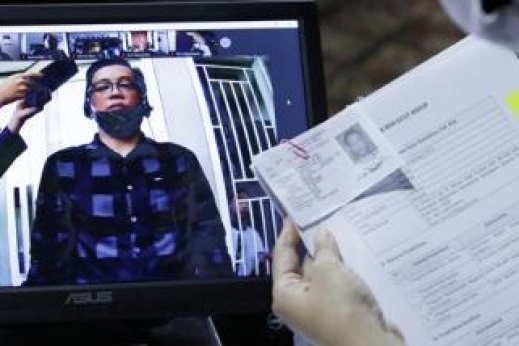
Expert Abdul Chair for Petitioners of case No. 43 taking oath before delivering his expertisevirtually at the judicial review hearing of the Law on the COVID-19 Pandemic, Thursday (22/10). Photo by Humas MK/Ifa.
JAKARTA, Public Relations of the Constitutional Court—The provision of the COVID-19 Law along the phrase “shall not constitute a loss to the state” in Article 27 paragraphs (1) and (2) has limited the law enforcement process. This restriction means [officials implementing the law] they cannot be prosecuted civilly or criminally, as long as they do so on good faith and is in accordance with statutory regulations. This means the a quo article has violated or negated the criminal justice system.
The statement was made by Abdul Chair Ramadhan, an expert presented by Ahmad Sabri Lubis and 9 other individuals in the case No. 43/PUU-XVIII/2020. The fifth judicial review hearing of Law No. 2 of 2020 on the Government Regulation in Lieu of Law No. 1 of 2020 regarding the Stipulation of the State’s Financial Policy and Fiscal Stability for the Mitigation of the COVID-19 Pandemic and/or in Order to Face Threats That Endanger the National Economy and/or the Financial System’s Stability into Law was held by the Constitutional Court on Thursday, October 22, 2020.
Also read: NGOs and Researchers Challenge COVID-19 Law
Abdul Chair said the enactment of the provision would lead to the termination of any criminal investigation on COVID-19 mishandling due to lack of evidence and objective and subjective requirements not being met to charge someone of a crime. “While in order to charge someone for a liability, a mistake must’ve been made, including any subjective mistake in an alleged corruption, which is the most determining aspect of a criminal case,” he said before Chief Justice Anwar Usman and the other eight constitutional justices.
Criminal Act and Liability
He further said that the criminal justice system in Indonesia is monistic, i.e. it combines criminal acts and criminal liability. The element of a criminal act is met when a person has committed a criminal act and a mistake. There must be a psychological or mental state that correlates with the act that one has committed to cause reproach. This is what will determine whether or not a person can be criminally liable for an action.
Also read: Petitioners of COVID-19 Law Reaffirm Arguments
He illustrated the definition of intent in the Corruption Law. The presence or absence of an intent must be proven in court. Therefore, he said good faith in the a quo law cannot be accounted for because it is only guided by intent. Meanwhile, criminal justice doesn’t focus on intent.
Court’s Authority
Abdul Chair said that, referring to Article 53 of the Criminal Code (KUHP), this can be interpreted as attempt. It can also be seen from mistake by concrete signs of intent. Criminal law actually divides intent into three: deliberate intent, certain intent, and possible intent. If one of those types is met, then deliberate action as an element of offense is also met.
Based on that reason, he stated that the provision in Article 27 of the a quo law relating to proving losses to the state and any mistakes therein are the authority of the court and must be proven in court. "Therefore, the provision in Article 27 of the COVID-19 Law has contradicted the principles of legal ideals, that is, certainty, justice, benefit, and legality, which must be fulfilled in every formulation of the law," he explained.
Also read: Village Funds Delayed, Two Village Chiefs Challenge COVID-19 Law
The virtual hearing was for seven cases: No. 37/PUU-XVIII/2020, No. 42/PUU-XVIII/2020, No. 43/PUU-XVIII/2020, No. 45/PUU-XVIII/2020, No. 47/PUU-XVIII/2020, No. 49/PUU-XVIII/2020, and No. 75/PUU-XVIII/2020. This fourth hearing had been scheduled to hear the testimonies of the House (DPR) and the expert for the Petitioners of case No. 37/PUU-XVIII/2020, YAPPIKA and others. The seven petitions challenge most of the articles in the Appendix to the COVID-19 Law.
Also read: Sri Mulyani: COVID-19 Law Protects the Public
The petition No. 37/PUU-XVIII/2020 was filed by the Indonesian Foundation to Strengthen Civil Society's Participation, Partnership, and Initiatives (YAPPIKA); Desiana Samosir; Muhammad Maulana; and Syamsuddin Alimsyah. Their reasons for the formal judicial review petition are: first, the Regional Representatives Council (DPD) was not involved in the discussion to determine whether the COVID-19 Perppu was approved or not; second, the virtual House (DPR) meeting was likely not have been attended by MPs.
The Petitioners of case No. 42/PUU-XVIII/2020, Iwan Sumule and the other 49 Pro-Democracy (ProDem) activists, argue that if the COVID-19 Law and its appendix are enacted, there will be no more discussions on the revised state budget (APBN-P) between the Government and the House as the president can revise the details of the state budget and stipulate that revision unilaterally in a presidential regulation, while Article 23C of the 1945 Constitution mandates that all matters related to the state finances be regulated with a law, not a presidential regulation.
Also read:
House: Ratification of COVID-19 Law, Legal Basis of Financial Authority
Expert: Budgeting during Emergency Must Be Transparent and Accountable
The Petitioners of case No. 43/PUU-XVIII/2020, Ahmad Sabri Lubis and 9 other individuals, argued that Perppu No. 1 of 2020, which is stipulated in Law No. 2 of 2020, doesn’t regulate the “compelling crisis situation” clearly and rather focuses on the Government’s authority to set the state budget deficit beyond the 3% GDP limit until fiscal year 2023.
The Petitioner of case No. 45/PUU-XVIII/2020 Sururudin argues that Article 2 and Article 12 paragraph (2) of the COVID-19 Law gives the president a great power to manage state finances without involving the House from 2020 to 2023. It is contrary to the scope referred to in Chapter I Article 1 of the a quo law, which clearly regulates the state’s need of the 2020 budget to implement the administration. However, Article 2 paragraph (1) letter a gives the Government the authority to exclude the House in managing state finances until 2023.
The Petitioners of case No. 47/PUU-XVIII/2020, village heads and village consultative bodies members Triono and 26 others, understand that the funds might be delayed or redirected to other causes due to COVID-19, but stated that it would be problematic if village funds were to be declared null relating to state financial policies for COVID-19 mitigation and/or in order to face threats that endanger the national economy. They also believe that Article 28 paragraph (8) of the COVID-19 Law is not in accordance with Article 2 paragraph (1) letter l, which doesn’t specify that the pandemic will motivate the central government to eliminate village funds.
The Petitioner of case No. 49/PUU-XVIII/2020, advocate Damai Hari Lubis, challenges the provision on state budget in the a quo perppu, which has to refer to the principles stipulated in Article 23 paragraph (1) of the 1945 Constitution, especially on the transparency and accountability of the use of the state budget for the people’s welfare, which cannot be interpreted in exclusive conditions but in any condition. He believes the enactment of Article 27 paragraphs (1), (2), and (3) of the COVID-19 Law disregards any abuse by public officials in using the state budget for COVID-19 mitigation, which will lead to legal setbacks.
The petition No. 75/PUU-XVIII/2020 was filed by 47 petitioners, including M. Sirajuddin Syamsuddin, Sri Edi Swasono, and H. M. Amien Rais. They argue that the approval of Perppu No. 1 of 2020 into Law No. 2 of 2020 by the House were done in the same session as its stipulation when it was supposed to be in “the next sessions,” according to Article 249 of Regulation No. 1 of 2020 on the House’s Code of Conduct relating to session year and session period. The approval of the perppu violated Article 22 paragraph (2) of the 1945 Constitution. As the House had received the perppu in session III, it must be approved/rejected in session IV. In addition, Article 22D paragraph (2) of the 1945 Constitution stipulates that the Regional Representatives Council (DPD) should’ve participated in the discussion of Perppu No. 1 of 2020 as the norm concerns the central and regional budget. However, the House discussed the perppu without the DPD’s involvement.
Writer: Sri Pujianti
Editor: Lulu Anjarsari
PR: Fitri Yuliana
Photographer: Gani
Translator: Yuniar Widiastuti (NL)
Translation uploaded on 10/27/2020 14:45 WIB
Disclaimer: The original version of the news is in Indonesian. In case of any differences between the English and the Indonesian version, the Indonesian version will prevail.
Friday, October 23, 2020 | 08:56 WIB 320