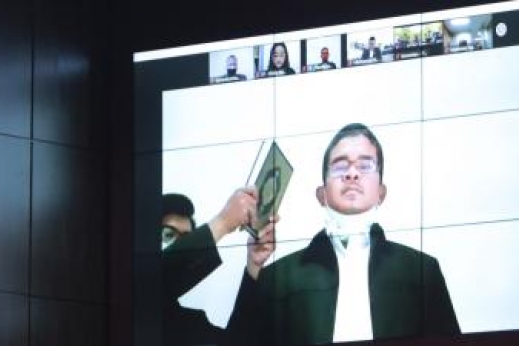
Plenary judicial review hearing of the Law on the COVID-19 Pandemic to hear the House and an expert for the Petitioners, Thursday (15/10). Photo by Humas MK/Ifa.
JAKARTA, Public Relations of the Constitutional Court—Budget drafting during emergency in various countries in the world requires swiftness to anticipate the impacts of the situation, but it isn’t exempt from mandatory transparency and accountability, said Yuna Farhan, an expert for the Petitioners of case No. 37/PUU-XVIII/2020 at the judicial review hearing of Law No. 2 of 2020 on the Government Regulation in Lieu of Law No. 1 of 2020 regarding the Stipulation of the State’s Financial Policy and Fiscal Stability for the Mitigation of the COVID-19 Pandemic and/or in Order to Face Threats That Endanger the National Economy and/or the Financial System’s Stability into Law in the Constitutional Court on Thursday, October 15, 2020.
In his statement on "The Politics of Constitutional Budget during Pandemic," the country manager of the International Budget Partnership (IBP) explained the politics of budgeting in Indonesia. He said several countries had made efforts to fast track budget approvals, for example, from 11 weeks to 4 days in the UK and several weeks to merely 2 days in Sweden.
"This time cut actually poses a risk of exploitation by the Government to include a budget unrelated to emergency response. It can also be said that there is ample room for the Government to make budget improvisations," he explained.
Also read: NGOs and Researchers Challenge COVID-19 Law
Discretion
Yuna also said that there are several ways for a state to control emergency budgets. The Netherlands, Sweden, and Switzerland expend emergency budget first then ask for approval from the legislative branch. Norway, Israel, and Spain formed a COVID-19 special committee and gave it full authority to manage emergency budget. Australia set a deadline on the allocation of its emergency budget. Canada, Sweden, and Ireland set a time limit on the emergency situation.
“Those countries had periodic monitoring and reporting. If the deadline [is passed] and the budget is insufficient, it will be discussed further by the legislative branch,” he said before the Court led by Chief Justice Anwar Usman.
Also read: Petitioners of COVID-19 Law Reaffirm Arguments
No Budget Deficit Limit
Yuna observed that in Indonesia, the Government’s discretion based on the COVID-19 Law in the State Budget of 2020 is stipulated in Article 1 paragraph (2) of the a quo law. However, the state budget deficit beyond the 3% GDP limit was set for until 2022 and no ceiling was put on the number. He also didn’t see any kind of time limit on revision of budget and expenditure, which isn’t yet available. He also observed that the COVID-19 mitigation proposal was only discussed internally among ministries/agencies and the Ministry of Finance. This, he believes, can lead to treasury officials and the National Disaster Management Authority (BNPB) spending more than the available budget.
“Upon observation, the perppu was meant as an emergency measure in the state budget of 2020, but it set the state budget deficit until 2022 without a ceiling, which is needed for fiscal sustainability. Why 3 percent? The 1997 and 1998 crisis taught us how rupiah and the economy shattered. Therefore, a state financial package is necessary to limit debt for COVID-19 mitigation,” he explained.
Accountability
Yuna also said, the impacts on the 2020 budget revision for pandemic mitigation without law—such as the lack of proposal or financial notes of budget changes, the lack of explanation on budgets relocated by ministries/agencies that made pandemic mitigation budgets, and the lack of discussion at the DPR (House of Representatives) and hearings with other parties—should be observed carefully.
“The consequence of the lack of proposal or financial notes of budget changes is that the public and the House not having the details on the budget used by the Government. This presents a risk of accountability where every rupiah must be accounted for,” he explained.
At the end of his testimony, Yuna said that the current increase of the state budget deficit was cause by the decline of state revenue and the increase of state expenditure. It actually wasn’t due to COVID-19 mitigation but due to the decline in corporate income tax as stipulated in the a quo law. He believes before the pandemic, the Government had already planned for corporate income tax cuts, which was irrelevant with COVID-19 mitigation.
Also read: Village Funds Delayed, Two Village Chiefs Challenge COVID-19 Law
Before Before concluding the session, Chief Justice Anwar reminded that the virtual hearing would resume on Thursday, October 22, 2020 at 11:00 WIB to hear an expert for the Petitioners of case No. 37/PUU-XVIII/2020 as well as 2 experts and 3 witnesses for the Petitioners of case No. 43/PUU-XVIII/2020.
Also read: House: Ratification of COVID-19 Law, Legal Basis of Financial Authority
The virtual hearing was for seven cases: No. 37/PUU-XVIII/2020, No. 42/PUU-XVIII/2020, No. 43/PUU-XVIII/2020, No. 45/PUU-XVIII/2020, No. 47/PUU-XVIII/2020, No. 49/PUU-XVIII/2020, and No. 75/PUU-XVIII/2020. This fourth hearing had been scheduled to hear the testimonies of the House (DPR) and the expert for the Petitioners of case No. 37/PUU-XVIII/2020, YAPPIKA and others. The seven petitions challenge most of the articles in the Appendix to the COVID-19 Law.
The petition No. 37/PUU-XVIII/2020 was filed by the Indonesian Foundation to Strengthen Civil Society's Participation, Partnership, and Initiatives (YAPPIKA); Desiana Samosir; Muhammad Maulana; and Syamsuddin Alimsyah. The petition No. 42/PUU-XVIII/2020 was filed by Iwan Sumule and the other 49 Pro-Democracy (ProDem) activists. The Petitioners of case No. 43/PUU-XVIII/2020 are Ahmad Sabri Lubis and 9 other individuals. The Petitioners of cases No. 45/PUU-XVIII/2020 and No. 49/PUU-XVIII/2020 are Sururudin and advocate Damai Hari Lubis, respectively. The Petitioners of case No. 47/PUU-XVIII/2020 are village heads and village consultative bodies members Triono and 26 others. The petition No. 75/PUU-XVIII/2020 was filed by 47 petitioners, including M. Sirajuddin Syamsuddin, Sri Edi Swasono, and H. M. Amien Rais. Those seven petitions argue that the COVID-19 Law is formally and materially defective, so that it must be declared unconstitutional and not legally binding.
Writer: Sri Pujianti
Editor: Lulu Anjarsari
PR: Fitri Yuliana
Translator: Yuniar Widiastuti (NL)
Translation uploaded on 10/22/2020 13:41 WIB
Disclaimer: The original version of the news is in Indonesian. In case of any differences between the English and the Indonesian version, the Indonesian version will prevail.
Friday, October 16, 2020 | 07:54 WIB 428